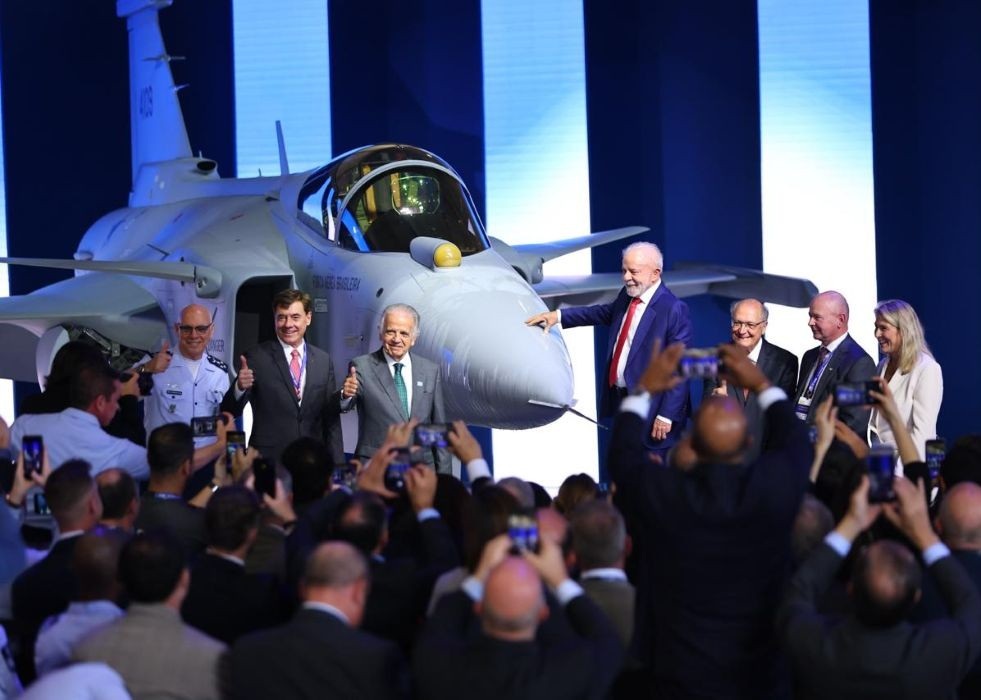
Brazil has unveiled the first supersonic fighter aircraft assembled in Latin America, rolling out a locally built F-39E Gripen at Embraer’s (B3: EMBR3) Gavião Peixoto facility in São Paulo state. The aircraft is part of the F-39E Gripen programme conducted jointly by Brazilian aerospace company Embraer and Sweden’s Saab (Nasdaq Stockholm: SAAB B).
The rollout represents a significant milestone for Brazil’s defence aviation ambitions. Final assembly and systems integration were carried out at Embraer’s Gavião Peixoto complex, one of the largest aerospace production and testing facilities in Latin America. The aircraft forms part of the Brazilian Air Force’s (FAB) future combat aviation fleet and will gradually replace ageing Northrop F-5 fighters and AMX attack aircraft.
The F-39E Gripen is powered by the General Electric F414-G engine and equipped with the Raven ES-05 active electronically scanned array (AESA) radar developed by Saab. The aircraft is designed as a multirole fighter capable of air-to-air and air-to-ground missions, incorporating advanced sensor fusion, network-centric warfare capability and modern electronic warfare systems. The Brazilian designation F-39E refers to the single-seat version of the Gripen E variant acquired by the Brazilian Air Force.
Brazil’s Gripen acquisition traces back to the FX-2 fighter competition launched to replace the country’s ageing combat aircraft fleet. In 2014 Brazil selected Saab’s Gripen E/F over competing proposals from Dassault’s Rafale and Boeing’s F/A-18E/F Super Hornet. The contract covered 36 aircraft and included an extensive technology transfer package designed to strengthen Brazil’s domestic aerospace industry.
Under the agreement, Brazilian engineers and technicians participated in development activities in Sweden, while Brazilian companies gained involvement in structural manufacturing, software development and systems integration. The programme also includes the assembly of a portion of the aircraft in Brazil, enabling Embraer to build experience in advanced fighter aircraft production processes.
However, the programme should be understood as an industrial partnership rather than a fully indigenous fighter development effort. The aircraft design remains Swedish, and key systems such as the engine, avionics architecture and core flight systems originate from Saab and its international suppliers.
In this sense, the aircraft unveiled in Brazil represents local assembly and industrial participation rather than full domestic manufacturing. While final assembly and integration take place in Brazil, the underlying platform continues to be designed and engineered primarily in Sweden.
The rollout nevertheless carries broader industrial significance. It marks the first time a supersonic fighter aircraft has been assembled in Latin America, expanding the region’s aerospace manufacturing capability. For Saab, the programme represents the first instance of Gripen production taking place outside Sweden. For Embraer, participation in the programme provides valuable experience in fighter aircraft assembly, systems integration and advanced defence aerospace manufacturing.
Brazil has previously demonstrated its ability to develop indigenous aerospace platforms such as the A-29 Super Tucano light attack aircraft and the KC-390 Millennium military transport aircraft. Participation in the Gripen programme therefore reflects a broader ambition to expand the country’s role in advanced combat aviation and move its aerospace industry into the advanced fighter manufacturing ecosystem.
Author: Özgür Ekşi