As London struggles to replace failed armoured vehicle programmes, Otokar’s Tulpar has emerged in UK defence debate as a possible response to the British Army’s unresolved IFV gap.
The British Army’s long-running struggle to modernise its armoured vehicle fleet has become one of the most persistent weaknesses in the United Kingdom’s defence posture. The cancellation of the Warrior Capability Sustainment Programme (CSP) and the prolonged crisis surrounding the AJAX reconnaissance vehicle have left London with unresolved capability gaps and a markedly reduced appetite for high-risk land programmes. While Boxer has stabilised parts of the mechanised force structure, it has not addressed the underlying absence of a credible, modern infantry fighting vehicle solution.

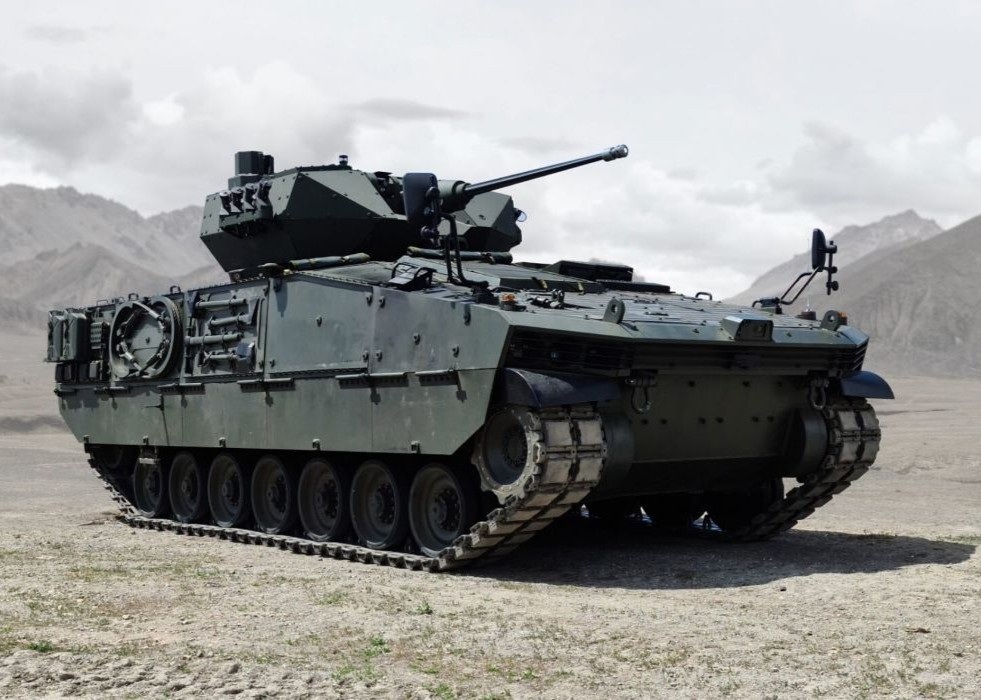
It is against this backdrop that Otokar’s Tulpar infantry fighting vehicle has entered the British defence debate — not through official procurement channels, but via social media commentary. UK-based defence strategist Nicholas Drummond recently drew attention to Tulpar as a potential answer to the British Army’s post-Warrior and post-AJAX dilemma, explicitly referencing the failures of both programmes as drivers for alternative thinking.
Drummond’s intervention reflects broader frustration within British land forces. Warrior CSP, originally conceived as a cost-effective life-extension effort, gradually evolved into a near-new vehicle programme burdened by technical complexity and diminishing strategic justification. AJAX, meanwhile, became emblematic of over-ambitious requirement-setting, combining reconnaissance, heavy protection and advanced sensor integration in a single platform, with damaging consequences for reliability and user confidence. Together, the two programmes reshaped how land capability is discussed in the UK defence community.
Within this context, Tulpar has been framed not as a direct replacement for Warrior CSP or AJAX, but as a platform built around a fundamentally different design philosophy. Developed from the outset as a heavy infantry fighting vehicle, Tulpar prioritises protected mobility, firepower and growth margin, rather than attempting to reconcile multiple, often conflicting roles.
A central element of his argument is adaptability. Rather than importing a foreign solution wholesale, Drummond has suggested that Tulpar could be made compatible with British requirements through the integration of “UK content” (a proposal put forward by the author, including British-linked subsystems such as a Cummins V8 diesel engine, local assembly, and the potential reuse of turrets originally developed for Warrior CSP or AJAX). This approach aligns with a broader shift in British thinking, favouring mature, lower-risk platforms that can be adapted incrementally instead of launching clean-sheet development programmes. He has also drawn attention to what he describes as Tulpar’s low acquisition cost, calling it “a very attractive price”.
Drummond’s views also draw attention because of his professional proximity to European land systems programmes. Drummond is a consultant to KNDS Germany, familiar with the industrial, technical and political constraints shaping armoured vehicle development. There is no doubt that he does not speak for the British Army or the Ministry of Defence. These words however reflects an informed understanding of why recent UK land programmes have struggled.
It is also known that the opinions in British Army remain divided over whether such capability gaps should be addressed through a national solution or managed at the NATO level through allied burden-sharing and interoperability. This debate has gained a new perspective following the Eurofighter Typhoon agreement between Türkiye and the United Kingdom. It is certain that it has elevated bilateral defence relations to a strategic level and created a broader foundation for industrial engagement.
What Drummond’s comments highlight is not a procurement decision, but a deeper sense of urgency within UK land forces. Britain’s challenge is no longer simply replacing ageing vehicles, but redefining how it approaches risk, complexity and realism in armoured vehicle procurement. Whether this debate translates into concrete cooperation or remains an expression of Britain’s unresolved land warfare problem will depend on how London confronts the structural lessons of Warrior CSP and AJAX — and whether it is prepared to accept that some capability gaps cannot be closed through adaptation alone.
Author: Özgür Ekşi