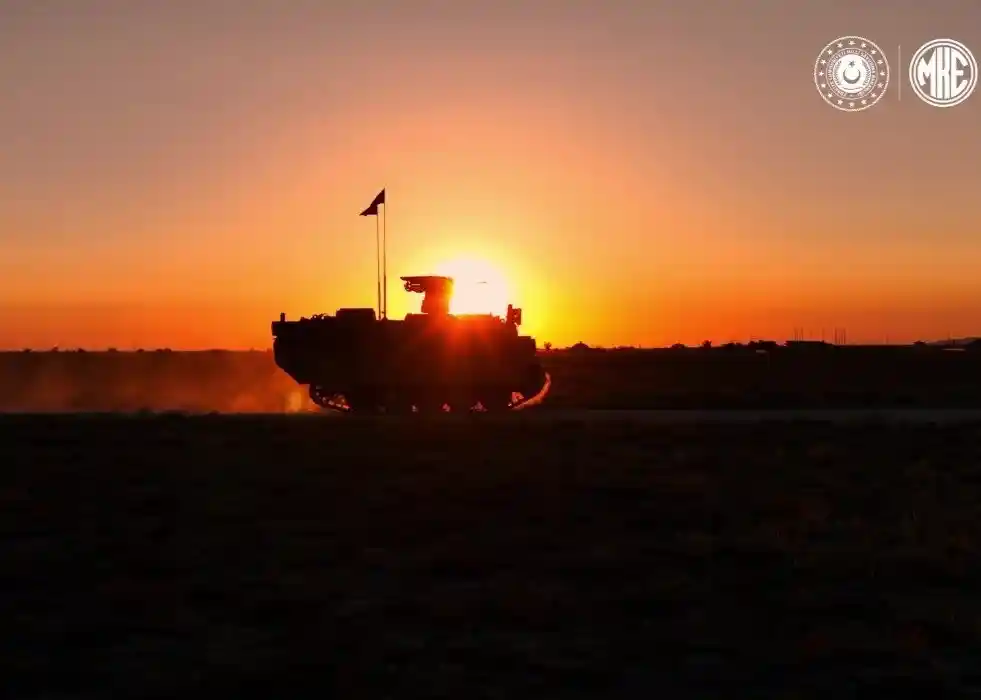
The Turkish Land Forces formally accepted the first T-155 TTA Integrated Panter howitzer on 5 November 2025, marking the close of a nearly three-year qualification programme and the start of serial production. The project, run under the administrative authority of the General Directorate of Military Factories (AFGM) and led by prime contractor ASFAT, integrates a modernised 155 mm Panter gun onto a domestically produced BMC 8x8 tactical wheeled vehicle.
According to ASFAT’s social media announcement, the prototype completed its inspection and acceptance procedures on 5 November and has been recorded on the Land Forces’ inventory. Integration works were carried out by the 2nd Main Maintenance Factory Directorate, combining the gun system — removed from a towed Panter and modernised by Mechanical and Chemical Industry Corporation (MKE) — with an ASELSAN-developed fire-control suite adapted for the wheeled platform.
The qualification campaign was extensive. During the tests, the prototype travelled more than 20,000 km across different types of terrain and fired over 350 times in different types of combat circumstances. Statement added that as part of the qualification, the vehicle also had to pass environmental and endurance tests. This proved that it could be used in a wide range of weather and battlefield circumstances.
The project started with a contract between AFGM and ASFAT in 2020, and the official schedule of operations began in November 2021. The work to integrate the prototypes was finished in November 2022, and the first live-fire tests were done in December 2022.
With inspection and acceptance activities now concluded, the T-155 TTA Integrated Panter has transitioned from prototype to fielded system and serial production has commenced.
The conversion of the proven Panter 155 mm gun to a mobile 8x8 chassis aims to combine the firepower and range of the Panter family with greater operational mobility and tactical flexibility. Putting the weapon on a wheeled tactical vehicle makes logistics and deployment times less than with towed weapons. This lets manoeuvre units shoot and move quicker and stay in the field longer.
Defence industry sources note the programme’s emphasis on domestic content and cross-company cooperation: BMC supplied the chassis, MKE carried out the gun modernisation, ASELSAN provided the fire-control and integration electronics, while ASFAT coordinated the overall delivery under AFGM oversight. The result is a locally engineered solution intended to strengthen Türkiye’s artillery mobility and responsiveness on the modern battlefield.
Author: Özgür Ekşi