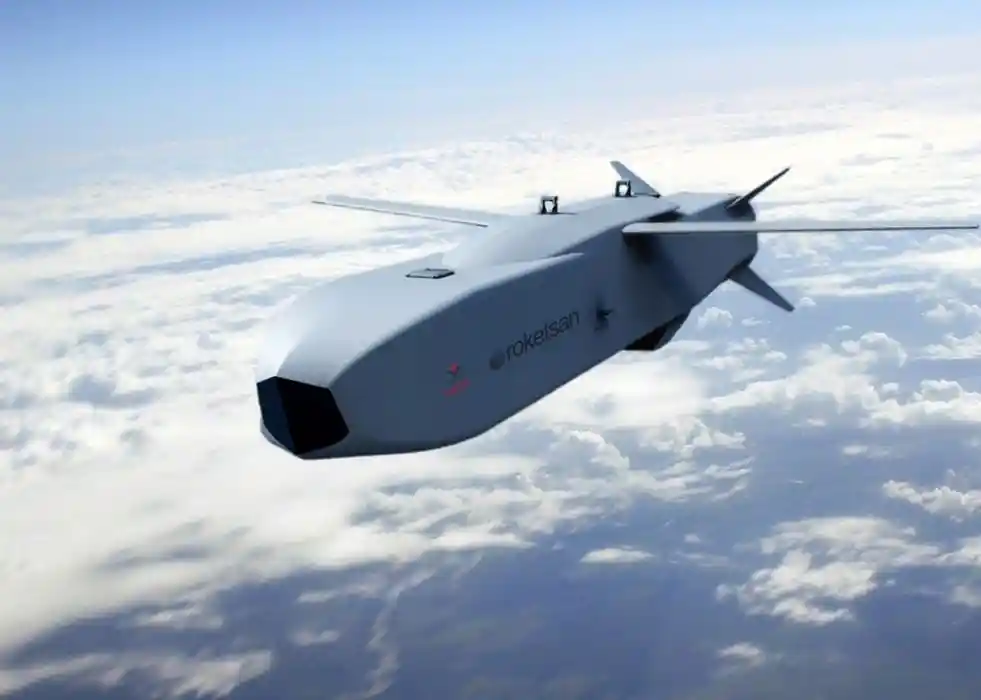
ROKETSAN and TÜBİTAK have signed a deal to cooperate on the development of a ramjet engine for a supersonic anti-ship missile during the IDEF25 exhibition.
The cooperation covers the development of a liquid fuel ramjet engine, like the one used in the GÖKHAN BVRAAM of TÜBİTAK SAGE, for a supersonic anti-ship missile.
The missile will be the first supersonic anti-ship missile to be developed in Turkiye. Current missiles with anti-ship capabilities include ATMACA, SOM-J, and ÇAKIR, which are all subsonic.
There is no information regarding the launch platform, as it can be either aircraft or warships.
However, it is predicted that the missile will be developed as something that comes in a moderate size to allow fitting on ships or aircraft. While countries like Russia and China have sizable platforms to accommodate anti-ship missiles weighing more than some short-range ballistic missiles, Turkish warships, being in line with the Western bloc design patterns, do not allow such sizes. For aircraft, a similar case applies as Turkiye’s launch platforms for cruise missiles are fighter jets and large UCAVs.
Thus, Taiwan’s Hsiung Feng III supersonic anti-ship missile could be a good example to have a rough picture of what might come out. Taiwan, like Turkiye, operates fighter jets and small to medium-sized ships. Thus, Hsiung Feng III was designed with a size to allow fitting on even a corvette like the Tuo Chiang-class. Recently, the missile’s air-launched variant was seen on an FC-K-1 fighter jet.
Supersonic Anti-Ship Missiles’ Pros and Cons
Supersonic Anti-Ship missiles, most of which are powered by ramjet engines that activate upon reaching supersonic speeds. Thanks to the ramjet engines, the missiles can reach speeds above Mach 3.
Such high speeds allow the missiles to penetrate through the enemy ship’s defences, not only thanks to the high speed making interception harder but also thanks to the less time to take action. Additionally, the high speed gives these missiles far better structural breach capabilities per the kinetic energy, which, if coupled with a delayed fuse, can cause more severe damage to ships.
However, these missiles’ high speed also brings disadvantages alongside the advantages. Firstly, far higher speeds mean limitations on sea skimming and manoeuvring both in terms of time window and envelope. Secondly, the intense heat resulting from supersonic speeds makes the missiles more susceptible to IR sensors, whereas subsonic missiles (Especially the ones with low observability) are harder to pick up by optical means.
Thus, it can be said that it would be more sensible to take supersonic anti-ship missiles as complements for striking ships alongside the slower but sneakier subsonic anti-ship missiles. Their time to target less than three times, a smaller window to take action, and the potential for damage makes them viable A2/AD weapons.
Author: Kaan Azman
Editor:Özgür Ekşi