Spain's ambitious programme to procure around 2,200 military trucks has recorded its first eliminations, with Turkish manufacturer BMC and Spanish company EM&E reportedly excluded from the competition.
According to Spanish defence news outlet Infodefensa, the programme forms part of a broader effort to modernise the Spanish Army's logistics fleet through the acquisition of a new family of tactical vehicles. Valued at more than €1 billion, it is considered one of Europe's largest military logistics vehicle procurements in recent years.
The competition was launched as an open tender under Spain's public procurement framework, allowing any company meeting the stated requirements to submit a bid rather than limiting participation through a pre-selected shortlist.
Because the programme was structured as an open competition rather than a restricted procedure, participating companies were expected to comply with the same technical, administrative and delivery requirements throughout the process.
What kind of logistics fleet is Spain seeking?
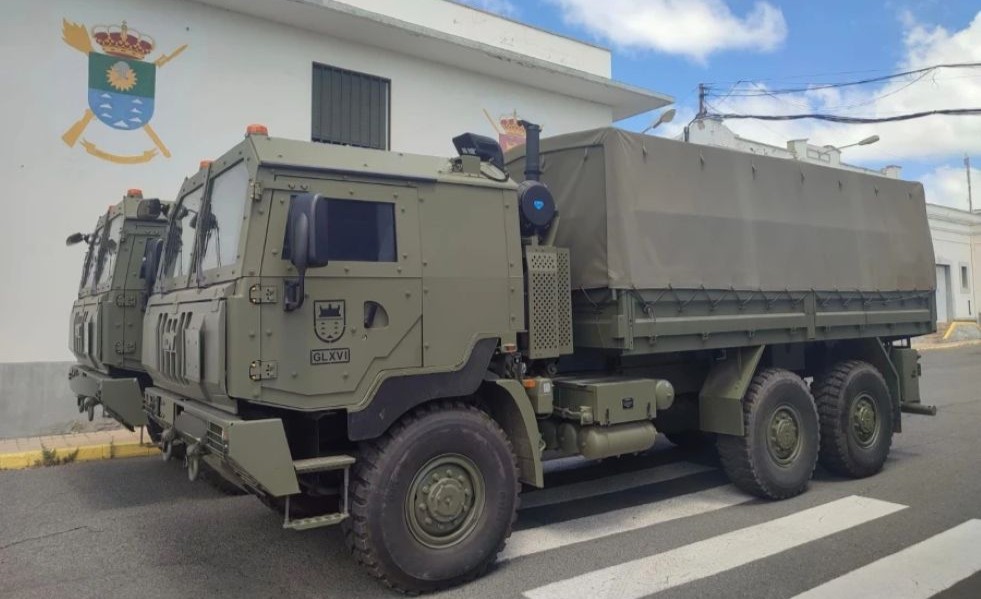
The programme is intended to establish a common family of military trucks capable of supporting a wide range of operational and logistics missions.
According to Infodefensa, the requirement covers 2,201 chassis in 4x4 and 6x6 configurations, together with 74 tractor units to be delivered over the next four years.
The future fleet will include vehicles in the 4-ton, 10-ton and 15-ton classes as well as a wide range of specialised variants, including:
Fuel tankers
Water tankers
Recovery vehicles
Crane-equipped trucks
Hook-lift systems
ISO container carriers
Shelter carriers
Firefighting vehicles
The objective is to simplify maintenance, training and spare-parts support through a common vehicle architecture while reducing long-term operating costs.
Protected and unprotected cab configurations are also included within the requirement, reflecting the need for both logistics and operational support roles.
Taken together, the programme represents not simply a truck purchase but the creation of a long-term logistics ecosystem intended to support the Spanish Army for decades.
Why BMC and EM&E were eliminated
According to information published by Infodefensa, BMC and EM&E were excluded for different reasons during the early stages of the competition.
Infodefensa reported that EM&E failed to physically submit the prototype vehicle required by the tender before the 3 June deadline. The company reportedly requested an extension, citing the complexity of preparing and delivering the vehicle, but the Ministry of Defence rejected the request.
In BMC's case, Infodefensa reported that the company transported its truck to the military facility on a lowboy trailer but lacked the registration certificate required to obtain the provisional licence plate specified by the tender requirements.
According to Infodefensa's reporting, BMC was not excluded because it failed to bring a vehicle to Spain. Rather, the reported issue concerned the registration requirements associated with the prototype presented for evaluation.
BMC truck reached the barracks but failed registration requirements
The details reported by Infodefensa make BMC's exclusion particularly notable.
According to Infodefensa, BMC had already transported its truck to the military facility on a lowboy trailer before the registration issue led to its exclusion. The report suggests that the elimination stemmed from compliance with registration requirements rather than the physical availability of the vehicle.
For industry observers, the development is likely to attract attention because preparing, transporting and presenting a demonstrator vehicle for an international military procurement programme typically requires months of industrial planning, logistical coordination and financial commitment.
At present, neither the precise nature of the missing registration documentation nor the circumstances surrounding its absence have been publicly explained.
The reported sequence of events may therefore prompt questions regarding whether the issue could have been identified or resolved at an earlier stage of the process.
Competition narrows as major contenders remain
The first eliminations do not alter the broader significance of the programme.
Spain remains engaged in what is expected to become one of Europe's most important military truck procurements, with the selected vehicles likely to form the backbone of the Spanish Army's logistics fleet for years to come.
According to Infodefensa, major European manufacturers remain in contention, including Iveco Defence Vehicles, Rheinmetall MAN Military Vehicles and Tatra Defence Vehicle, all of which are competing for a contract that will shape Spanish military logistics capabilities well into the future.
At the same time, the exclusions of EM&E and BMC demonstrate that technical capability alone is not sufficient to remain in contention. The ability to satisfy delivery schedules, registration requirements and other tender conditions is already shaping the outcome of the competition.
Several questions nevertheless remain unanswered:
What specific registration document was missing in BMC's case?
Could the issue have been resolved before the vehicle reached the military facility?
Why was EM&E's request for additional time rejected?
How many competitors ultimately remain eligible for the next phase of the competition?
Which manufacturers remain in contention for the contract?
The case also illustrates how major defence competitions can be shaped not only by vehicle performance but by a bidder's ability to satisfy every administrative, regulatory and logistical requirement attached to the procurement process.
For now, one of Europe's largest military logistics vehicle programmes continues with a reduced field of competitors, while the circumstances surrounding the exclusion of BMC and EM&E are likely to remain part of the discussion as the competition progresses.
Author: Özgür Ekşi