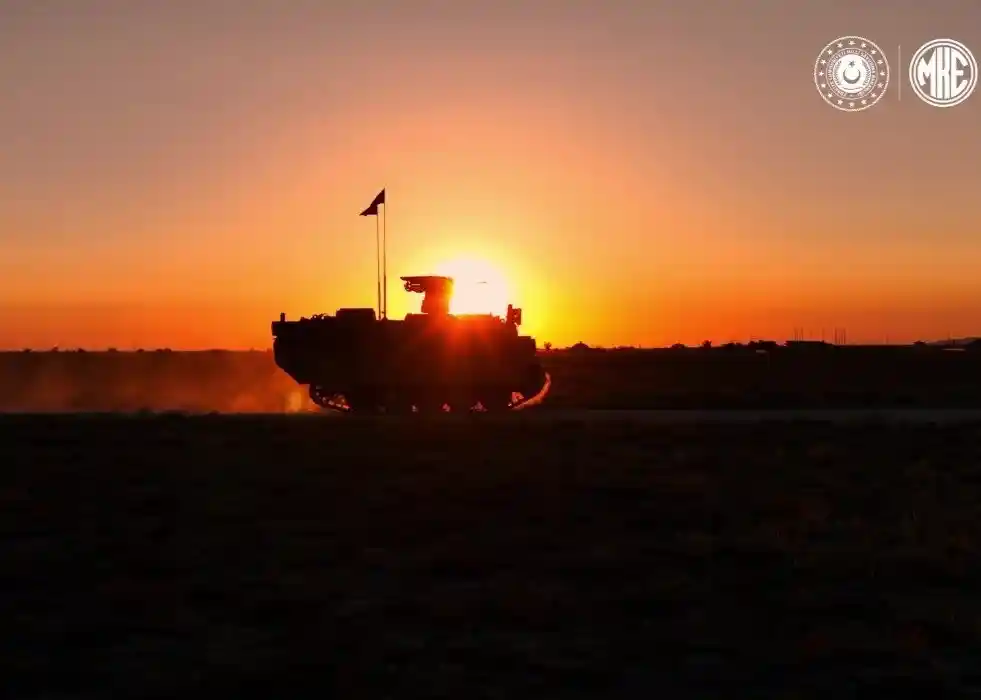
Chinese social media users have shared various images of the PLAAF’s new light tank ZTZ-201, introducing a hybrid powerpack and new protection measures.
The tank takes a rather radical approach with the turret configuration and internal layout.
According to reports from Chinese sources, the tank is using a 105 mm main gun with “next-generation” features. While it is hard to tell if this claim is true, it is easy to see that there is a considerable concealment of the gun barrel to prevent the leak of heat signature during combat. However, ZTZ-201’s interestingness lies in other sections.
Firstly, the turret is fitted extensively with a RCWS that appears to use a heavy machine gun with UAV tracking capabilities. New automatic target acquisition algorithms have been a recent subject of study for existing or new RCWS to provide another cheap solution against offensively utilised UAVs like munition droppers or FPVs that have inflicted considerable damage to armoured units.
On the other hand, there is an active protection system present with two turrets holding four munitions each. While such high capacity is ideal for dealing with saturation attacks involving salvos, there are possible disadvantages too. Typically, munition launchers for active protection systems are either magazine-fed or hold two rounds to maintain quick rotational speed. It is unknown if there is a proportional change in the actuator power to keep up with the bigger weight to be moved.
For situational awareness, a commander’s optics system can be seen. Additionally, there are small optics around the vehicle and crew members are seen with on-wrist devices. The former hints at a 360-degree view system which allows through-armour vision, while the latter might be for coordination among the crew members or with other crews.
Finally, the powerpack is stated to have a provision for hybrid-electric integration. This could be either a series hybrid, where the internal combustion engine acts as the generator for the electric motors, or a parallel hybrid, where batteries and the internal combustion engine provide power in tandem. However, most military hybrid vehicle demonstrators have been seen to use the former type for simplicity and efficiency.
Author: Kaan Azman
Editor:Özgür Ekşi