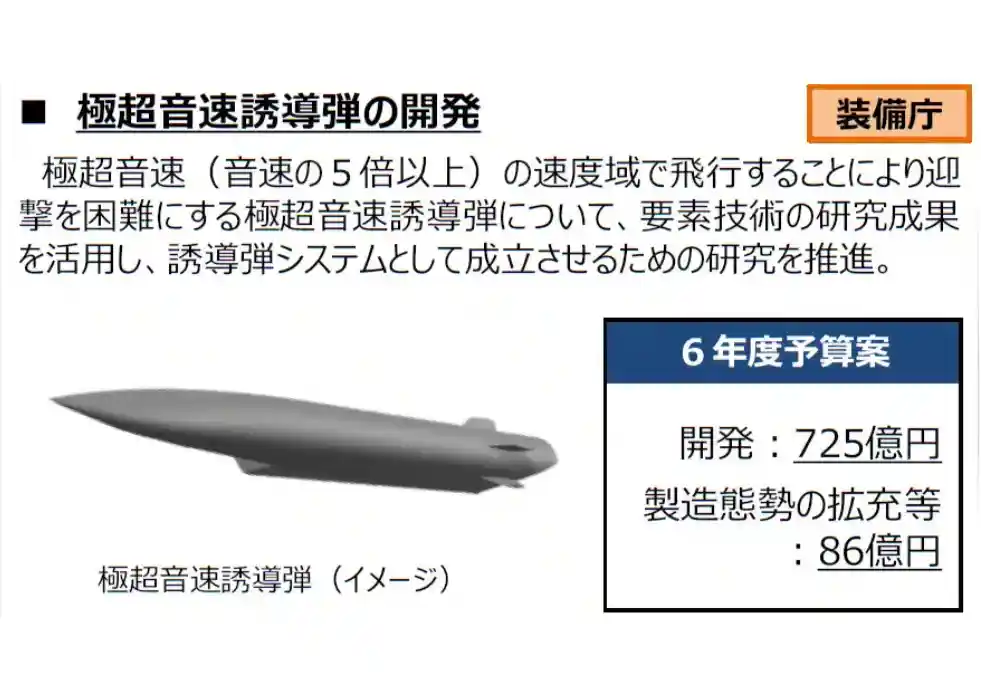
As a follow-up to the ongoing Type 25 SSM and Type 25 HGP hypersonic weapons, ATLA is planning to introduce a hypersonic cruise missile into the early 2030s.
Naval News reported that a hypersonic cruise missile that can sustain its speed at extended ranges is among the next in line after the Type 25 SSM cruise missile and the Type 25 HGP hypersonic glide weapon.
The development of Japan’s first hypersonic cruise missile started in 2023, with the goal for IOC set as 2032.
A hypersonic cruise missile, when compared to a glide vehicle, mainly has the advantage of being able to sustain its speed. In contrast, a glide vehicle experiences a decay due to being unpowered. Additionally, hypersonic cruise missiles are usually better suited for air launch, as all the rocket booster has to do is provide the needed starting speed, while an effective hypersonic glide weapon for air launch still needs a massive booster to attain extreme speeds, which constrains platforms that can use such weapons.
However, it is more difficult to produce a hypersonic cruise missile due to the inclusion of the scramjet, which has to reliably operate at extreme temperatures and dynamic pressures.
Aside from the demanding conditions, hypersonic cruise missiles still require large boosters to provide the starting speed, which makes the integration into multiple platform types a rather delicate problem. To combat this, ATLA is developing a ramjet-scramjet hybrid that can be started at supersonic speeds rather than hypersonic speeds. One possible way to achieve this is a variable intake geometry that is adjusted depending on the speed regime.
Author: Kaan Azman
Editor:Özgür Ekşi