TİTRA Technology, a defence industry company of Pasifik Technology, participated in World Defence Show 2026 held in Riyadh between 8–12 February 2026, presenting latest developments in autonomous and swarm-enabled combat systems to an international audience.
The exhibition brought together senior defence officials, procurement authorities and leading global defence companies. Within this framework, TİTRA highlighted its portfolio of unmanned platforms and its evolving operational approach to coordinated and networked warfare.
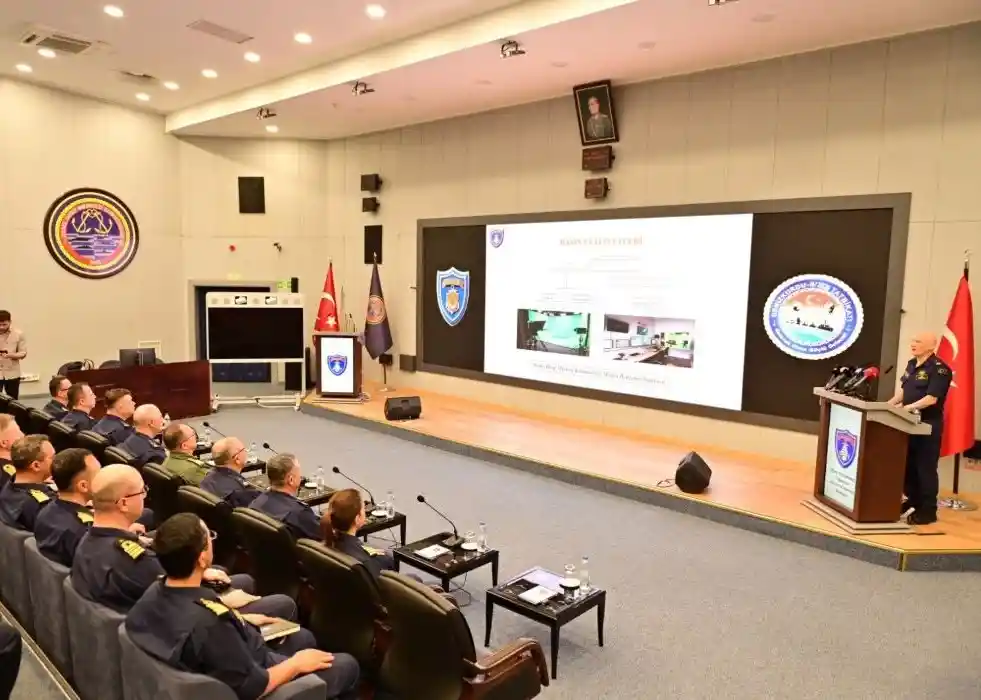
TİTRA Technology Co-Founder and Board Member Muhammed Selman Dönmez delivered a presentation titled “Operational Deployment of Swarm and Autonomous Warfare Systems on the Modern Battlefield.” Addressing international defence representatives,
In his speech, Muhammed Selman Dönmez emphasized that the swarm concept fundamentally transforms the cost and power balance of modern warfare. He explained that unmanned systems operating simultaneously and in coordination can effectively challenge enemy air defence systems and achieve operational superiority against multi-million-dollar platforms using significantly lower-cost assets. Dönmez noted that while certain losses may occur during operations, the true strength of swarm systems lies not in individual units but in their interconnected and coordinated network structure. This approach ensures that even if a single element is neutralized, the mission continues uninterrupted.
Next-Generation Superiority with Integrated and Intelligent Platforms
Emphasizing that TİTRA Technology’s swarm approach is not limited to a single platform, Dönmez stated: “The system we have developed is based on the integrated and coordinated operation of multiple elements. We design the ALPİN, DUMRUL, PARS, DELİ, and MERKÜT platforms to operate together within the same operational infrastructure. This enables systems developed for different missions to operate under a unified intelligence and coordination framework. As a result, information collected from the field can be shared in real time, decision-making processes are accelerated, and operations can be conducted more efficiently and flexibly.”
Robust and Uninterrupted Communication: The Backbone of Swarm Systems
Highlighting that robust and uninterrupted communication infrastructure is the most critical requirement for swarm systems to remain effective on the battlefield, Muhammed Selman Dönmez emphasized the decisive role of reliable communication, particularly in electronic warfare environments:
“Our systems gain a significant advantage not only by receiving commands from a central control unit but also by rapidly and securely sharing data among themselves to operate in coordination. This structure allows information collected from the field to be shared in real time, enabling swarm elements to function under a joint decision-making mechanism. With an AI-supported infrastructure, target detection, tracking, and engagement processes can be carried out largely autonomously. In the near future, swarm systems capable of navigating without satellite signals, making independent decisions, and operating across multiple platforms will play a critical role in both defence and assault operations.”
Dönmez emphasised that TİTRA’s approach is not limited to a single platform, but built on integrated and coordinated multi-system operations. He stated that ALPİN, DUMRUL, PARS, DELİ and MERKÜT platforms are being configured to operate within a common operational architecture, enabling different mission-specific systems to function under a unified coordination framework. According to the company, this structure facilitates real-time data sharing, accelerates decision cycles and increases operational flexibility.
Highlighting communications resilience as a decisive factor, Dönmez underlined that robust and uninterrupted connectivity remains critical, particularly in electronic warfare environments. Beyond receiving instructions from a central command, systems are designed to exchange data securely and rapidly among themselves, enabling distributed decision-making within the swarm.
He added that AI-supported infrastructure allows target detection, tracking and engagement processes to be conducted with a high degree of autonomy. Looking ahead, TİTRA expects future swarm systems to navigate without reliance on satellite signals, make independent decisions and execute coordinated missions across heterogeneous platforms in both defensive and offensive roles.