A Sudanese Air Force AKINCI UCAV self-recorded shooting down an enemy jet-powered aircraft, using what appears to be a short-range air-to-air missile.
AKINCI UCAV might have scored its first known air-to-air kill with a purpose-built air-to-air missile in Sudan, during a shoot-down recorded from the onboard optics, where an enemy jet-powered aircraft was shot down, as reported by a footage shared by Clash Report.
The missile’s high-speed and lofted trajectory, as well as the small amount of time it takes (Roughly 15 seconds) to reach the target, strongly support AKINCI having used an air-to-air missile.

As for the missile type, ROKETSAN’s SUNGUR was likely used to shoot down the enemy aircraft, considering the quick engagement, trajectory, and the identical exhaust visuals at launch.
SUNGUR was developed as the successor to the FIM-92 Stinger MANPADS as a man-portable and platform-mounted solution featuring a range of eight kilometres, an IIR seeker, and semi-armour piercing warhead.
Baykar previously showed the SUNGUR integration on its UCAVs in single and double pod configurations.
On the other hand, BOZDOĞAN and GÖKDOĞAN air-to-air missiles remain less likely due to the fact that they are too early in their service life with the Turkish Air Force, while SUNGUR was introduced a few years before the two missiles.
What Type of Aircraft Was Shot Down?
As seen in the footage, the aircraft has a pair of jet engines (Turbojet or turbofan), and the post-impact part shows that the engines are not mounted on wings.
This can go many ways, but considering the fact that the UAE and China are the primary supporters of the terrorist organisation RSF, some predictions can still be made. China’s newer weaponry, such as the FK-2000 air defence system, has already made its appearance on the scene.
RSF itself is known to use Wing Loong II and the smaller FH-95 UCAVs, both of which are produced by China and used by the UAE.
China’s CH-6 HALE UCAV, powered by a pair of small turbofans, has been pointed out as the main suspect. CH-6 was unveiled at Zhuhai Airshow 2021, but no other news came after its unveiling regarding introduction to Chinese service or exports. However, the UAE quietly acquiring it would not be a far-off possibility considering the fact that the Gulf country is a customer of large-sized Chinese UCAVs like Wing Loong II.
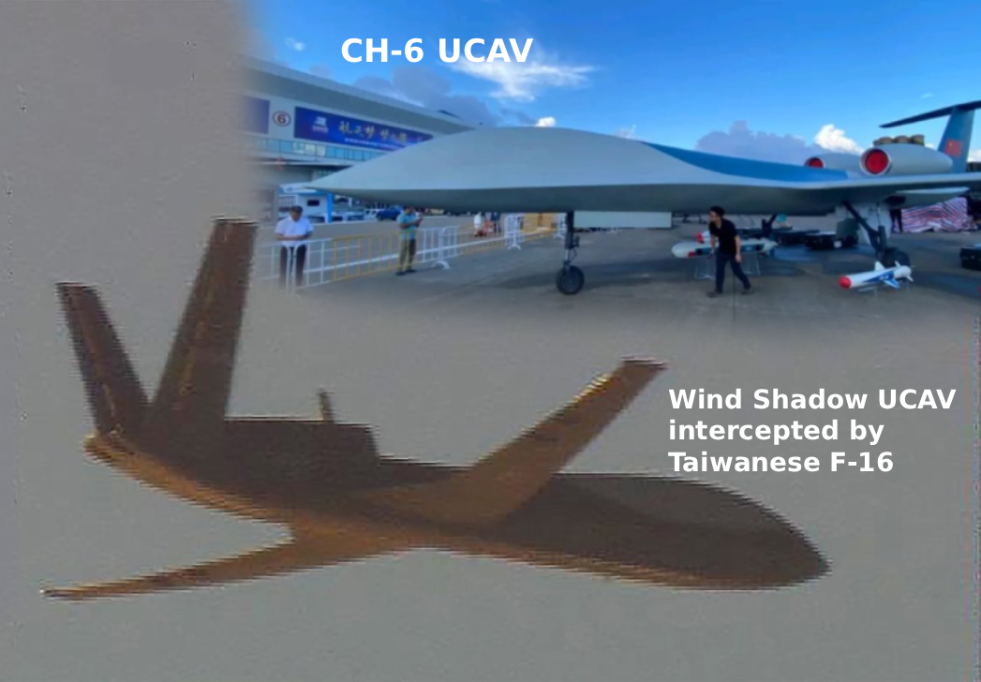
CH-6 [Chinese Social Media Photo], and Wind Shadow [Taiwanese MoD Footage] UCAVs
Similar to CH-6, in terms of being a twin jet engine UCAV, is the Wind Shadow UCAV. Featuring two small turbojet engines, the UCAV has been seen rarely but is nonetheless known to be in Chinese service.
On the other hand, another possibility is the L-15 advanced trainer in armed configuration, with the UAE also having acquired it. UAE’s L-15 acquisition officially covers aerobatics use with the option of 36 additional aircraft. If the UAE acquired additional L-15s, some of these might have been flown by or in support of RSF militants with basic armament.
Regardless of the type, it can be said that turbojet/turbofan-powered non-fighter aircraft exhibit high cruise speeds generally above 500 km/h, which is another important consideration for analysis.
An Analysis of the Engagement
The engagement is important as the first confirmed UCAV-borne air-to-air kill performed with a purpose-built anti-air missile during a conflict. An attempt was previously made by an MQ-1C UCAV against an Iraqi MİG-25 with AIM-92 Stinger missiles, which were too slow to catch the high-speed interceptor aircraft, but an engagement still took place, including target acquisition.
The first things to consider when analysing the engagement, as stated before, are the time it took for impact, the aspect of engagement, and the missile’s behaviour.
It is inferred from the video that it took 15 to 16 seconds for the missile to hit the target engaged from the rear aspect. The missile’s flight path is a lofted one, widely employed by air-to-air missiles as an optimised form of ballistic trajectory that provides energy efficiency.
As previously discussed, the missile is likely to be the SUNGUR missile currently in use by the Turkish Armed Forces due to the overall behaviour observed in the video.
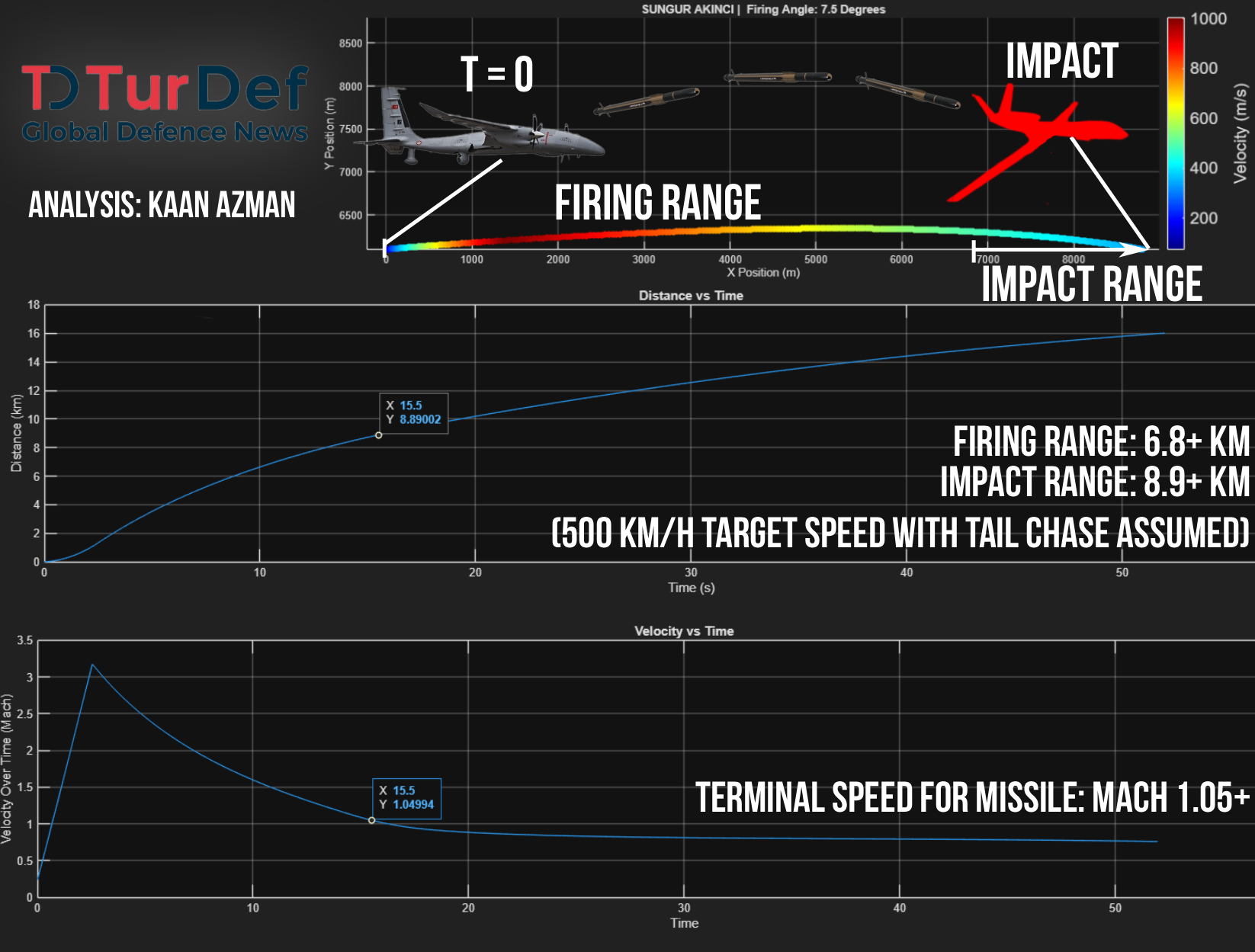
Analysis by TurDef on the engagement
Going from this, the engagement range and terminal velocity can be predicted using an assumption of a simple ballistic trajectory, which is mainly used as a preliminary method to evaluate the kinematic performance for surface/air-to-air missiles.
Considering SUNGUR belonging to the MANPADS class of air defence missiles, identical performance to Stinger was assumed for an analysis by TurDef using a ballistic trajectory that involves estimated drag, burn time, and a specific impulse (Isp) of 250 seconds for a safer guess.
According to the simple ballistic trajectory analysis, a total range nearing 8.9 km and a firing range of at least 6.8 km with the assumption of a tail chase at the same altitude and 500+ km/h target speed has been found. However, the range and speed values are likely to be higher with the consideration of a lofted trajectory that is better optimised in terms of kinematics.
Author: Kaan Azman
Editor:Özgür Ekşi