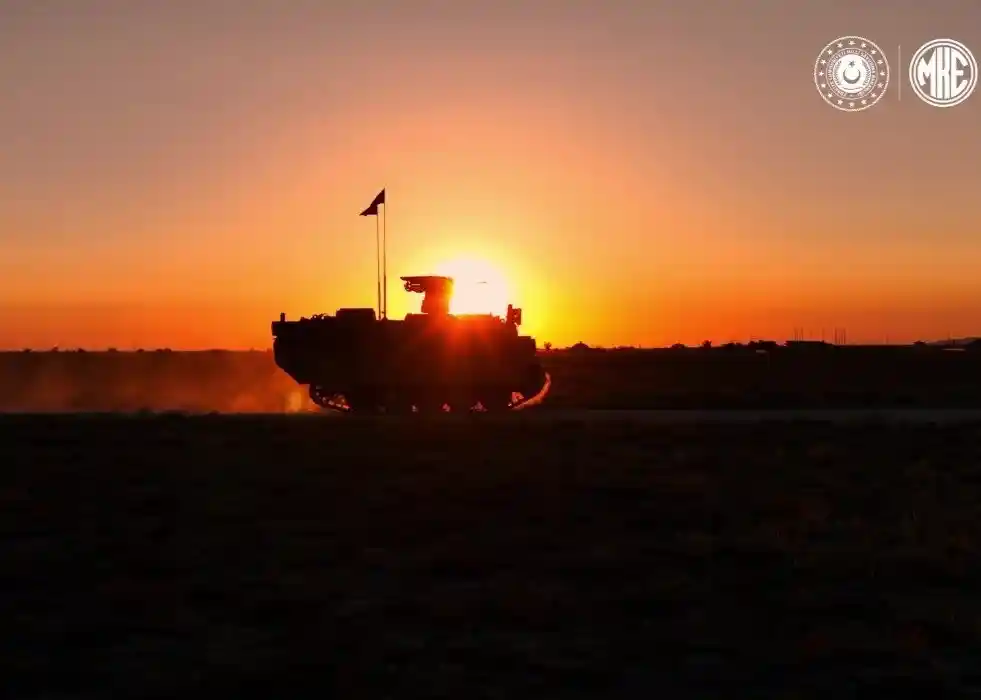
Türkiye’s Ministry of National Defence (MoD) has announced that qualification tests for the Electric Armoured Personnel Carrier (E-ZPT), developed by Makine ve Kimya Endüstrisi AŞ (MKE), have been successfully completed and the first serial production vehicle has been delivered to the Land Forces Command.
The delivery was carried out under a programme coordinated by the General Directorate of Military Factories.
Providing an update on ongoing activities, MoD Spokesperson Rear Admiral Zeki Aktürk stated: “Under the project coordination of General Directorate of Military Factories, the qualification tests of the Electric Armoured Personnel Carrier (E-ZPT), developed by Makine ve Kimya Endüstrisi Incorporated Company with domestic and national capabilities, have been successfully completed and the first serial production vehicle has been delivered to Land Forces Command; and the delivery of various weapons and ammunition in different quantities and calibres has been completed by Makine ve Kimya Endüstrisi Incorporated Company.”
Developed by MKE, the E-ZPT is based on an electric and hybrid propulsion-focused modernisation approach aimed at adapting existing tracked armoured platforms to evolving operational requirements. In terms of driving performance, hybrid powerpacks can offer improved acceleration thanks to the efficient torque delivery of electric motors and range with the use of a smaller internal combustion engine. The project is being pursued on the basis of the E-APC infrastructure, itself developed around the M113 family.
The E-ZPT is configured for Infantry Carrier Vehicle duties and operates with a 12.7 mm SARP Remote Controlled Weapon Station (RCWS). A key objective of the platform is enabling personnel transport to the mission area with significantly reduced acoustic signature. This supports counter-intelligence efforts by lowering detectability, while also mitigating noise-induced fatigue for embarked troops and improving situational awareness on route to operations. In this sense, the E-ZPT is positioned separately from Armoured Combat Vehicles (ACV) designed primarily for direct combat and fire support roles.
Author: Özgür Ekşi