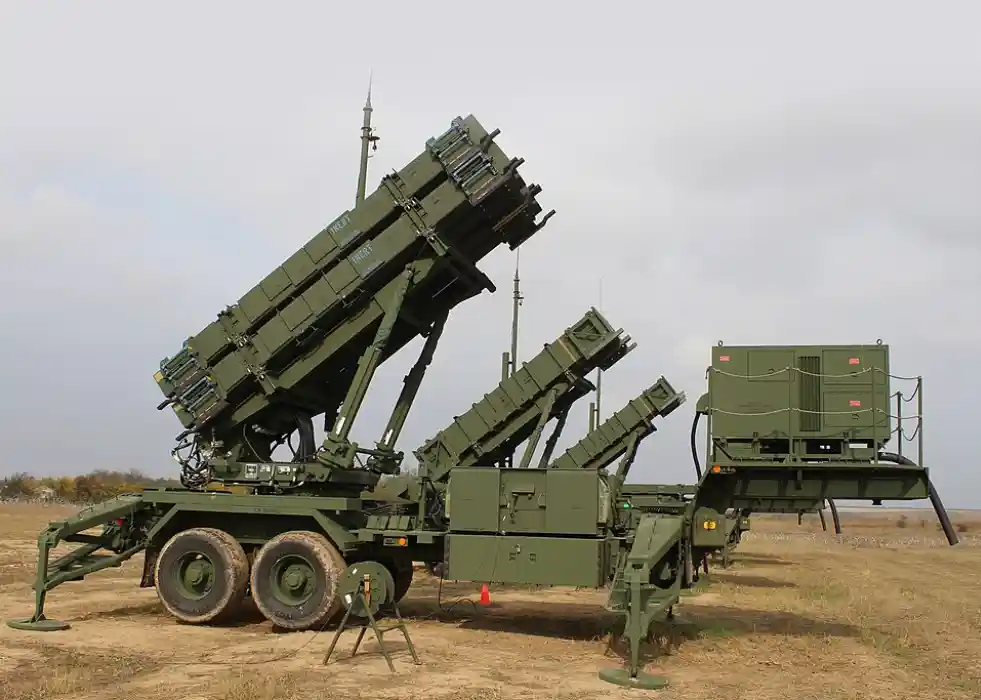
Turkish MoD announced new measures for the air defence in the southeastern region, with a Patriot long-range air defence system being deployed in Malatya.
In response to the two ballistic missiles launched from Iran, which were intercepted by SM-3 missiles launched from AEGIS destroyers, the Turkish MoD and NATO are taking extra measures with the deployment of a Patriot air defence system in Malatya.
It is unknown if the Patriot battery being deployed is loaded with PAC-2 GEM-T or the newer PAC-3 CRI/PAC-3 MSE missiles. Two types of missiles are utilised for Patriot based on the target type.
PAC-2 GEM-T
PAC-2 GEM-T, the primary option against aircraft with a long range and large warhead, uses track-via-missile (TVM) guidance. Different from traditional semi-active guidance, where a radar and a fire control radar are used while the missile has to manage interception on its own, TVM guidance redistributes the roles between the missile and radar.
The missile, fitted with the semi-active RF seeker and a datalink, relays its position to the radar, which tracks and illuminates the target and also calculates the interception course based on both the missile and target’s information.
PAC-2 GEM-T is the latest variant in the PAC-2 line in active production, introducing a seeker with GaN transmitters that allow higher performance and less maintenance burden compared to legacy PAC-2.
PAC-2 GEM-T can reach a range of 160 km and a maximum speed of Mach 3.5, carrying a warhead roughly weighing 100 kg. Each launcher carries four missiles.
PAC-3 CRI and PAC-3 MSE
PAC-3 is an entirely new type of missile family compared to PAC-2, focusing on missile defence with not only new guidance and control methods but also higher capacity per launcher.
Whereas PAC-2 GEM-T employs TVM guidance, PAC-3 is fitted with an active RF seeker, which allows for shorter engagement loops and provides better effectiveness against massed threats in tandem with deeper magazines.
In addition to this, PAC-3 is fitted with thruster controls aiding manoeuvrability, especially at high altitudes, as well as a dual pulse rocket motor to improve terminal kinematic performance. These, coupled with active radar homing, provide a massive increase in accuracy, allowing for hit-to-kill engagements with an almost ten times smaller warhead compared to PAC-2.
PAC-3 is available in two variants, PAC-3 CRI and PAC-3 MSE. PAC-3 CRI is the baseline configuration with a range of 80 km against aircraft and 40 km against ballistic missiles, with each launcher having a capacity for 16 missiles. PAC-3 MSE with a larger rocket motor pushes the range to 120 km against aircraft and 60 km against ballistic missiles, with the capacity per launcher at 12 missiles due to a larger diameter. The higher kinematic performance of PAC-3 also allows it to intercept MRBMs at the terminal stage.
Author: Kaan Azman
Editor: Özgür Ekşi