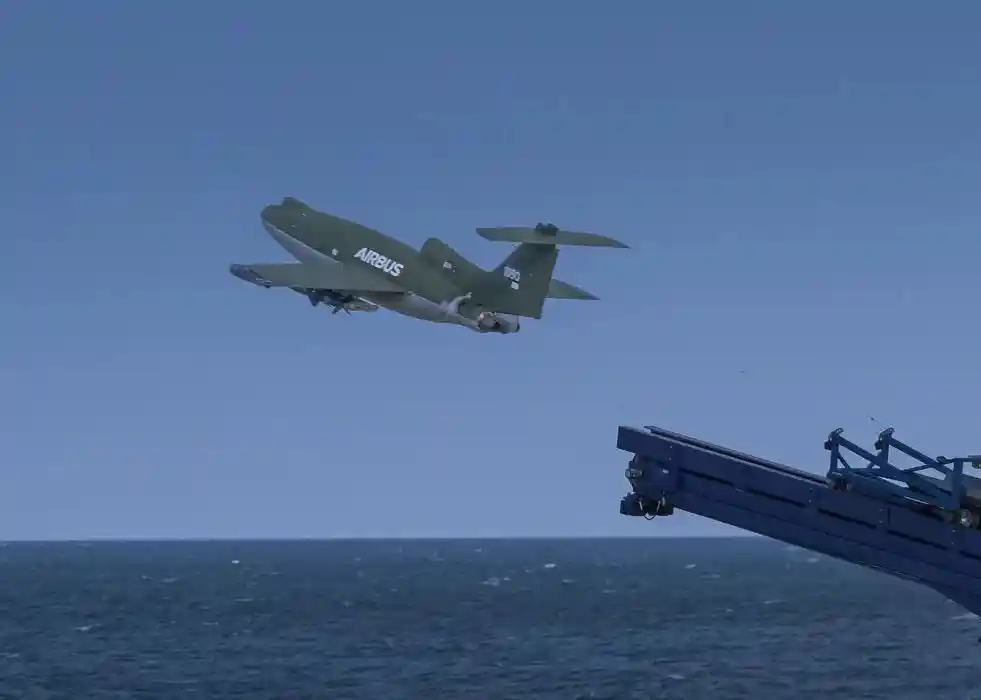
Airbus completed the first test flight of its “Bird of Prey” interceptor UAV based on the Do-DT25 target UAV, armed with Frankenburg’s Mark 1 C-UAS missiles.
Bird of Prey, previously named LOAD, developed as a rather different approach to the interceptor UAVs in a format that resembles a combat aircraft, was launched from a catapult and performed an engagement using the Mark 1 C-UAS missile developed by Estonia-based Frankenburg.
So far, the interceptor UAV concept consisted of small and cheap high-speed kamikaze UAVs that smash into incoming UAVs, which has seen considerable success in Ukraine.
Bird of Prey takes a new route by modifying a Do-DT25 high-speed target UAV powered by two small turbojet engines to carry up to four Mark 1 missiles and what appears to be an optical targeting system on the nose.
Do-DT25, launched by catapult and recovered by a parachute, provides a combination of rapid interception and reusability. At the same time, the multi-carriage of Mark 1 missiles allows the engagement of salvos, which have become a problem in the case of cheap and long-ranged kamikaze UAVs.
Mark 1 has gained attention in Europe as a small and low-cost missile specifically tailored to defeat UAVs and other slow, low-altitude threats. The missile can be launched from surface platforms or aircraft and utilises an AI-assisted optical seeker with automatic target recognition. Mark 1, weighing less than two kilograms, can reach a range of two kilometres.
The reusability of the Bird of Prey, coupled with the simplicity of the Mark 1 missile, is noteworthy in terms of responding to situations of attrition. Attrition-based warfare, even when performed by adversaries of minimal conventional prowess, has proven its risks against the better-equipped side due to the exhaustion of defensive assets and the psychological effect.
Author: Kaan Azman
Editor:Özgür Ekşi