U.S. B-2 bombers flew east in a surprise strike on Iranian nuclear sites, using European bases for refuelling. Türkiye’s İncirlik Air Base was not involved in operations.
In the early hours of 21 June, U.S. Central Command launched Operation Midnight Hammer, the largest B-2 bomber strike in history, targeting Iran’s nuclear infrastructure with a coordinated multi-domain assault.
The attack was not surprise as it was already announced but the tactics were not shared. Gen. Dan Caine, Chairman of the Joint Chiefs of Staff, on Operation shared the details of Operation "Midnight Hammer" at the press briefing at Pentagon.
At the heart of the mission were seven B-2 Spirit stealth bombers, supported by an undisclosed number of 4th and 5th generation fighter aircraft, EA-18G Growlers for electronic warfare, and over 30 aerial refuelling tankers. The bombers struck Fordow, while 30 Tomahawk cruise missiles launched from submarines, hit Natanz and Isfahan.
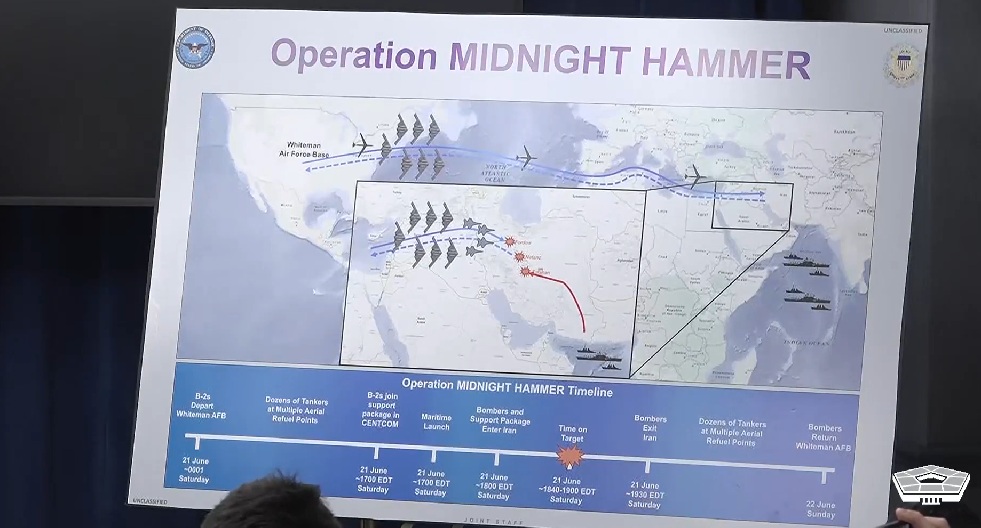
To ensure operational surprise, the U.S. executed a deception manoeuvre: a decoy B-2 flight headed west toward Guam, while the actual strike force flew eastward across the Atlantic, bypassing detection. Aviation observers in Missouri tracked the eastbound aircraft early on 21 June.
This deception was supported by an unprecedented aerial refuelling buildup in Europe. Tankers forward-deployed between 15-16 June to Ramstein (Germany), Morón and Rota (Spain), Aviano (Italy), Souda Bay (Greece), Prestwick (UK) and Lajes Field (Azores).
These movements prepositioned fuel for the long-range B-2 strike.
Notably, there was no mention of Türkiye’s İncirlik Air Base in any official briefing or unofficial reporting, despite its proximity to the CENTCOM area of operations.
Fordow was struck with 14 GBU-57 MOPs, each capable of penetrating 200 feet of concrete. President Trump confirmed the site was “taken off the table.” After previous Israeli attacks, TLAMs, launched from a U.S. Navy submarine in the Gulf of Oman, performed the attack on Natanz and Isfahan.
The raid included assets from CENTCOM, EUCOM, STRATCOM, and U.S. Space, Cyber, and Transportation Commands.
Author: Özgür Ekşi