The delivery of the 1000th THAAD seeker was announced on the 26th of August 2025. BAE Systems operates a production facility for the seekers located in New York, and is among the subcontractors for the prime terminal ballistic missile defence system of the U.S.
THAAD’s IIR seeker located on one side of the kill vehicle is activated after the boost stage ends to acquire the ballistic missiles with a considerably large heat signature after the midcourse phase.
During the extensive U.S. support to Israel's missile defence efforts against Iran's mass ballistic missile launches, %25 of the U.S. THAAD missiles in the inventory had been spent. Thus, the production of missiles might be ramped up for not only a refill but also build larger stocks following the experience.
THAAD as the Starting Layer of Exo-Atmospheric Defence
THAAD is the first layer within the U.S.’s ballistic missile defence structure covering altitudes beyond the atmosphere. THAAD’s components include the TPY-2 radar for detection/tracking, and the M1075 launcher vehicle.
To operate efficiently at near-space/space conditions, the THAAD missile adopts a design unlike the endo-atmospheric missiles like PAC-3 or SM-6.
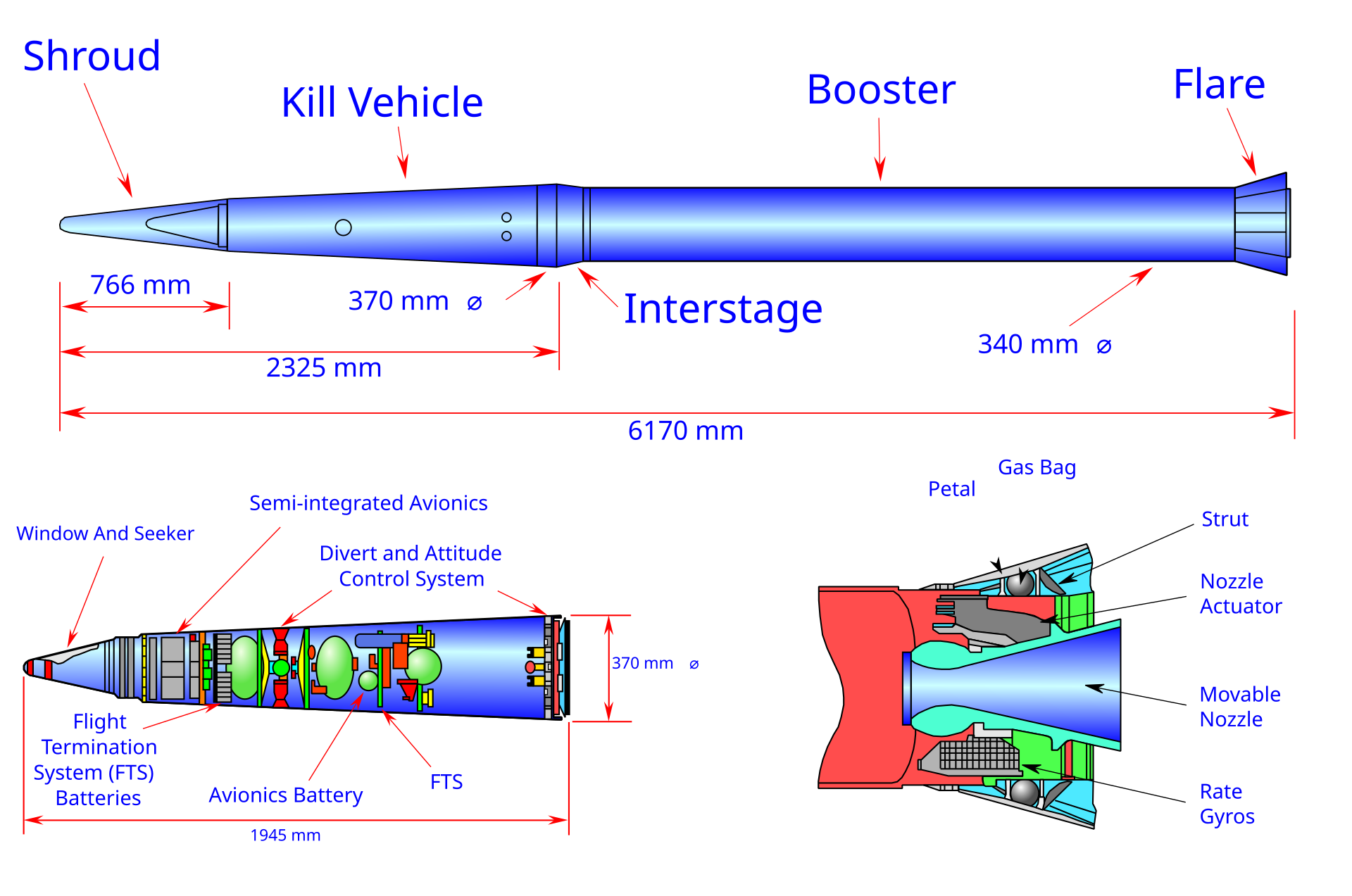
The missile relying solely on kinetic energy uses a long booster and a kill vehicle. After the booster propels the kill vehicle to the desired position and speed, the kill vehicle starts manoeuvring using the Divert and Attitude Control System (DACS) using thrusters rather than fins. At this stage, the terminal guidance is provided by the IIR seeker.
Each M1075 launcher vehicle, based on the 8x8 HEMTT truck, can carry up to eight THAAD missiles.
The anti-ballistic missile system is in service with the U.S., Saudi Arabia, and UAE. Qatar is expected to become an user in near future as well.