According to Analisi Difesa’s 17 January 2026 report, Italy has significantly revised upward its expected development costs for the Global Combat Air Programme (GCAP), tripling the budget line allocated to the early phases of the programme over a five-year period.
The Italian defence outlet reported that—compared with cost estimates made in 2021—Italy’s commitment to the design and development of a 6th-generation air combat system, including the manned fighter and accompanying “wingman” drones, has risen from €6 billion to €18.6 billion.
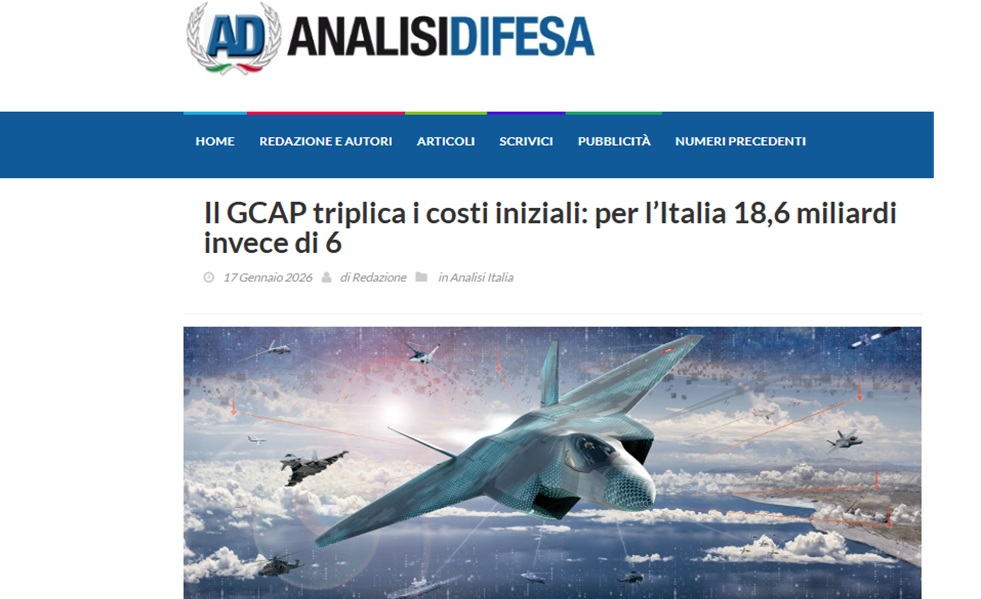
Analisi Difesa pointed to an Italian Ministry of Defence decree currently under review by the Defence Committee of the Chamber of Deputies. The decree is linked to Italy’s multi-year modernisation and renewal programme aimed at the development of “a complex and interoperable architecture based on a 6th generation Air Combat System,” including GCAP and advanced drones, with the programme framed as supporting the prospective replacement of Italy’s Eurofighter Typhoon fleet (F-2000).
The overall GCAP timeline in Italian planning reportedly runs through 2050 and is structured into four phases. The revised cost estimate relates to the first two phases, with the decree stating that the increase reflects higher expenditure associated with “technological maturation, testing, development, and design.”
Under the updated funding framework, around €2 billion is allocated to partially cover the first phase. The remaining requirement—€16.6 billion—is expected to be financed nationally. Analisi Difesa reported that approximately €8.769 billion is to be funded through appropriations recorded in the Ministry of Defence’s budget under existing legislation, spread across 12 financial years starting in 2026.
The Italian parliamentary committees are therefore being asked to approve additional long-term financial commitments for GCAP, with the Milex military spending observatory highlighting that Italy’s revised GCAP development estimate alone now exceeds the country’s F-35 programme cost.
Milex noted that the revised €18.6 billion figure—covering research, design and development rather than aircraft procurement—already surpasses Italy’s €18.3 billion F-35A/B programme for 90 aircraft, underlining the scale of the cost growth even before operational platform acquisition costs are considered.
Analisi Difesa further reported that the funding profile reflects the completion of international cooperative activities signed by the GCAP Agency with the programme’s partner states, the United Kingdom and Japan, as well as complementary national tasks such as avionics testing, adjunct demonstrator activity, advanced armament and countermeasures work, flight test laboratory investments, dedicated infrastructure, and the establishment of collaborative programme working environments.
Industrial spillover is presented in the decree as a key justification for the programme’s strategic value, extending beyond prime contractors to SMEs, universities and research centres. The expected benefits are tied to capability growth in areas such as artificial intelligence (AI), simulation, sensors, propulsion and cyber defence, and to technological and economic impact across Italian industrial regions including Lazio, Piemonte, Lombardia and Campania, with the decree also noting additional involvement beyond 2021 expectations in Umbria and Friuli Venezia Giulia.
A further constraint highlighted by Milex is that GCAP cannot be financed through the planned European SAFE loan route. As the programme is not European and remains in development, it is not eligible for SAFE-based financing and must therefore rely on national resources.
While Italy has now formally revised its cost outlook, similarly detailed adjustments have not yet been publicly confirmed in the same timeframe for GCAP’s other partners. The reporting centres on Rome’s budget decree, leaving uncertainty over whether the UK and Japan will also revise their national cost lines, or whether any such shifts will be presented through different accounting structures and approval cycles.
With development costs rising sharply before the programme has even flown, the Italian revision is likely to intensify efforts to widen the partnership base and spread long-term financial risk as the programme approaches full-scale development.
Author: Özgür Ekşi