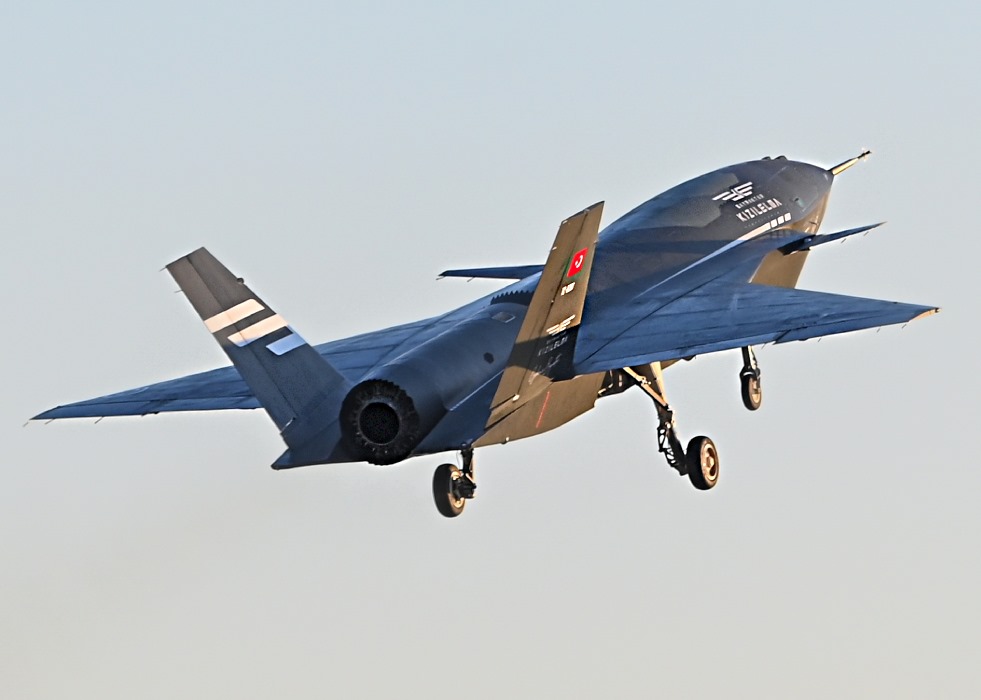
Baykar’s KIZILELMA unmanned fighter’s third prototype, or the production prototype, performed its maiden flight.
The first flight test of the production prototype is another milestone in the project, as the prototype is the closest to the configuration that will enter service with the Turkish Air Force.
KIZILELMA, emphasising air-to-air combat with a highly manoeuvrable layout, will be capable of using air-to-air missiles, guided bombs, and cruise missiles from internal bays or external hardpoints. Autonomous operation and stealth characteristics are among the forefront characteristics of KIZILELMA due to its intended use.

The aircraft will come in three versions: KIZILELMA-A (Subsonic), KIZILELMA-B (Supersonic), and KIZILELMA-C (Twin-engined and larger than the others).
The new prototype features a large number of improvements over the previous prototypes based on the experiences during the tests.
Design changes include reworked control surfaces and the fuselage on the external side. On the control surfaces, the flap arrangement was observed to be revamped with two flaps instead of five on the wings. The vertical stabilisers have become larger and angled more uniformly with the fuselage’s sides.
The lower number of flaps might have been preferred to simplify the flight control. More importantly, the actuators for flaps and vertical stabilisers have been concealed, improving aerodynamics and reducing the radar cross section (RCS). Low RCS is among the primary goals for KIZILELMA’s production version.
The landing gear has been reinforced with reinforcements at the root areas to increase the sturdiness at landing. This is critical for KIZILELMA’s variant to be operated from LHDs and aircraft carriers. However, arresting gear is yet to be developed and integrated into the unmanned fighter.
The larger intakes will provide the needed airflow for the Ukrainian AI-322 afterburning turbofan engine, which has a maximum thrust of 44 kN on the afterburner. The previous engine, the AI-25TLT medium-bypass turbofan, has a lower maximum thrust of 16.9 kN. With a stronger engine, KIZILELMA’s production variant is capable of supersonic speeds.
The third prototype has provisions for sensors such as MURAD 200-A AESA radar and directional awareness systems (DAS). Additionally, ASELSAN’s KARAT-100 IRST and TOYGUN-100 EOTS are planned to be used on KIZILELMA.