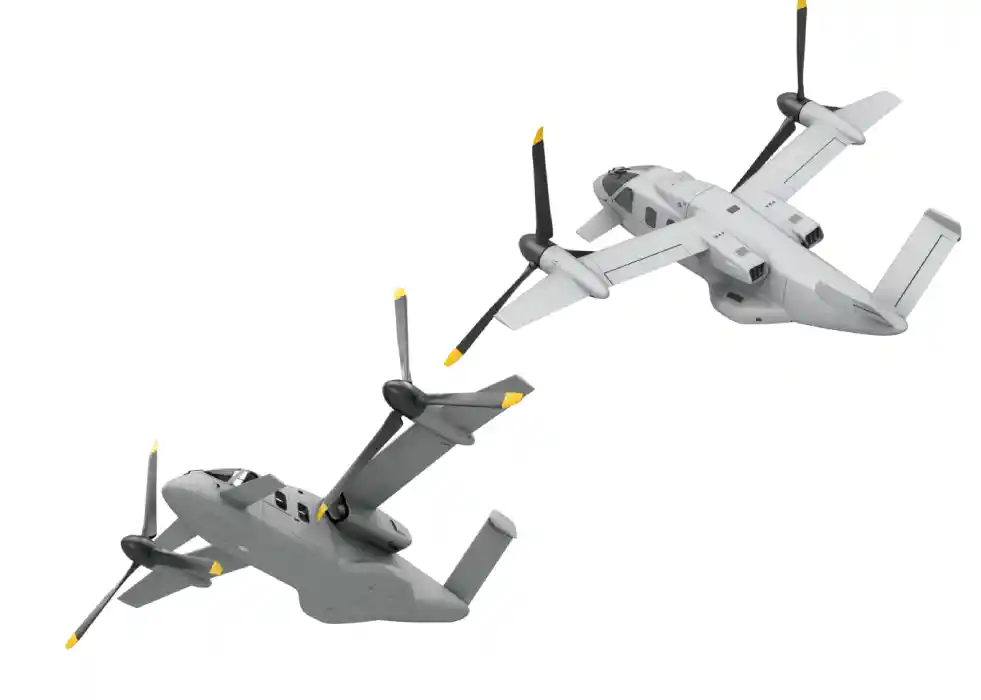
Leonardo has unveiled its ATA-NXM tiltrotor that introduces a reworked layout and a provision for upscaling as a follow-up to the AW609 lightweight tiltrotor.
While AW609, developed for commercial use, is yet to be certified, Leonardo is pressing with a new tiltrotor development that introduces layout changes and a larger capacity.
The new design, named (Advanced Tiltrotor Aircraft – Next Generation Military) ATA-NXM, as reported by Vertical Magazine, shows a major overhaul in layout compared to AW609. Whereas AW609 stands at six tonnes MTOW, the new design is anticipated to have a MTOW between 11 and 13 tonnes with room for scaling between eight and 18 tonnes, as long as there is an existing and suitable engine.
The most striking features include canard and V-tail configuration, as well as the shifting of the engines to be slightly closer to the fuselage. Canards are understood to provide increased pitch control alongside the V-tail.
In addition to this, the transmission layout appears to be centralised with both engines on the sides of the fuselage instead of at the wingtips. This would mainly reduce the structural stress on wings due to the reduced weight towards the tip, potentially allowing for lighter wings that only have the propeller assembly and transmission components inside.
Considering the recent proposal from Airbus for NATO's programme for general-purpose high speed rotorcraft, it would not be a surprise to see Leonardo joining the race with ATA-NXM.
While still rare due to the complexity, safety concerns, and handling differences compared to helicopters, tiltrotors are receiving interest as a proven path for high-speed VTOL capability. This is best exemplified by the US Army’s adoption of the MV-75 tiltrotor as the successor to the UH-60 Blackhawk within the scope of the FLRAA programme. MV-75, compared to the first operational tiltrotor, V-22, features some improvements, such as a reduced disk loading giving improved vertical flight mode handling and autorotation, as well as a new transmission aimed at improving the safety.
Author: Kaan Azman
Editor: Özgür Ekşi