For much of history, food and water were the foundations of warfighting. Armies marched on supply chains, and sieges targeted the most basic elements of survival. Wells were poisoned, fields destroyed and cities starved into submission. Without access to food and water, war could not be sustained.
The growing centrality of food insecurity marks a departure from earlier assumptions that placed water scarcity at the centre of future conflict scenarios.
In the late 20th century, this logic evolved into a new question: could scarcity itself trigger conflict? Adel Darwish’s Water Wars theory, widely discussed in the 1990s, argued that future conflicts would be driven by competition over water resources. Strategic control of water-rich areas, such as Israel’s hold over the Golan Heights, was often cited as evidence of this emerging paradigm.
Yet water scarcity, while unresolved, has not translated into large-scale interstate wars. Efforts to improve efficiency and recycling have mitigated some pressures but do not resolve the underlying structural imbalance. Instead, a different dynamic has begun to take shape—one that shifts the focus from water to food.
Recent assessments, including by the Financial Times, suggest that “food wars” are no longer a dystopian projection but an evolving reality. Food insecurity is increasingly both a cause and a consequence of conflict. Rising bread prices, for instance, played a significant role in triggering the Arab Spring, demonstrating how access to basic commodities can destabilise entire regions.
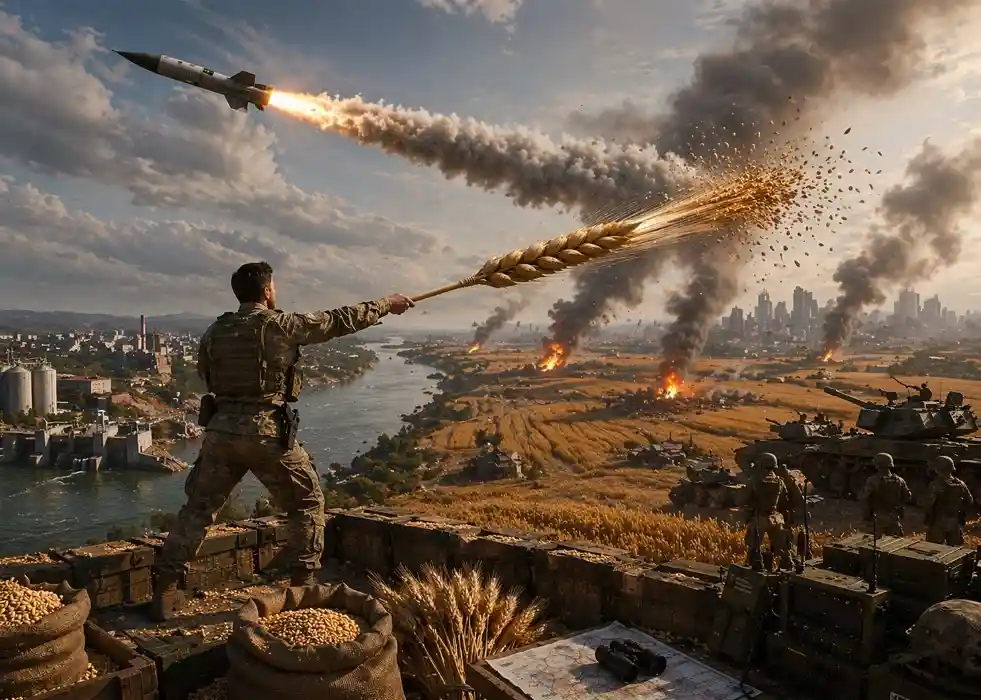
Modern warfare has also seen the return of hunger as a deliberate strategy. In conflicts such as Ukraine and Sudan, attacks on agricultural infrastructure, grain silos and export routes have effectively revived siege tactics in a contemporary form. Blocking ports or disrupting supply chains now serves the same purpose as surrounding a city centuries ago: forcing submission through deprivation.
At the same time, a growing trend of resource nationalism is reshaping global markets. Countries facing domestic shortages are increasingly restricting exports to protect their own populations. India’s rice export bans are one example of this “me-first” approach, which reduces global supply and intensifies competition among import-dependent nations. This dynamic has accelerated since the COVID-19 pandemic and subsequent conflicts disrupted global supply chains.
Underlying these developments is a deeper structural issue often described as the energy-food nexus. Modern agriculture is heavily dependent on energy inputs—from fertilisers derived from natural gas to fuel for machinery and transport. When energy prices rise, food production becomes more expensive, pushing basic nutrition beyond the reach of vulnerable populations. This creates a tipping point where economic pressure can translate into social unrest and political instability. The core issue is not absolute scarcity, but the fragility of the systems that sustain production and distribution.
Land is also emerging as a critical factor. As water scarcity and climate change affect agricultural output, fertile and water-rich land is increasingly seen as a strategic asset. Wealthy but resource-constrained countries have already begun acquiring large tracts of land in Africa and Latin America, signalling a shift toward what could become a new form of geopolitical competition.
Demographic pressure adds another layer of complexity. Global food demand is projected to rise significantly by 2050, while climate change threatens to disrupt production cycles. However, rising population alone does not constitute the core problem. The challenge lies in building efficient, resilient systems capable of converting available resources into stable food supply. In this sense, the issue is less about how many people need to be fed, and more about whether production, distribution and energy systems can keep pace under stress.
Compared to water, food occupies a unique position in global trade. While water itself is rarely exchanged across borders at scale, food effectively represents “virtual water”—the embedded resources required for its production, particularly water. This makes food supply chains more vulnerable to disruption and more directly tied to global markets.
From this perspective, the limitations of the “water wars” concept become clearer. TurDef’s assessment suggests that water scarcity alone does not translate into a direct cause for war. Capturing a water source does not increase its availability; it merely transfers control over scarcity. A state that seizes a water-stressed region inherits the same structural constraints—along with the population dependent on that resource. In this sense, military control does not resolve scarcity, but relocates the burden, limiting the strategic utility of water as a primary driver of interstate conflict. By contrast, food does not behave in the same way. Water is a fundamental input for human survival, whereas food production is a process—dependent on land, energy, labour and logistics. Capturing agricultural land or infrastructure does not automatically translate into food security, as conflict often disrupts the very systems required to sustain production and distribution.
The emerging “food wars” framework reflects a broader return to Malthusian concerns. This concept, rooted in the work of economist Thomas Malthus, refers to the risk that population growth outpaces the capacity to produce sufficient food. When this imbalance intensifies, it can lead to so-called “natural corrections” such as famine, migration pressures and conflict. In modern terms, this raises the possibility that systemic stress—rather than deliberate strategy—may drive instability. In this sense, the scenario often depicted in fictional universes such as Mad Max—a post-apocalyptic film series starring Mel Gibson, set in a collapsed world where fuel, water and food are scarce and society has broken down—appears less speculative and more structurally grounded. It portrays a brutal environment in which armed groups fight over basic resources as systems fail.
For defence and security planners, this shift has significant implications. Food is no longer just a logistical requirement or a humanitarian concern; it is becoming a strategic variable in its own right. As global systems face increasing strain, the intersection of food, energy and conflict may define the next phase of geopolitical competition. In this sense, future conflicts may not be fought for territory alone, but for the systems that sustain life itself—and for the ability to keep those systems functioning.
Author: Özgür Ekşi