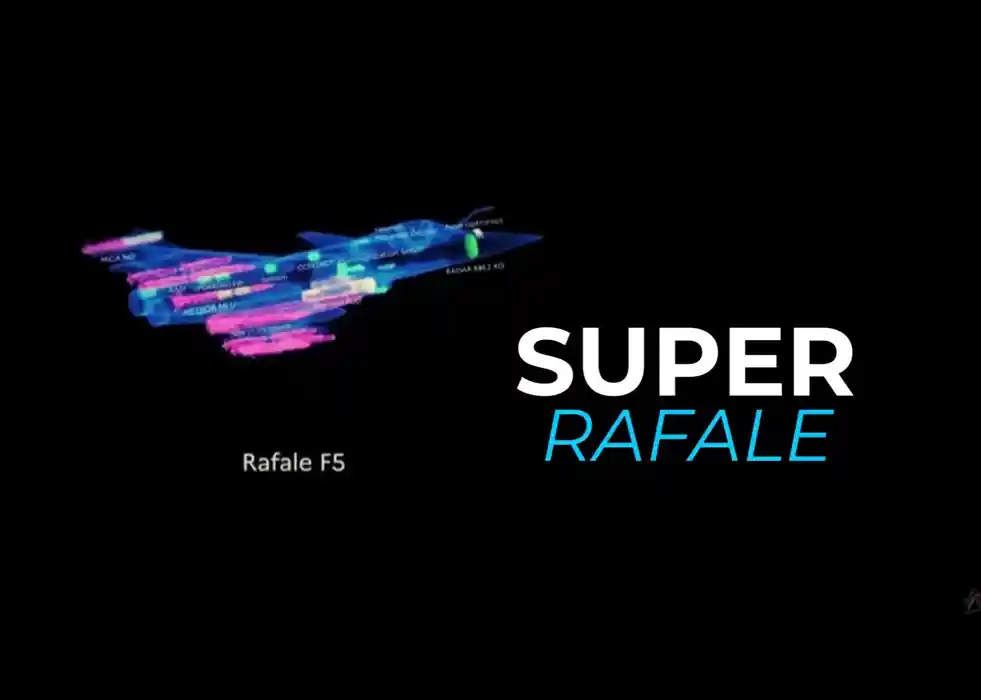
Rafale F5 restores France’s long-lost SEAD role with 18 Smart Cruiser missiles, bridging a post-Cold War gap in suppressing advanced enemy air defences.
Dassault Aviation’s upcoming Rafale F5 variant will restore France’s SEAD capability with up to 18 Smart Cruiser missiles, a new generation tactical weapon designed to defeat advanced ground-based air defences.
Revealed at the Paris Air Show, the configuration includes three hexalaunchers, each carrying six Smart Cruisers. Developed by MBDA under the Future Air-to-Ground Weapon (AASF) programme, the missile features swarm deployment, in-flight data links, and onboard AI for adaptive targeting. It will operate in concert with drones and other assets through a network-centric architecture designed to overwhelm integrated air defence systems (IADS).
The French Defence Procurement Agency (DGA) confirmed the configuration is specifically engineered to suppress and destroy enemy air defences in contested environments. France had lacked a dedicated SEAD platform since retiring the AS-37 Martel missile, a gap now addressed through Rafale F5.
This capacity gap came about because France didn't want to fund for specific SEAD capabilities at Post Cold War era, when the world was less worried about threats and strategic objectives changed.
However, the proliferation of Russian and Chinese A2/AD systems, as well as recent conflict in Syria and Eastern Europe, have highlighted the importance of France regaining the ability to infiltrate airspace on its own.
The decision represents a doctrinal change towards full-spectrum air dominance and strategic autonomy in high-threat environments. The initial operational capability is projected in 2033, with complete capability in 2035.
Rafale F5 will enter inventory in 2030.
Author: Özgür Ekşi