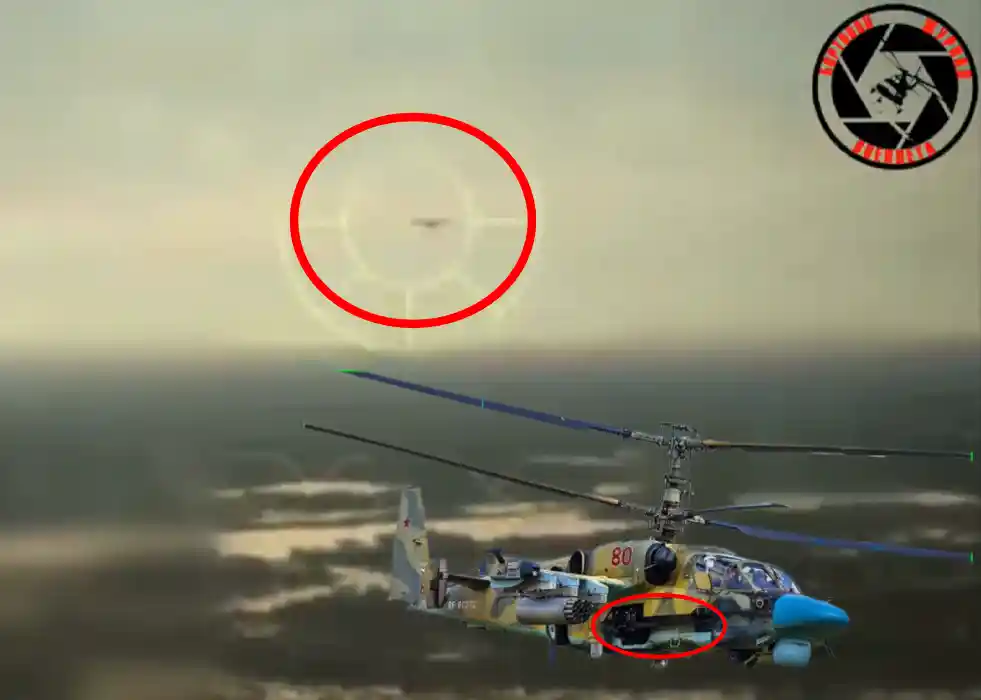
Russian sources shared a footage of a Ka-52 Alligator attack helicopter engaging a Ukrainian UAV using 30 mm airburst ammunition from its 2A42 autocannon.
To combat the UAVs used by Ukraine, Russia has started the operational deployment of its new 30 mm airburst ammunition on attack helicopters using the 2A42 autocannon. Footage from a Ka-52 shows a UAV being shot down using 30 mm airburst ammunition.
Due to 2A42 being a dual-feed autocannon, the helicopters can still use armour-piercing ammunition against armoured targets or high-explosive ammunition against soft targets.
However, the placement of 2A42 considerably limits its movement on Ka-52, while the other attack helicopter with the autocannon, Mi-28, has a better freedom of movement.
Beyond the attack helicopters, Russia is also likely to deploy this ammunition on its air defence systems like Pantsir and 2K22 Tunguska, even BMP-3 IFVs, which use the same autocannon as Ka-52 and Mi-28 attack helicopters. Previously, Russian gun-equipped air defence systems have been inadequate at close range against UAVs in terms of engagement performance due to using conventional ammunition. However, the airburst ammunition is one part of the problem; sensors to detect small UAVs remain full of question marks.
The US is similarly pursuing gun-based UAV engagement for its AH-64 Apache attack helicopters, through proximity-fused 30x113 mm ammunition for the M230 chain gun as a persistent short-range weapon to work alongside the proven APKWS II laser-guided rockets.
Author: Kaan Azman
Editor: Özgür Ekşi