TMRS Enerji Teknolojileri Sanayi ve Ticaret A.Ş., whose establishment was announced in the Türkiye Trade Registry Gazette on 8 January 2025, lists Selçuk Bayraktar as its founder. Bayraktar is widely known as the Chairman of the Board of Baykar, a company with extensive involvement in defence, aerospace and advanced technology programmes including space.
According to the official Trade Registry records, TMRS Enerji’s registered scope of activities covers nuclear energy technologies, including reactor-related systems, fuel technologies and associated engineering fields. The registry also includes the processing, refining and utilisation of rare and strategically significant elements such as uranium, thorium, niobium, zirconium and hafnium.
The inclusion of such materials in a company’s registered activity scope is a standard legal requirement under Turkish law for entities that may seek future licences related to strategic minerals, nuclear technologies or associated industrial processes. As such, the presence of these elements in the registry does not, by itself, indicate an active project or programme.
However, TurDef notes that beyond their legal function, the specific selection and combination of certain elements can still provide indirect insight into a company’s potential technological orientation when assessed against established technical literature and international practice. In this context, two materials in particular — hafnium and niobium — merit closer examination.
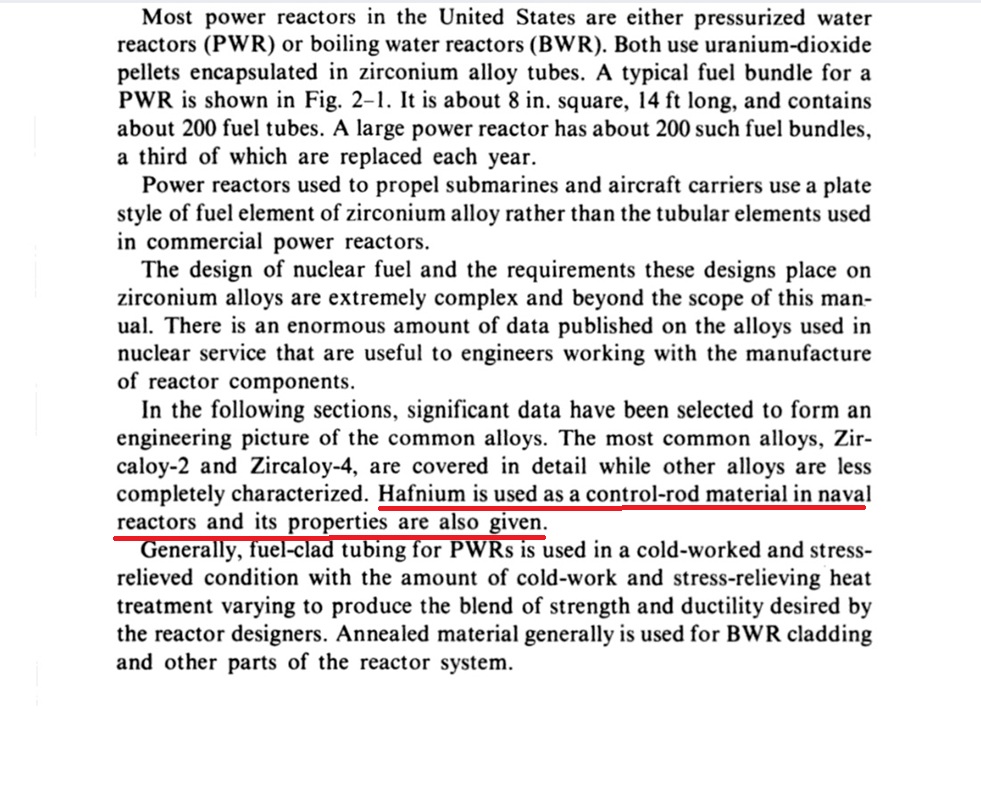
ASTM Manual on Zirconium and Hafnium Chapter 2 Page 21
From a nuclear engineering perspective, hafnium and niobium are not essential materials for conventional land-based commercial power reactors, where their use would generally increase cost without providing corresponding operational advantages. The technical documentation shows that these materials exist in naval nuclear environments because they need to withstand long operational periods and maintain their structural integrity while resisting oxidation and producing minimal vibration noise.
The available public information shows hafnium serves as a control-rod material in naval nuclear reactors, but niobium-based alloys find use because they maintain their structure and strength during extreme high-temperature operations. TurDef assesses that these characteristics align more closely with maritime nuclear reactor applications than with standard civilian power generation.
In this context, TurDef assesses that, should Türkiye pursue future naval nuclear propulsion capabilities — particularly in submarine platforms — the use of compact, highly specialised reactor technologies would be consistent with international practice. In such systems, rare and strategic elements listed in TMRS Enerji’s registered activity scope are employed more extensively than in land-based civilian reactors. Currently Turkiye is known to have NUKDEN programme but the modalities are not announced yet.
TurDef emphasises that all assessments beyond the information published in the Trade Registry Gazette represent analytical interpretation only. There is currently no publicly available document, programme announcement or official statement indicating the existence of any naval nuclear platform project linked to TMRS Enerji. The analysis above is derived solely from the company’s legally registered scope of activities, established technical knowledge regarding rare element usage, and Baykar’s publicly known focus on defence-related technologies.
Author: Özgür Ekşi