Turkish Companies Ares Shipyard and Meteksan Defence’s joint product, the Expendable Unmanned Surface Vessel ULAQ KAMA, brings new capabilities to the seas.
Unmanned vehicles are an important force multiplier in today’s battlefield, as they offer users a wide range of low-cost solutions and do not put trained personnel, who are much more valuable than the vehicle, at risk. The success of remotely piloted aerial vehicles has led to the extension of the concept to the sea and land. Solutions initially deployed for ISR missions, such as reconnaissance and surveillance, like their predecessors, have now inevitably started to serve in attack tasks.

Having caught the transition era in remote-controlled vehicles just in time, Turkiye has crowned its experience in unmanned aircraft with the jet age and has also made significant parallel progress at sea. The products offered one after the other by various domestic producers constitute trump cards for the Turkish Defence Industry in both the domestic and export markets. Horizontal diversification in existing products is now on the agenda, along with achieving a certain level of competence in subsystems and major solutions.
The ULAQ family of unmanned naval vehicles, a joint product of Ares Shipyard and Meteksan Defence, is among the solutions that have received its share of this diversity. The new member of the product range is ULAQ KAMA.
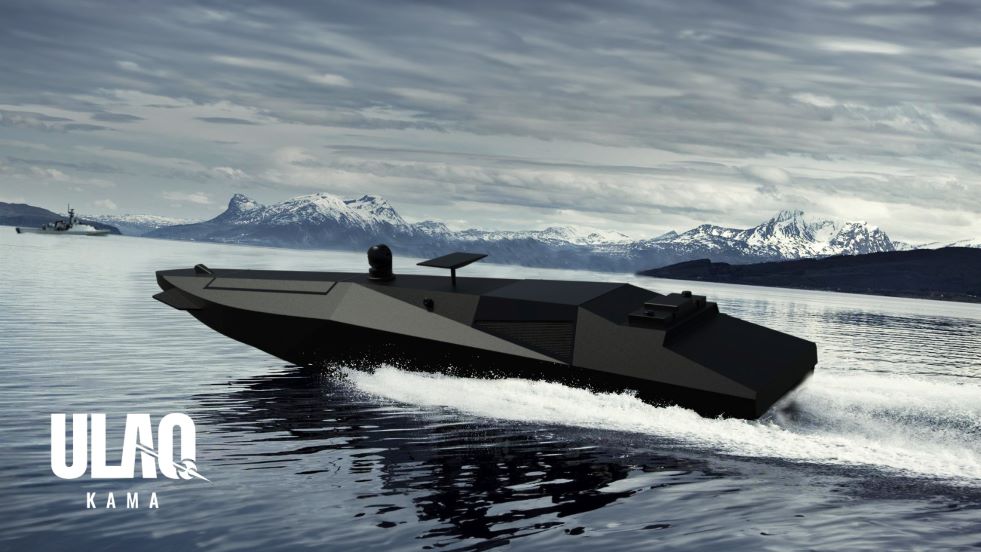
Since the term “kamikaze” is more political, it would be more accurate to characterise the solution as “One Way / Single Use Offensive Armed Unmanned Surface Vessel” or “Expendable Unmanned Surface Vessel”. Considering the changing and increasingly asymmetrical balances on the battlefield, unmanned naval vehicles are one of the newest solutions to fly the flag or show armed power to opposing or threatening elements, thus increasing deterrence. Offering a very good solution for countries that have to dominate large sea areas with relatively limited naval power, the class in question brings the possibility of control at extremely low costs compared to major surface combatants.
Unmanned naval vehicles, which have reached the capability to conduct surface and/or anti-submarine warfare with their armament, are an important factor in developing deterrence potential. KAMA, the expendable model of the ULAQ family, is a weapon with a new terminology. In addition to its low draught of 0.35 metres, its extremely low silhouette, which is less than 1 metre above the waterline on the surface, makes it extremely difficult to detect the vehicle by eye, electrooptics or radars. Capable of a maximum speed of 50 knots, AUSV can reach distances exceeding 200 nautical miles at an economical cruise speed of 20 knots. Operating in Sea State 4-level environmental conditions provides the user with significant flexibility.
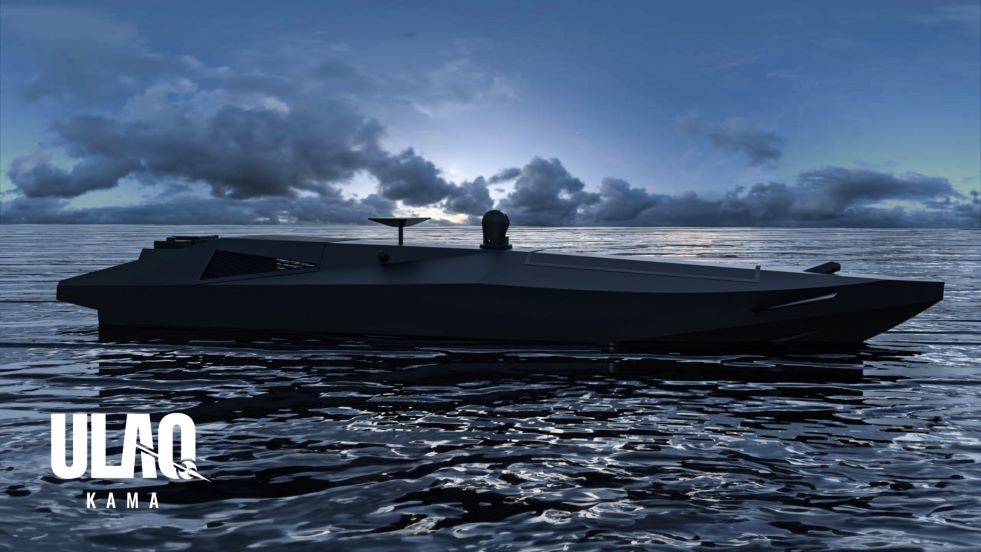
When necessary, KAMA can be deployed as a fast attack craft and patrol in predefined areas, and it can attack the target like a torpedo or guided missile. ULAQ KAMA, which can operate at different autonomy levels such as full control, man-in-the-loop or man-over-the-loop, can be controlled via satellite. Thanks to its antenna structure and special stabilisation equipment, the vehicle can maintain its sky orientation to ensure optimum communication even in harsh sea conditions. The vehicle’s comms and navigation equipment are jamming-resistant. However, in the event of a communication loss, it can continue to search for its target until a digital twin is found in the predefined scanning pattern. When AUSV detects a target, it warns the user. If there is no intervention or rejection to attack, the mission is completed by switching to strike mode.
The vehicle has a navalised propulsion structure resistant to harsh sea conditions. However, it should be noted that various measures have been taken to reduce costs as it has been developed for one-way use. An important vehicle capability, which has been meticulously designed in every detail, is its hull, which can overcome various obstacles. While the water jet preference prevents the entanglement of environmental obstacles such as steel ropes, skipping over the manias to be taken is a tactical multiplier that brings a significant level of counter-countermeasures, thus expanding the target range to protected harbour facilities.
The unmanned naval vehicle can hibernate. Thanks to this feature, the system, which has been deployed to the required areas, can be switched to a standby mode with low power consumption and wait for the time to be reassigned. Thus, the system can define its own rules of engagement, such as sea mines. Since the capability brings with it an asymmetry that is unpredictable for hostile elements, it is safer than mines, and it can be returned to the required areas when necessary and can be re-evaluated, providing low-cost tactical flexibility.
In the ongoing battles in Ukraine, unmanned naval vehicles for offensive purposes have achieved significant success. Some solutions that led to the sinking of various Russian Navy platforms could have been intercepted. The lessons learnt from the systems whose explosions were observed in the images released to the media have been integrated into KAMA. The most important issue here is the insensitive explosive-type warhead that can reach 200 kilograms. With this feature of the payload, even in the event of a 12.7-millimetre hit, it is possible to continue the transfer to the target without triggering and, therefore, without explosion. In this case, the defenders may have to resort to very low probability remedies such as hitting specific targets like the propulsion system on extremely small targets in the turbulent environment of the sea. With its insensitive payload, KAMA also has an important coefficient regarding mission success and survivability.
The ULAQ KAMA is a weapon that can be acquired at a relatively lower cost than many of its counterparts and other naval weapons due to its emphasis on expandability. Its low silhouette, high manoeuvrability, and ability to do so in swarms or multiple operations make it extremely difficult to intercept attack packages. The scenario in which the KAMA is most effective for attack is attacking the same target from multiple directions. Here, a highly variable dimensional asymmetry is achieved against the defender, while a flexible attack pattern that plays at any time at the critical terminal stage, which requires instant and definitive results such as target selection and firing priority, is put on the field. Thus, both the decision-making mechanism and the firing infrastructure in the defence system are faced with a much more difficult problem to solve, increasing the probability of success of the attack. The system’s expendability, compact structure and low weight enable it to carry multiple numbers on each ship, thus paving the way for the dispatch and management of more crowded packages.
In the ongoing war in Ukraine, the damage caused to thousands of tonnes of ships by AUSVs converted from jet skis paved the way for a new concept of combat-proven in naval warfare. Turkiye, which is surrounded by seas on three sides, is behind schedule in terms of renewing the navy and expanding its capabilities in line with its Mavi Vatan (Blue Homeland) Policy. Considering the claims and hydrocarbon deposits in the region, it is obvious that there is an urgent need for a solution that will fly flags in every inch of the region. Now, unmanned naval vehicles, which can be launched faster, more cost-effectively and practically than ships that take a long time to build, are an important capability opportunity for the Turkish Naval Forces. In particular, armed solutions with high survivability, such as the KAMA, which will determine its own rules of engagement, are waiting for the days when they will take their place on the battlefield as important factors that will bring tactical and even strategic advantage in mass operations for the user in situations that go beyond the requirements such as patrol and patrol.