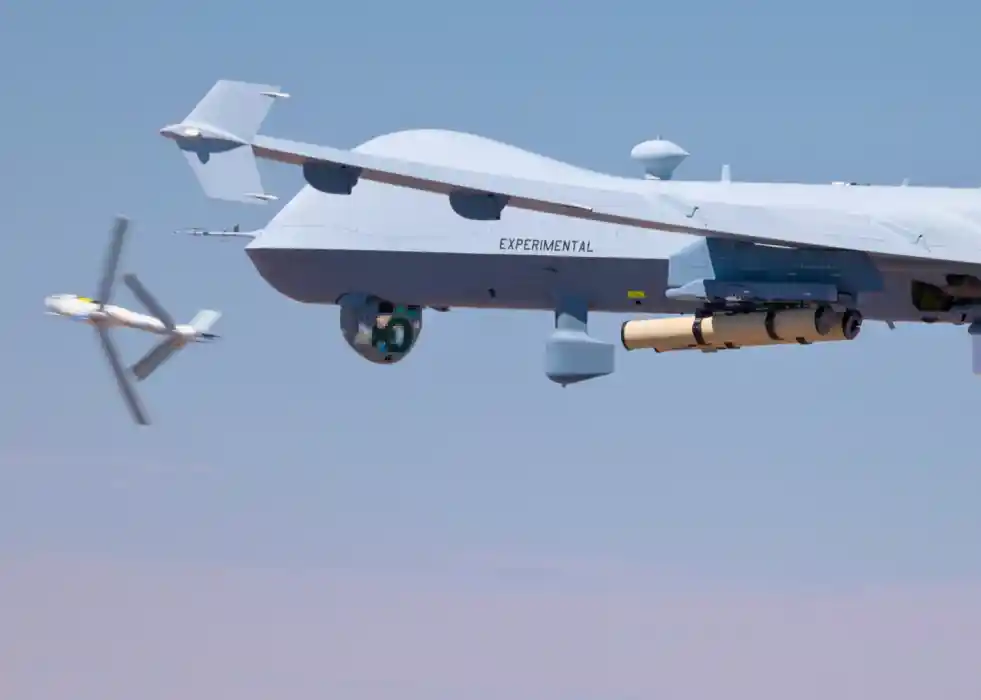
Australia has approved a USD 930 million (A$1.4 billion) contract to procure six MQ-28A Ghost Bat unmanned combat aircraft, marking the platform’s transition from a demonstrator into an operational Royal Australian Air Force (RAAF) asset. The deal follows this month’s air-to-air firing test, during which an MQ-28A launched an AIM-120 AMRAAM with guidance support from an E-7A Wedgetail and F/A-18F Super Hornet.
Canberra says the funding package covers aircraft, mission systems, autonomy development and the infrastructure needed to scale manned–unmanned teaming. Developed in Australia, the MQ-28A is built around the loyal-wingman concept, extending a fighter’s sensor reach, absorbing high-risk missions and forming a future combat mass alongside crewed aircraft.
However, the Ghost Bat currently lacks an onboard air-to-air radar, making fully autonomous target detection and terminal engagement impossible in its present configuration. Test data and released imagery confirm that the recent AMRAAM shot was a conventional cooperative engagement, not an autonomous attack as described in Boeing’s announcement. The unmanned aircraft operated as a missile-launching system which used crewed platforms to establish sensing and guidance operations.
The program stands as a strategic priority because Australia needs to address the increasing competition which exists in its Indo-Pacific region. The aircraft design with its low-observable features and built-in payload compartment and adjustable mission nose section enables flexible operations for reconnaissance and electronic warfare and upcoming weapon systems. Türkiye, meanwhile, has already demonstrated capabilities beyond this stage. Bayraktar Kızılelma recently executed a confirmed BVR air-to-air strike using the GÖKDOĞAN missile against a jet-powered target over Sinop, establishing one of the world’s earliest MUM-T concept unmanned platforms to perform a true autonomous-style engagement with its own sensor–weapon cycle. This milestone places Türkiye among the few countries now validating real combat-credible unmanned fighter behaviour—an objective still in development for many Western programmes.
Author: Özgür Ekşi