DARPA unveiled X-76 HSVTOL, being developed as a demonstrator for USSOCOM’s SPRINT programme in cooperation with Bell, aimed at 400+ knots cruise speeds.
Aiming to surpass the cruise speed of current tiltrotor aircraft for special operations, Bell has launched work on the X-76 demonstrator for USSOCOM’s SPRINT programme following its selection.
The programme’s goals include cruise speeds above 400 knots, VTOL from unprepared surfaces and retention of hover capability over austere environments.
X-76 is set to be the first fleshed-out example of the HSVTOL concept that Bell has been working on over the course of past few years. DARPA stated that the demonstrator is set to start its test flights in 2028.
Drawing from the experience with V-22 Osprey in service and soon to be introduced MV-75 Valor, Bell’s HSVTOL concept brings a new type of propulsion system that adds a third mode after the forward tilting.
A conventional tiltrotor aircraft has two main modes: vertical flight mode and forward flight mode, switched by controlling the rotor alignment with respect to the body axis.
Bell’s HSVTOL concept, using what can be simply described as a cross-over of a turboshaft, turbofan, and turbojet engines, adds a high-speed mode where the blades are stopped and folded around the engine housing to minimise drag as the engine switches to high-speed cruise mode.
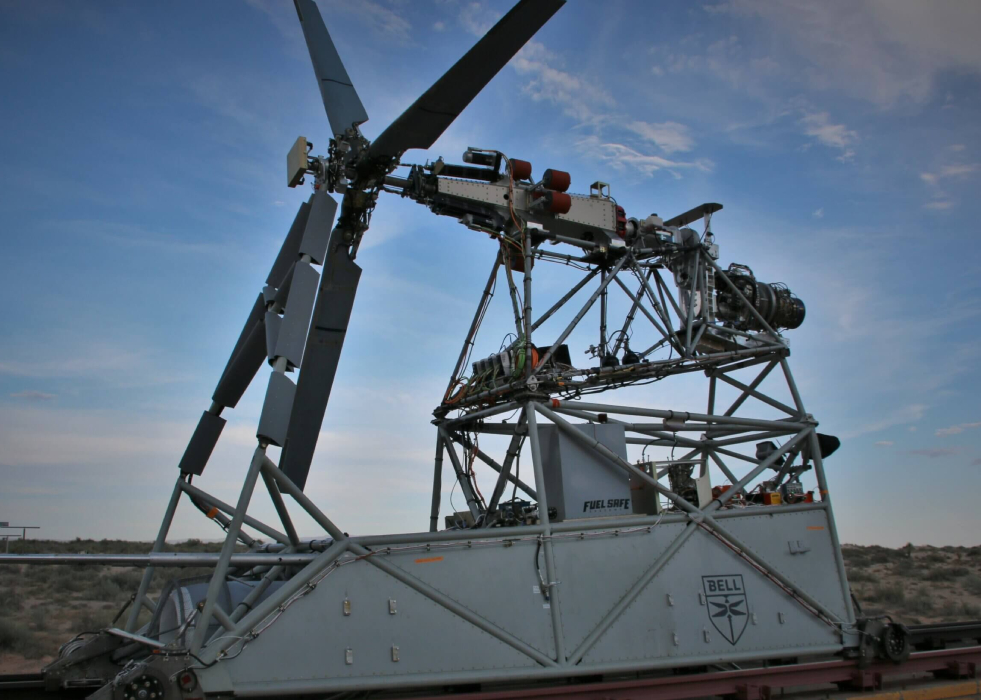
Bell’s Engine Demonstrator for X-76 HSVTOL
Bell demonstrated the new type of engine on a sledge mechanism in 2024, also providing real-time status of the engine during the transition from propeller-driven cruise to high-speed cruise mode.
The engine starts in turboshaft mode to accelerate to the transitioning speed. After reaching the required speed, the engine transitions to ‘turbofan mode’ where rotor pitch is adjusted to have a low angle of attack with respect to flight direction and reduces the input to the power turbine for forward propulsion to provide high-speed airflow to the nozzle.
Following further acceleration, rotors are locked in place and folded down for full transition to turbojet mode, which is projected to provide the cruise speed massively exceeding that of a conventional tiltrotor.
Author: Kaan Azman
Editor: Özgür Ekşi