Germany's EUROATLAS launched GREYSHARK autonomous underwater vehicles to defend subsea cables and infrastructure from escalating dangers of sabotage.
A number of high-profile events in recent years have brought the safety of underwater infrastructure to the forefront of global concerns. The 2022 sabotage of the Nord Stream pipelines in the Baltic Sea, as well as the problems that followed with undersea cables in the North Sea, France, Spain, and between Finland and Estonia, showed how weak important seabed networks are.
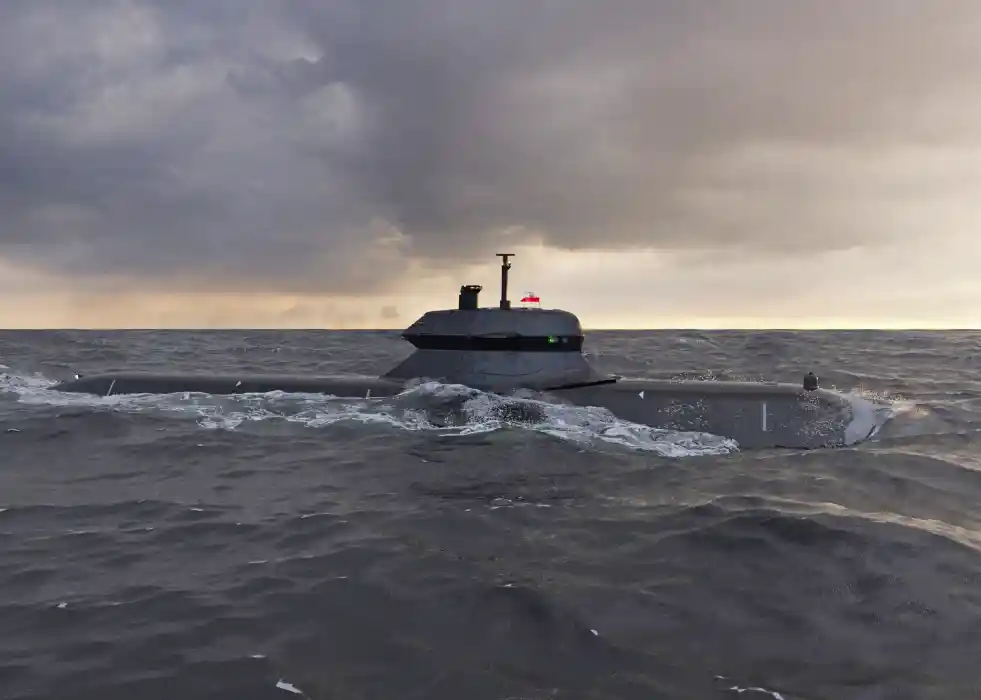
To meet this issue, the German defence company EUROATLAS has unveiled GREYSHARK™, a new line of autonomous underwater vehicles (AUVs) designed for a variety of missions, such as monitoring cables, sweeping mines, gathering intelligence, and keeping an eye on marine commerce routes.
Two variants — Bravo (battery-powered) and Foxtrot (hydrogen fuel cell-powered) — are currently undergoing sea trials.
Equipped with a suite of 17 sensors and powered by an advanced AI software stack developed with EvoLogics, GREYSHARK AUVs provide long-range, high-endurance underwater ISR. The Foxtrot model can operate for up to 16 weeks and cover 11,000 nautical miles without resurfacing. Both variants can autonomously reconfigure missions mid-deployment, shifting from cable inspection to submarine detection without human intervention.
The systems also feature swarm capabilities, enabling multiple vehicles to coordinate for wide-area surveillance and deterrence. Interoperability with other platforms — from submarines and frigates to land-based assets — integrates GREYSHARK into a broader “combat cloud” concept.
EUROATLAS CEO Eugene Ciemnyjewski emphasised the urgency: “In a changing world, global affairs are contested on multiple fronts. GREYSHARK is a force multiplier offering elevated protection across maritime operations.”
With production capacity targeted at 150 units annually by 2026, the company aims to supply NATO and partner nations with persistent undersea monitoring capabilities. The system is designed to safeguard critical chokepoints such as the Red Sea, the GIUK gap, the Baltic, and the Arctic, where 98% of global data and 15% of world trade rely on vulnerable subsea cables.