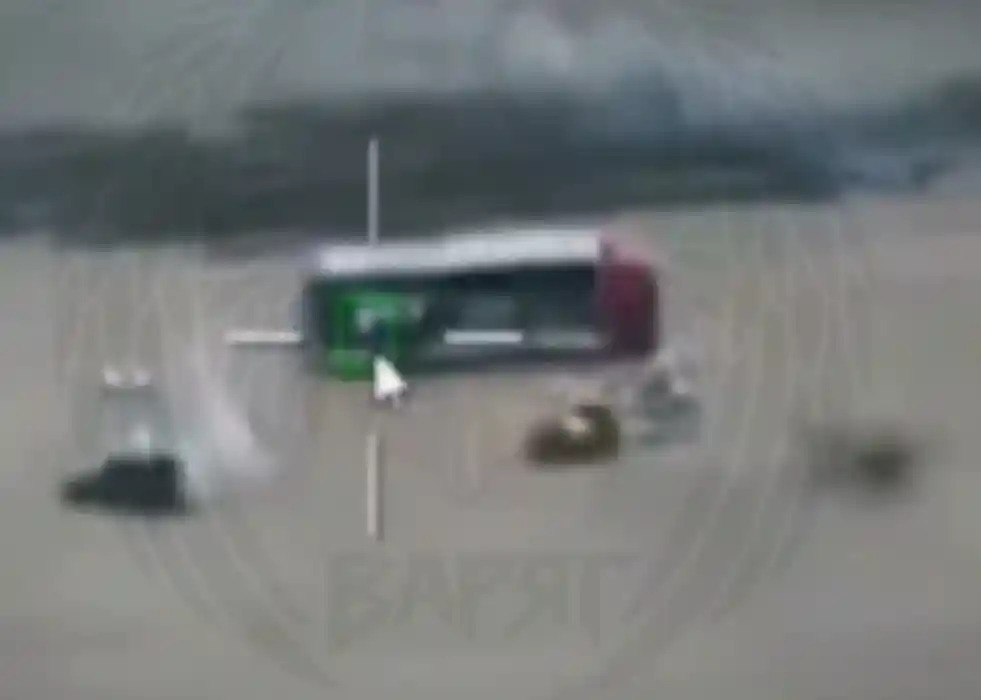
Russia shared a footage from a modified Geran kamikaze UAV, fitted with a small EO seeker for terminal guidance, used to strike a Ukrainian kamikaze UAV launcher.
Russia has started fitting some, if not all, of its Geran kamikaze UAVs with optics to provide terminal guidance against smaller and relocatable targets, with one Geran-2 striking a Ukrainian launcher for kamikaze UAVs. Russian sources on social media shared footage showing the feed from Geran’s optical seeker. It is also seen that another UAV was present to provide targeting assistance to the Geran.
So far, the use of Geran derivatives based on Iranian Shaheed-136 has been limited to fixed targets, usually facilities or cities, due to the rigidity of GNSS/INS navigation and potential deviations.
Russia’s addition of optics to its commonly used Geran kamikaze UAV renders last-minute relocation less effective, as the UAV can be manually or automatically kept on the specified target. Additionally, the use of optics might lead to navigation supported by optics (Widely employed by high-end cruise missiles and UAVs), which reduces susceptibility to GNSS interference.
Geran series of kamikaze UAVs have received various modifications throughout the war, including: FPVs, air-to-air missiles, turbojet engines (Geran-3), and Starlink antennas (Rendered ineffective by the Starlink ban on Russian military through speed-based detection). Additionally, Russia has developed two new variants: the turbojet-powered Geran-4, adopting the same layout but a larger frame compared to Geran-2/3, and the larger Geran-5, adopting a new layout closer to that of a cruise missile for improved efficiency during the cruise phase.
Author: Kaan Azman
Editor: Özgür Ekşi