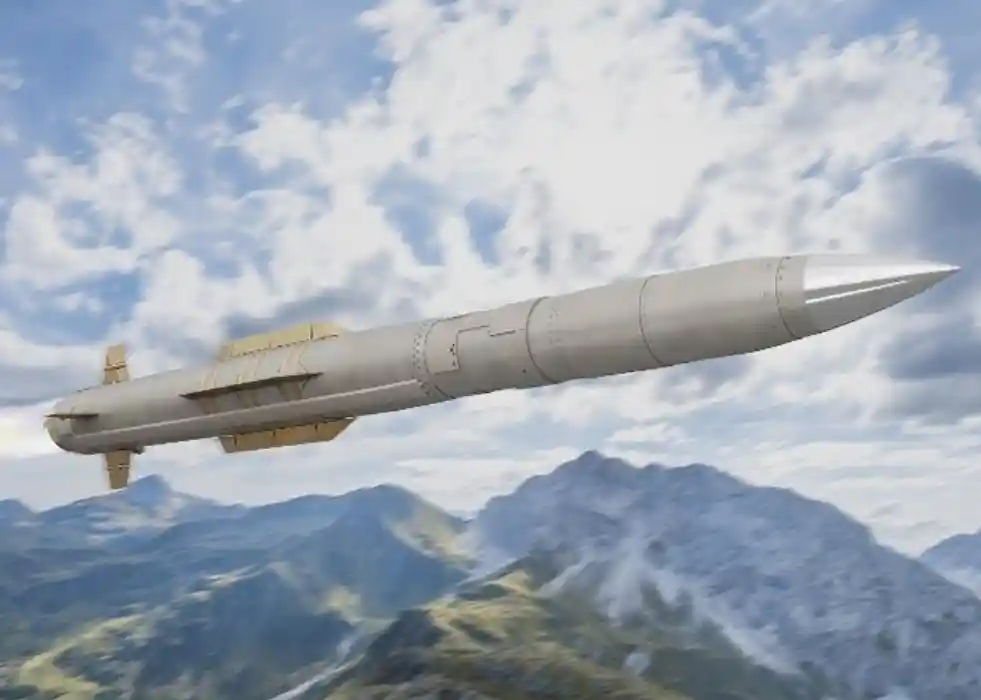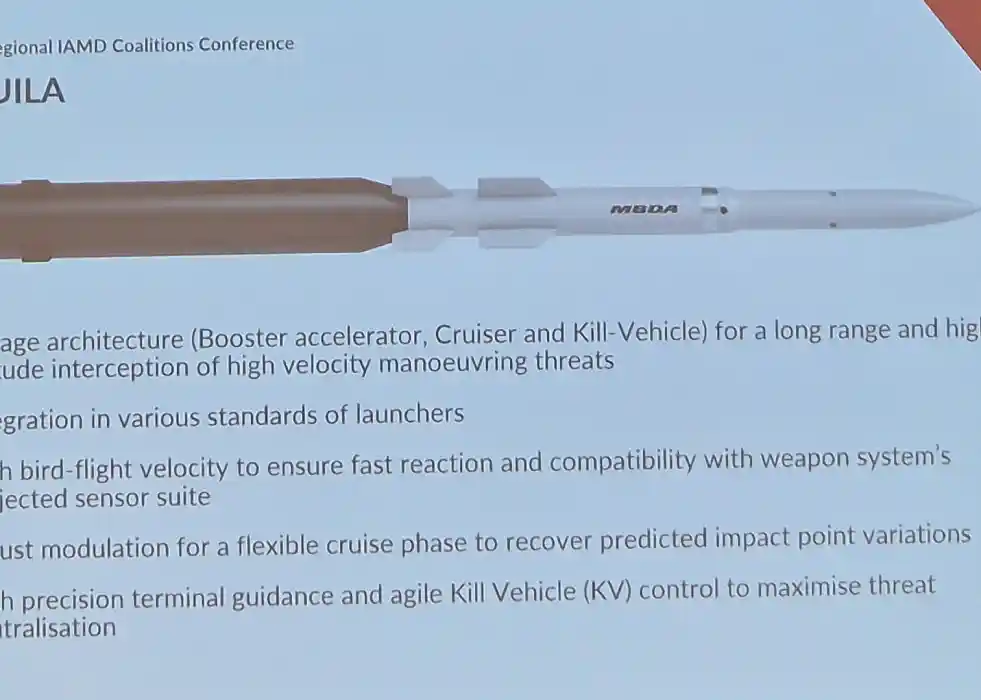
MBDA has provided details on its previously unveiled AQUILA air defence missile being developed to take out hypersonic threats like HGVs and cruise missiles.
MBDA seeks to answer the problem of countering lateral-flying hypersonic weapons like HGVs or cruise missiles with the AQUILA missile within the scope of the HYDIS programme, placing emphasis on attaining high speed with a three-stage design and atmospheric kill vehicle.
While the legacy Aster 30 can counter SRBMs thanks to its agile main missile, it is limited against manoeuvrable hypersonic weapons due to altitude and speed constraints.
AQUILA’s design differs greatly to address the lack of velocity to catch up to said threats at longer ranges and higher altitudes.
Unlike the two-stage Aster 30 missile with a booster and the main missile, AQUILA’s three-stage design adopts a booster, “cruiser”, and a kill vehicle.
After the booster burns out, the considerably manoeuvrable cruiser stage provides another push but also shapes the trajectory for an optimal approach to the incoming hypersonic glider or cruise missile.
Finally, the kill vehicle relying on thrusters for control is separated for the final manoeuvres, presumably travelling at high hypersonic speeds (For reference, Aster 30’s maximum speed only nears the hypersonic regime).
The Glide Phase Interceptor programme of the US and Japan adopts a similar philosophy (In terms of attaining higher speeds with a greater share of propulsion and using thruster assist for high altitudes), seemingly using the SM-6 Block 1B or SM-3 Block IIA’s two stages, thruster-controlled third stage booster, and an IR-guided kill vehicle with aerodynamic controls.
Author: Kaan Azman
Editor:Özgür Ekşi