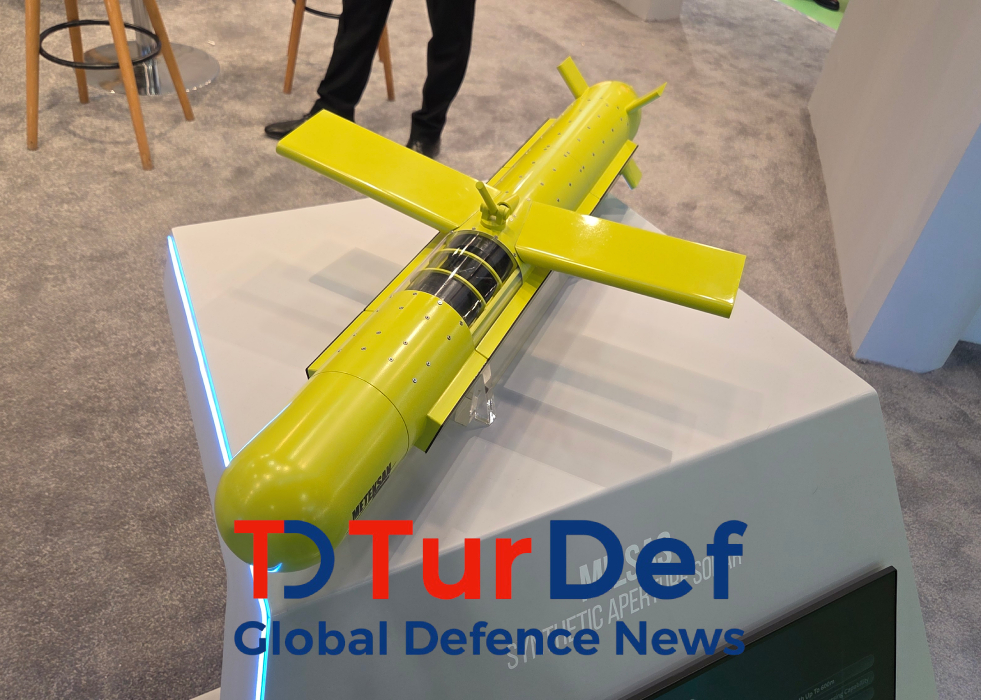
Meteksan Defence unveiled the MİLSAS (Synthetic Aperture Sonar) system, developed under the coordination of the Secretariat of Defence Industries’ R&D Department and with Meteksan as the main contractor, during SAHA Expo 2026.
The project transfers Meteksan’s synthetic aperture imaging experience from airborne radar systems into the underwater domain. The company previously developed the MİLSAR synthetic aperture radar system for airborne platforms and is now applying similar signal-processing and synthetic aperture imaging know-how to acoustic-based underwater imaging.
Although radar and sonar operate in different physical environments and use different wave types, both Synthetic Aperture Radar (SAR) and Synthetic Aperture Sonar (SAS) rely on closely related signal-processing principles, including aperture synthesis, coherent processing, beamforming, Doppler and phase analysis, image reconstruction and target discrimination. In the case of SAS, acoustic signals are processed in a manner conceptually similar to radar-based synthetic aperture imaging in order to generate high-resolution seabed imagery.
Using Synthetic Aperture Sonar (SAS) technology, MİLSAS is designed to generate seabed imagery with a resolution below four centimetres at longer operating distances. SAS technology enables significantly higher-resolution seabed imaging compared to conventional side-scan sonar systems. The capability is expected to support mine detection and other critical underwater operations.
The system combines wide-area seabed scanning with artificial intelligence-supported automatic target detection capability for underwater search and identification missions. According to technical data shared during the exhibition, MİLSAS offers a scanning range of up to 300 metres, can operate at depths between 0 and 600 metres, and is designed to perform missions at speeds ranging from two to eight knots.
The system features a modular architecture allowing integration onto both towfish platforms and autonomous underwater vehicles (AUVs), supporting flexible deployment across different underwater mission profiles.
Potential operational areas include mine countermeasure missions, port and critical infrastructure protection, seabed mapping, search and rescue operations, and underwater reconnaissance and surveillance tasks.
The project is expected to contribute to Türkiye’s indigenous underwater surveillance and mine warfare capabilities while expanding the domestic ecosystem for autonomous underwater systems and advanced seabed imaging technologies.
Meteksan stated that the project is scheduled for completion in the final quarter of 2027.
Author: Özgür Ekşi