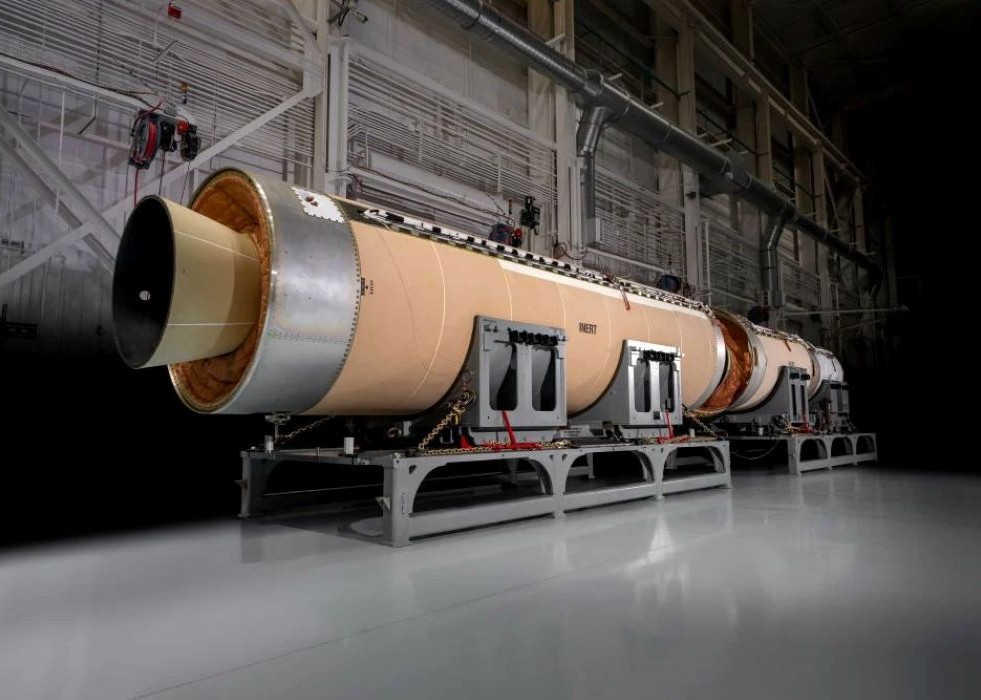
The United States Air Force has reiterated its commitment to the LGM-35A Sentinel intercontinental ballistic missile programme, framing recent technical progress as evidence of forward momentum. Yet this narrative sits uneasily alongside a programme still grappling with cost overruns, delays and structural uncertainty.
In February 2026, the Air Force formally reset the programme’s schedule, targeting a first test launch in 2027 and initial operational capability in the early 2030s, according to Air & Space Forces Magazine. This revised timeline followed a critical Nunn–McCurdy breach triggered by significant cost growth, which forced the Pentagon to revalidate the programme and restructure its acquisition framework.
The restructuring process, expected to conclude by the end of 2026, has already reshaped key assumptions. Instead of refurbishing legacy Minuteman III silos, the Air Force is now moving toward building new infrastructure, reflecting the scale of technical and cost uncertainties embedded in the original design.
Despite this reset, official messaging has shifted toward acceleration. Recent statements from both the Air Force and industry emphasise “progress” and “momentum,” highlighting component-level advances and infrastructure prototyping. However, these developments unfold against a backdrop of persistent programme risk.
Independent assessments paint a less optimistic picture. The U.S. Government Accountability Office (GAO) indicates that Sentinel is already years behind its original schedule, with early projections placing the first full flight no earlier than 2028. Software development delays and system integration challenges continue to pose “significant risks,” potentially extending reliance on the ageing Minuteman III fleet well beyond previously planned timelines.
This divergence between official timelines and oversight assessments defines the programme’s current trajectory. Sentinel is no longer advancing along a stable development path; it is being rebuilt while development continues.
Yet the programme’s trajectory is not driven solely by technical considerations. As the land-based leg of the U.S. nuclear triad, Sentinel occupies a position that makes cancellation politically and strategically implausible. Even as costs rise and timelines shift, the programme continues to advance—not because its risks have been resolved, but because its role within the broader deterrence architecture leaves little room for reversal.
In this sense, Sentinel reflects a form of strategic lock-in—one in which the United States can neither stabilise the programme quickly nor step away from it. It proceeds not as a stable acquisition effort, but as a system that must be completed regardless of the growing complexity—and cost—surrounding it.
Author: Özgür Ekşi