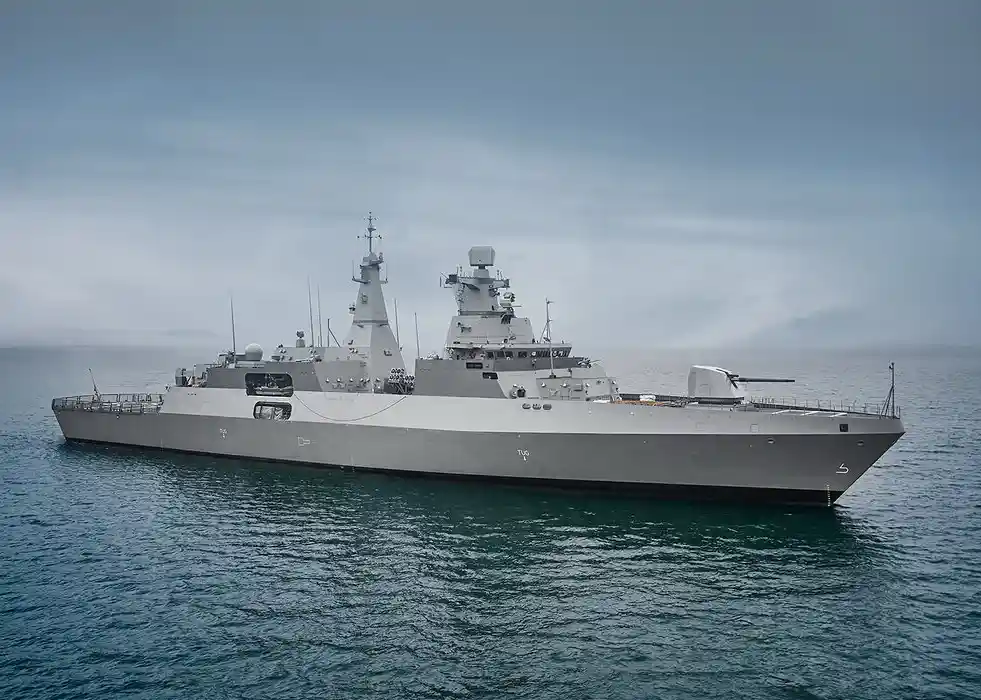
With the retirement of the EAV-8B Harrier II approaching and no apparent plans for F-35B, Spain has announced the plans for a catapult-fitted aircraft carrier.
Infodefensa reported that Spanish Navantia is working on the feasibility studies of a CATOBAR aircraft carrier to be accompanied by LHDs.
The carrier is being considered with a conventional powerplant instead of a nuclear one, somewhat like the ski jump-fitted carriers around the world.
The rough sketch of the feasibility study points out a platform carrying a combat wing consisting of up to 30 combat aircraft. Multiple options lie before Spain for CATOBAR fighters, including French Rafale M, U.S.-made F-35C, and F/A-18E/F Super Hornet. Doubts on fourth-generation fighter survivability in the next decade and Spain’s silence on F-35B
This marks the third European country to call for an aircraft carrier to serve the next decades after France (Working on PA NG) and Italy (Pursuing a nuclear-powered one).
The recent call for NATO countries to increase defence spending to five per cent of their GDP might become a catalyst for the funding of the aircraft carrier.
Future of LHD Aviation Wing
While an aircraft carrier is in the works, the EAV-B Harrier II VSTOL attack aircraft of the Juan Carlos I (L61) LHD will be retired soon. This necessitates a new aviation wing for the LHD.
The potential future aviation wing might consist of F-35B (On which no plans have been announced) and UCAVs with the capability to support anti-submarine missions and perform early warning.
For the UCAV part, Spain is considering SIRTAP, on which Airbus and Navantia are cooperating. However, alternatives like Bayraktar TB3 might be brought up, considering the UCAV has performed 100+ sorties from TCG Anadolu (L400) LHD based on Juan Carlos itself. Additionally, Bayraktar TB3 has a growth potential for the non-combat missions mentioned earlier. During the Paris Airshow, Baykar-Leonardo JV LBA Systems displayed the marine UCAV with ULISSES sonobuoy processing system, and it is safe to assume more powerful radars than Osprey 30 (Integrated on Polish Air Force Bayraktar TB2s) can be fitted.
Author: Kaan Azman
Editor: Özgür Ekşi