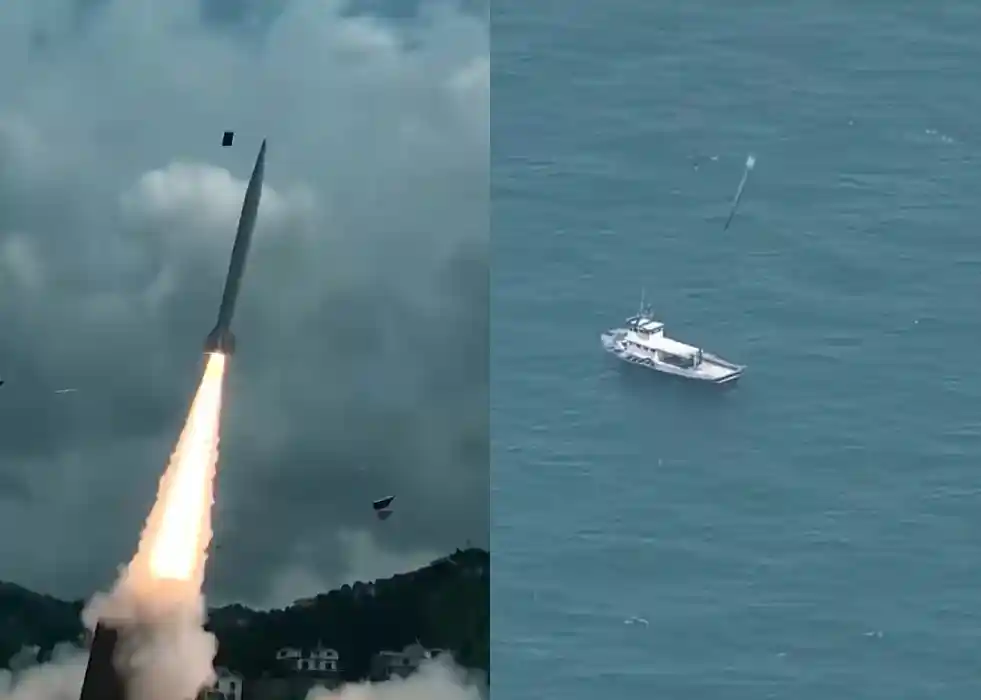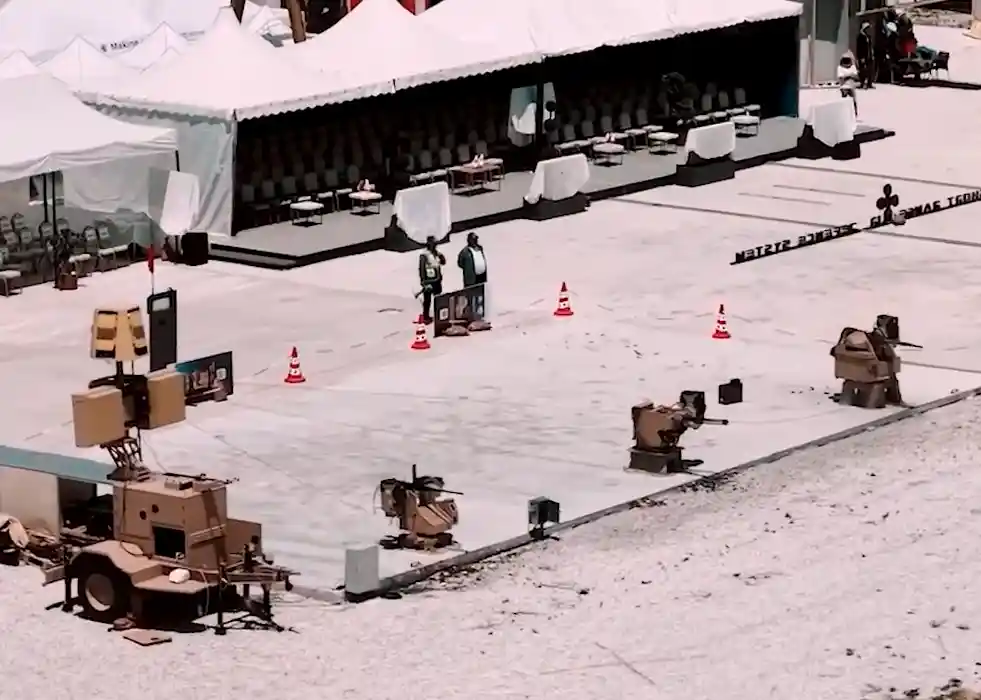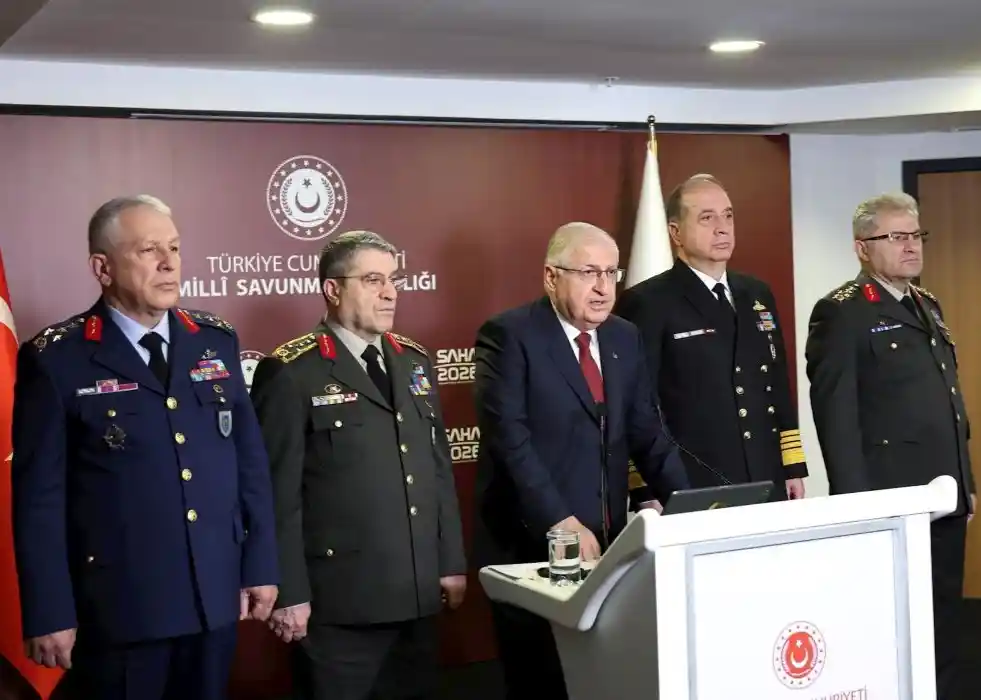
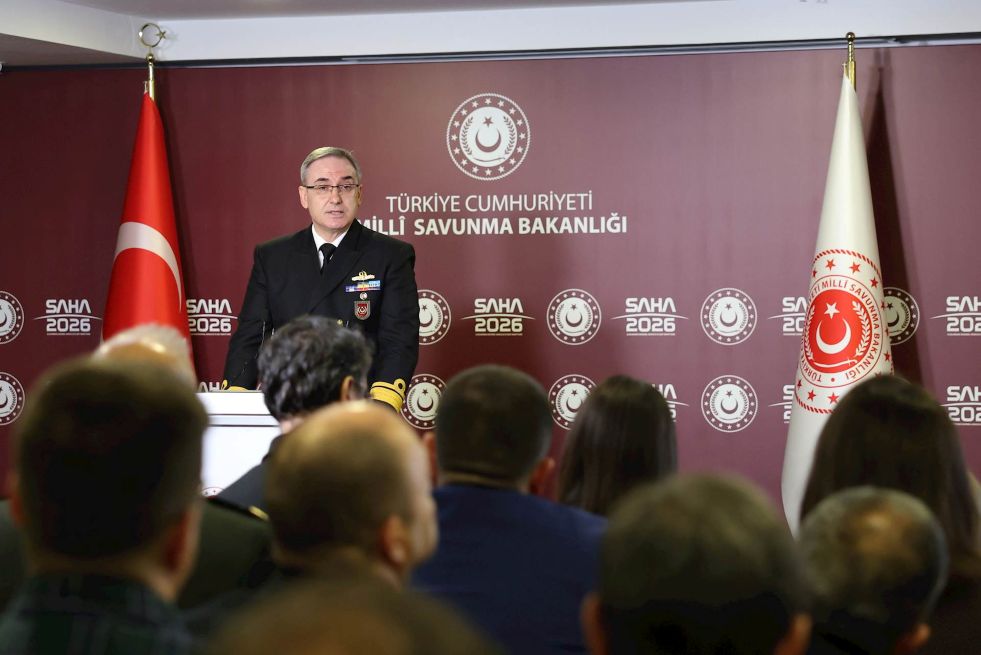
The Turkish Ministry of National Defence held its Weekly Press Briefing at the ongoing SAHA 2026 Defence, Aerospace and Space Industry Exhibition in Istanbul. The briefing effectively served as a public show of institutional support for two strategic projects that had already become one of the exhibition’s biggest talking points inside the defence sector.
Turkish Minister of National Defence Yaşar Güler attended the briefing alongside Chief of the General Staff General Selçuk Bayraktaroğlu, Commander of the Naval Forces Admiral Ercüment Tatlıoğlu, Commander of the Air Forces General Ziya Cemal Kadıoğlu and Commander of the Land Forces General Metin Tokel. Rather than leaving the issue solely to ministry spokespersons, Güler personally provided detailed remarks on the YILDIRIMHAN Long-Range Missile and the GÜÇHAN Turbofan Jet Engine programmes.
The two systems came as a surprise during SAHA 2026 as neither programme had previously been publicly known. Their sudden appearance also triggered widespread discussion inside the sector over how, where and by whom such projects had been developed under extraordinary secrecy.
“As the Ministry of National Defence, we began our work on liquid-fuel rocket engines and aircraft engine technologies many years ago,” Güler said. “With the technology base established within our Ministry’s R&D Centre two years ago, we have elevated these efforts to a more advanced level.”
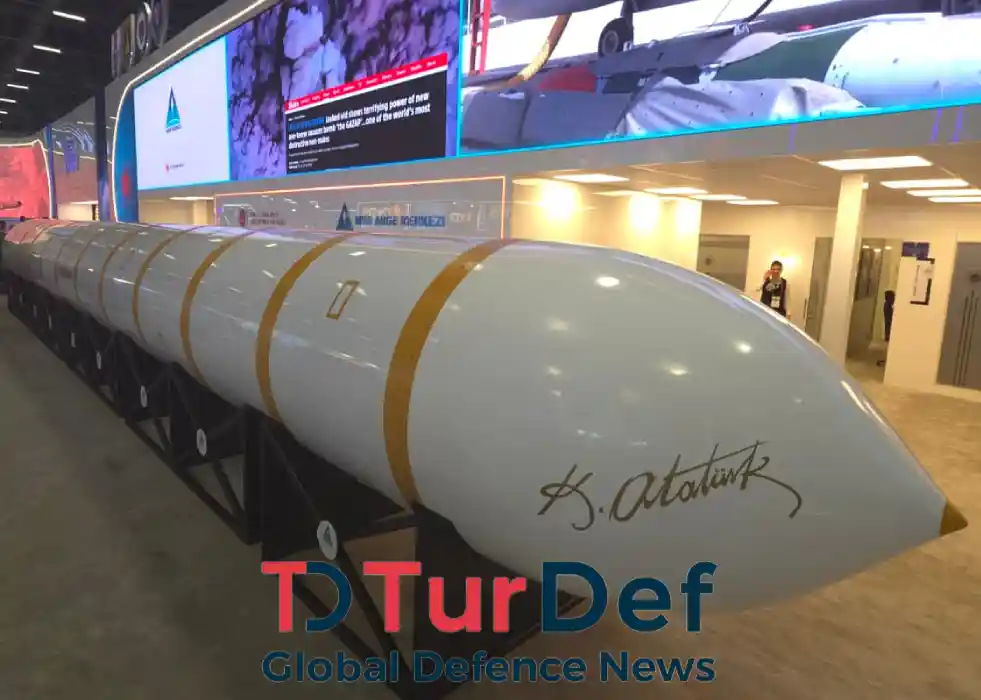
According to Güler, the YILDIRIMHAN missile represents “an important technological milestone” as Türkiye’s first liquid-fuel missile system capable of hypersonic flight and its longest-range missile programme to date. The Ministry revealed that the missile is designed to reach speeds of up to Mach 25 and strike targets at ranges of up to 6,000 kilometres. Minister Güler added that laboratory testing had already been completed successfully and that field testing would begin in the coming period.
Güler also announced that the GÜÇHAN Turbofan Jet Engine was a national jet engine developed entirely by the Ministry of National Defence R&D Centre. He stated that all critical components were domestically produced and that six engines had already been manufactured. Testing and calibration activities are planned to begin in November 2026.
“Our main objective is to reduce foreign dependency in critical technologies, improve our own engineering capabilities and establish a sustainable national infrastructure while guiding our defence industry companies,” Güler added.
Rear Admiral Zeki Aktürk, Press and Public Relations Advisor and Ministry Spokesperson, stated that the Ministry approaches the defence industry not only as a user, but also as a technology developer and strategic driver.
According to Aktürk, the Ministry’s long-term R&D activities resulted in the establishment of critical production infrastructure, advanced laboratories and high-precision manufacturing capabilities within the institution.
For the YILDIRIMHAN missile system, Aktürk stated that asymmetric dimethylhydrazine (UDMH) and nitrogen tetroxide-derived liquid fuels used by the missile were domestically developed by the Ministry’s R&D Centre. He noted that the fuel technology offers long-term storage capability, operation in low temperatures and high-energy generation, giving missile systems enhanced manoeuvrability.
The missile is designed to carry a three-ton warhead. Laboratory testing processes have already been completed successfully, while preparations for field testing are continuing according to schedule.
On the GÜÇHAN programme, Aktürk stated that the engine was designed with indigenous engineering solutions tailored to Türkiye’s operational needs and developed to reduce external dependency in critical technologies while establishing sustainable national capabilities.
He added that the engine uses single-crystal technology to improve resistance against high temperatures and intensive operating conditions, resulting in gains in efficiency, performance and service life. The engine is designed to produce 42,000 lbf of thrust, and six engines have already been manufactured. Qualification tests are planned within this year.
TurDef learned that both programmes had been developed under extraordinary secrecy. A source speaking to TurDef compared the Ministry’s role to a “pace setter” in athletics competitions. According to the source, the Ministry does not seek to compete with defence companies inside the sector, but rather to accelerate development across the sector, provide technological know-how and help push the broader ecosystem forward.
The Ministry’s R&D organisation had previously appeared publicly for the first time at IDEF 2025, attracting attention with the NEB-2 Hayalet and Gazap munitions programmes.
Aktürk also stated that the Ministry’s R&D Centre was displaying several additional systems at SAHA 2026, including:
- the GÖLGEHAN jammer system with wide-area effect and spectrum denial capability,
- the YILDIRIMHAN hypersonic long-range missile,
- the Turkish Defence Minister Yaşar Güler personally addressed growing industry debate over the YILDIRIMHAN ICBM and GÜÇHAN turbofan engine projects at SAHA 2026. turbofan aircraft engine,
- the ONUR turboshaft helicopter engine, and
- the PNR-53 SNIPER weapon system, described as the lightest weapon in its calibre category with a maximum range of 2,100 metres.
State-owned defence company MKE is also introducing more than 50 new products at the exhibition, including:
- the 105 mm URAN vehicle-mounted howitzer,
- the ATTİLA 155 mm vehicle-mounted howitzer,
- the ALPAY-2 mine-clearing system,
- a .300 Blackout rifle,
- 7.62 mm anti-drone ammunition,
- and new components integrated into the TOLGA Close-In Air Defence System, including an acoustic detection system, laser weapon system and the ENFAL-17 missile.
Several agreements and memoranda were also signed during the exhibition. These included:
- a CBRN protective material supply contract,
- procurement agreements for MOD184 multi-purpose artillery fuzes and MOD135 proximity fuzes,
- a contract with ASFAT for the supply of four DENİZHAN national naval guns,
- a memorandum with Hungary-based HT Division for integration of the TOLGA air defence system onto unmanned ground vehicles,
- and a memorandum with Azerbaijan-based Miras Military Industrial Company for BMP-1 armoured vehicle modernisation.
In addition, ASFAT and Italy’s Magnaghi Aerospace signed a letter of intent for joint production of the SkyArrow aircraft platform. A separate contract was also signed for the procurement of 27 ZAHA Marine Assault Vehicles (MAV) for the Turkish Naval Forces.
Author: Özgür Ekşi