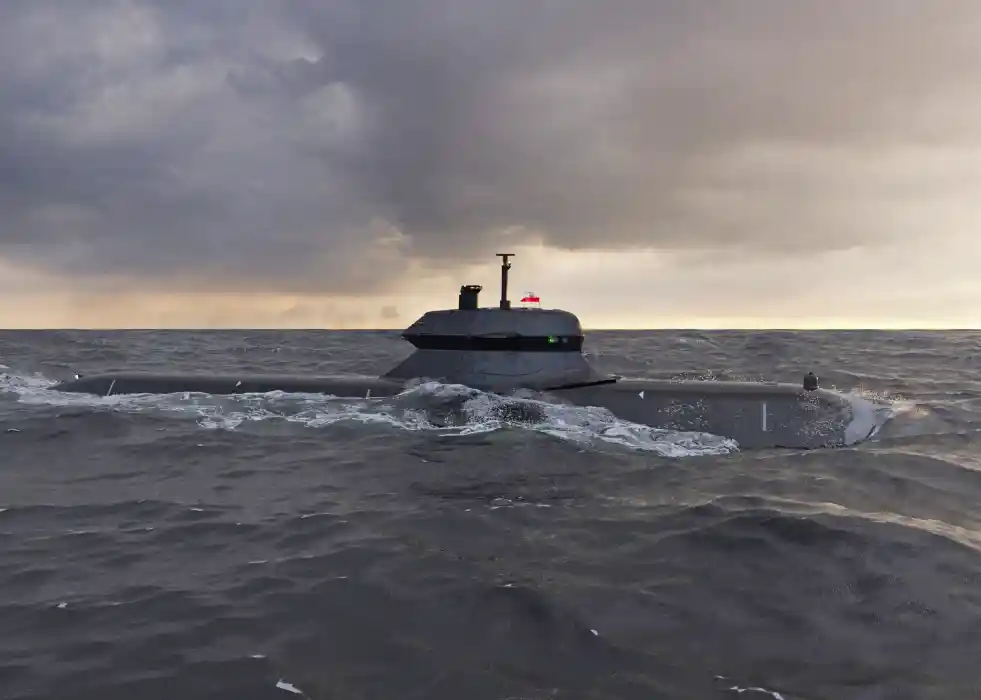
The strike on the Kilo-class submarine adds a new layer of threat on the Russian Navy’s end, not on top of but below Ukraine’s existing fleet of armed USVs.
Ukraine used the ‘Sub Sea Baby’ kamikaze UUV to hit a docked Kilo-class submarine, causing significant damage and presumably knocking the submarine out of action. While the ‘Sub Sea Baby’ name is new, it might be a re-designation of the previously unveiled Marichka kamikaze UUV. Sea Baby is more widely known as the name for Ukraine’s family of armed USVs, which currently come in kamikaze, RCWS, and MLRS variants.
Marichka kamikaze UUV was unveiled in a test footage, and was seen to be identical in size to heavyweight torpedoes. The explosion from the footage of the attack on the Russian submarine confirms that the UUV indeed has a comparable yield to conventional torpedoes, enough to damage medium-sized vessels critically.
When pitted against heavyweight torpedoes employed by submarines, a large kamikaze UUV is not exactly a fit for torpedo tubes, but can be launched from any suitable shoreline or mothership.
In terms of engagement, a torpedo can hit speeds of 50+ knots and ranges up to 50 km. On the other hand, a kamikaze UUV has limitations on the former but has a potentially far longer range thanks to more efficient propulsion. In addition to this, a UUV can be set to sit silently at depth for the best moment to strike, somewhat like a mobile mine.
Thus, kamikaze UUVs carrying significant explosive payloads can be regarded as a kind of threat that will take a new structure of continuous underwater surveillance and defence, especially at less guarded ports. This requirement draws a parallel to the efforts of European countries for better surveillance against seabed sabotage, believed to be conducted by Russia, which has caused large-scale communication outages in some cases.
Author: Kaan Azman
Editor: Özgür Ekşi