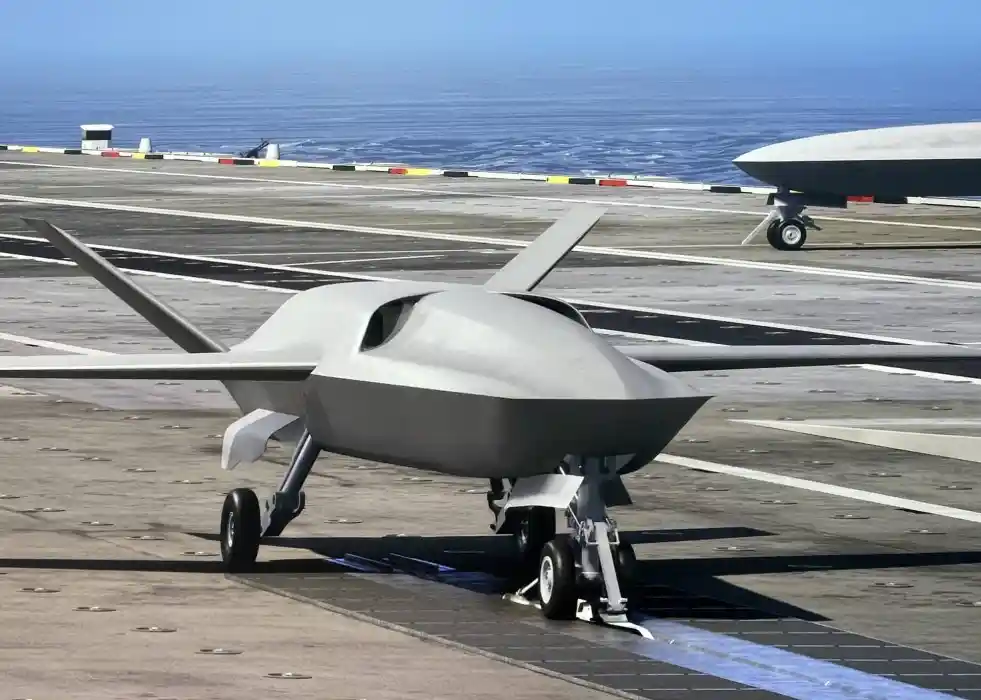
Following the start of US Air Force CCAs’ prototype testing, the US Navy has signed contracts with four firms for conceptual development of carrier-based CCAs.
The War Zone reported that the US Navy has signed deals with Northrop Grumman, General Atomics, Boeing, and Anduril for the conceptual development of carrier-based CCAs. At the same time, Lockheed Martin is responsible for the development of a common control system.
The contracts have come not too long after the start of flight tests with General Atomics’ YFQ-42’s maiden flight. Anduril’s high-speed prototype YFQ-44 is expected to follow.
MQ-25 Stingray unmanned tanker could be counted as a step towards the Navy’s CCA goals as a way to familiarise the personnel with carrier-borne UAVs to support manned aircraft logistically.

General Atomics with a Head Start
While it is early to talk about which firms have a more advantageous position, the attention that General Atomics has given to carrier-capable UAVs should not be ignored. The firm has shown that it is studying the operation of multiple UAV types from EMALS-fitted aircraft carriers during exhibitions.
More importantly, General Atomics is the developer of the US Navy’s EMALS catapult, which has succeeded the steam-driven ones. Being a developer of both platforms and the launch system itself could be considered a significant head start in the run for Naval CCAs in terms of analysis and testing.
So far, General Atomics has proposed a carrier-based HALE UCAV (MQ-20 variant or Gambit 1) and the high-speed Gambit 5 with a low observable design to support air-to-air missions.
Northrop Grumman and Boeing as F/A-XX Contenders
On the other hand, it is also important to ensure compatibility with not only F/A-18E/Fs and F-35Cs but also the future F/A-XX fighter, which will be the generation-mate of F-47.
With this in mind, Northrop Grumman and Boeing might come up with designs that can keep up with their respective F/A-XX submissions in terms of flight performance and low observability, even though not payload or sensor potency. The idea of having a higher-end UCAV that is meant to fight on the frontlines with considerable flight performance is already something receiving investment in other countries such as China, Turkiye, and Sweden.
Author: Kaan Azman
Editor:Özgür Ekşi