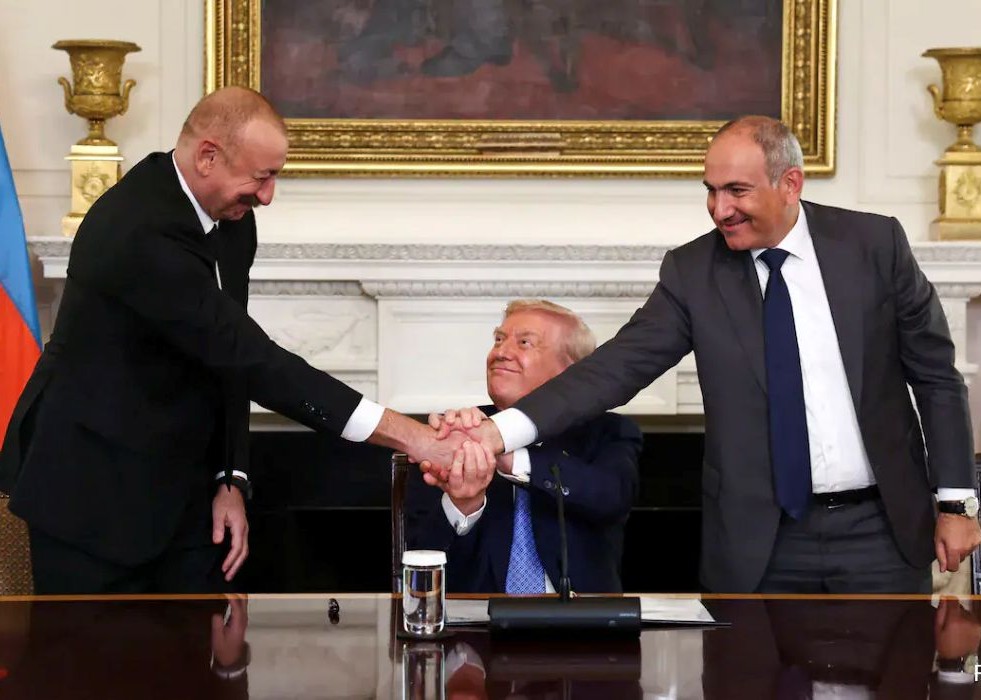
Aliyev and Pashinyan sign a historic deal at the White House that reopens the Zangezur transportation corridor and promises to end decades of warfare in the Caucasus.
On Thursday, President Ilham Aliyev of Azerbaijan and Prime Minister Nikol Pashinyan of Armenia signed a historic peace pact in the White House. Donald Trump, the President of the United States, hosted the event. The purpose of the deal is to end decades of armed conflict for good, restore travel, trade, and diplomatic ties, and reopen vital transit routes between the two countries.
Trump called the long-awaited pact a "breakthrough" that will "reopen vital transport corridors" and give the US more power in the area. The deal said that both parties would "permanently" stop fighting and start talking to each other again.
Aliyev declared, “We are establishing peace in the Caucasus. We have lost years to war, occupation and bloodshed.” Pashinyan described the agreement as “an important turning point” in bilateral relations.
A central element of the deal is the construction of the Trump Route for International Peace and Prosperity (TRIPP) — a major transport corridor linking Azerbaijan to its Nakhchivan exclave via southern Armenia. The US will provide assistance and hold exclusive development rights. The Zangezur Corridor, long a source of dispute, previously stalled peace efforts due to disagreements over control: Azerbaijan demanded authority, while Armenia insisted on retaining its own administration.
According to the BBC, the development reflects Washington’s bid to curb Russian influence in the Caucasus. Russian President Vladimir Putin, once the lead mediator in previous talks, was sidelined in this agreement — despite having drafted earlier peace texts.
Iran’s reaction was confusing. While its foreign ministry welcomed the peace deal as a step towards stability, senior adviser Ali Akbar Velayati warned Tehran would oppose any foreign-controlled corridor near its borders. He suggested recent military exercises in northwest Iran signalled readiness to prevent “geopolitical changes” in the area.
The TRIPP corridor is expected to boost regional energy exports and strengthen links between Azerbaijan, Nakhchivan and Turkiye, but Iran’s warning adds uncertainty to a plan already loaded with strategic significance.
Author: Özgür Ekşi