Following the US's current criticism of Europe, the EU has begun investigating new military alternatives, with India, a leader of the non-aligned, as its first stop.
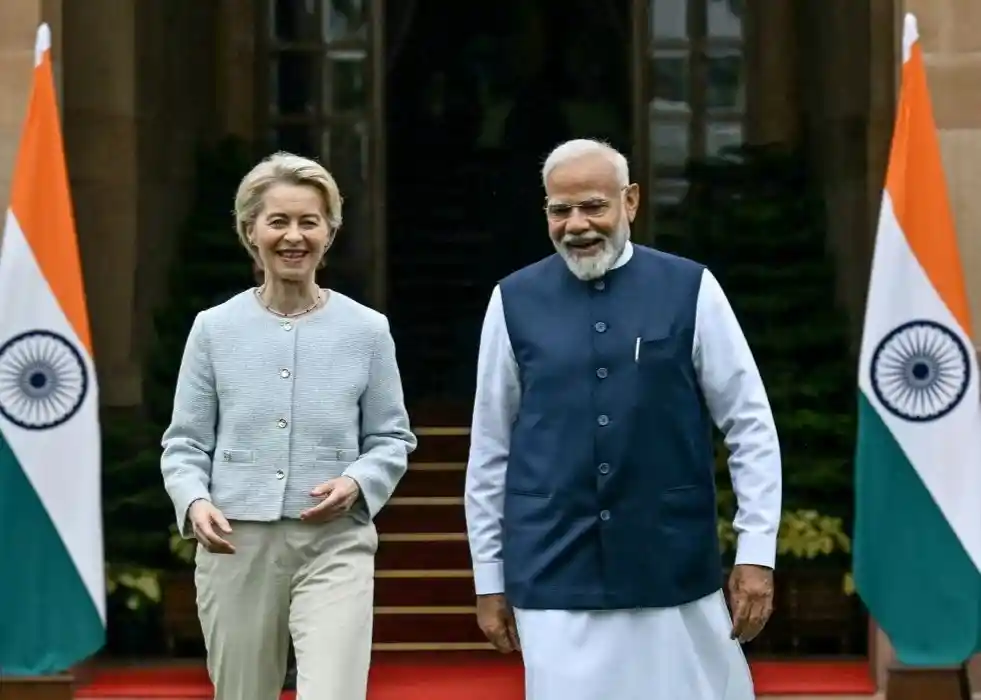
European Commission President Ursula von der Leyen indicated on Friday that the European Union is investigating a security and defence relationship with India ahead of her meeting with Prime Minister Narendra Modi in New Delhi.
Along with a group of commissioners, von der Leyen landed in India on Thursday for a two-day visit as the EU tries to reinterpret its worldwide alliances in reaction to growing tensions with its old friend, the United States. The visit tracks Washington D.C.'s most recent critiques of Europe and its attitude towards world security.
Multiple geopolitical objectives drive the EU's interaction with India, especially in terms of combating China's increasing influence in the Indo-Pacific, bolstering strong supply networks, and redefining the governance of developing technologies such as artificial intelligence. With trade worth €124 billion ($130 billion) in 2023, the EU is still India's top trading partner, making up more than 12% of its whole trade. Still, India's highly protected market accounts for just 2.2% of the EU's trade-in products. While India wants more EU investment in clean energy, urban infrastructure, and water management, the bloc wants a trade deal lowering entrance barriers.
Because it is a key partner in the Non-Aligned Movement, India is an important partner in the geopolitical affairs of the globe. Throughout its history, India has maintained a stance of strategic autonomy despite its dependence on Russia for military hardware. This has made it difficult for India to comply with Western calls to break off its connections with Moscow following the conflict in Ukraine. By implementing the "Make in India" initiative, New Delhi has increased domestic production while diversifying its defence purchases. This has strengthened connections with France, the United States of America, and Israel.
Engaging India offers the EU a chance to build a defence and security alliance with a country that is more of a balancing actor in world affairs than fully aligned with the West or hostile. Although the EU mission also aims to progress trade and investment agreements, talks are anticipated to cover more general geopolitical issues, including regional security dynamics and the situation in Ukraine.