Europe’s two pillars, NATO and the European Union, tend to join forces against their “common enemy”, Russia. EU Defence Commissioner Kubilius visits NATO.
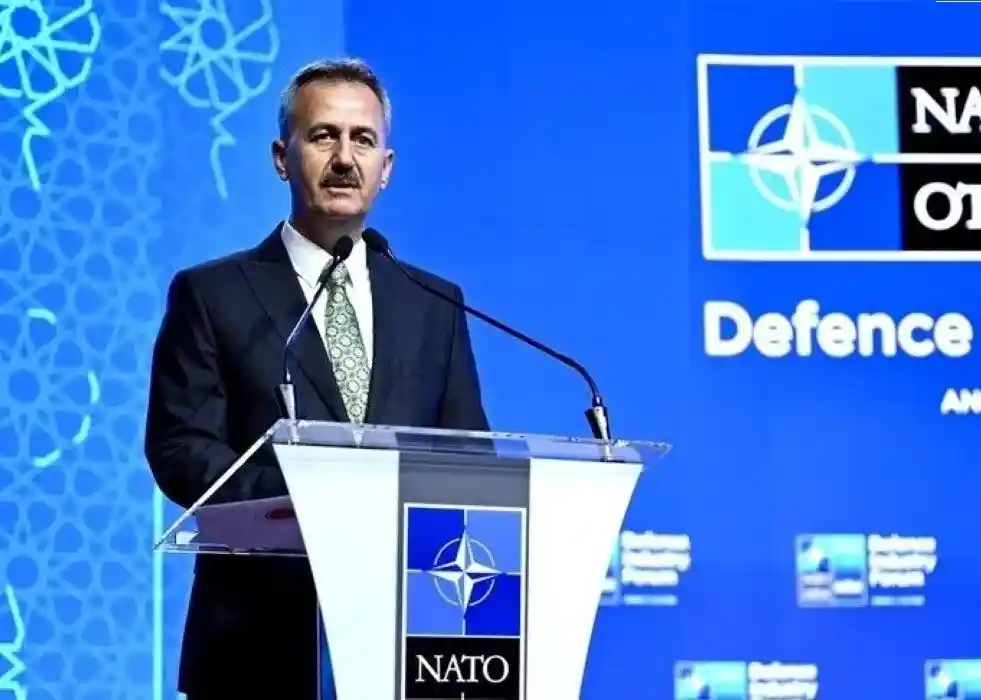
On Monday, Secretary-General Mark Rutte welcomed Andrius Kubilius, the new European Commissioner for Defence and Space, to NATO Headquarters for a meeting with Allies in the North Atlantic Council.
Secretary-General Rutte stated that these interactions are crucial for promoting openness and political dialogue between NATO and the European Union. He also pointed out that they give EU leaders the opportunity to hear directly from non-EU allies. He emphasised that increasing defence production is more important than ever to fulfil promises to Ukraine and ensure own deterrence and defence.
Secretary General expressed his support for the European Union’s efforts to improve the readiness of European defence and strengthen the military-industrial base. He acknowledged that the transatlantic defence sector is closely connected and that there is a special chance to determine the future of our collaboration.
Commissioner Kubilius delivered a speech at the North Atlantic Council.
He said in sum:
“We should have no doubt about Russia’s war aims.
If you listen to Putin and his propagandists, war aims go well beyond Ukraine.
And include annexation and occupation of parts of Europe.
And the domination of the rest.
And we are facing not only an aggressive Russia. North Korea and Iran are on the same Axis of Aggressive Authoritarians. China is not far away.
We are already under threat.
Disinformation. Weaponisation of migrants.
Dear Mark, As you have convincingly stated, Russia will have the military means to confront NATO in five short years.
We can still deter Russian aggression in Europe.
First, by supporting Ukraine. And by supporting the integration of EU and Ukrainian defence industries.
It is for NATO and Member States to assess military needs and set targets. And 23 of them do so here at NATO.
And the European Union will support it. We can bring our added value.
By mobilising our budget and industrial and regulatory clout.
We are now preparing a White Paper on the Future of European Defence.
We want the EU to help our Member States to enhance their defence readiness.
This means helping members of the EU to fulfil NATO capability targets.
Not in twenty years’ time as planned, in 2044.
But in the next five years, by 2030.
And that’s why I thank you for releasing NATO standards to the EU institutions.
I know for you this was an unprecedented step.
I count on much more intense cooperation with NATO.
We need to accelerate our cooperation.
And find pragmatic ways to increase information sharing. Including the aggregated numbers of NATO capability targets. In order for us to have an industrial “Victory Plan”.
In closing, let me return to Jean Monnet.
There are also big differences between Jean Monnet, and ourselves.
When Jean Monnet helped to mobilise United States industry for victory, war had already broken out.
His own country had already been overrun.
Unlike Monnet, we still have some time to prevent a major conflict.
And another big difference:
We have the European Union.
We have NATO.
The European Union is the biggest single market in the world.
And NATO is the largest defensive military alliance in the world.
We want to make the EU – NATO partnership even stronger.
Editors Note: Europe’s defence is being reshaped in Brussels
European Union was established with the idea of interdependency within European countries to prevent another war on the continent following the Second World War. The idea belonged to former French Prime Minister Robert Schuman and economist Jean Monnet. The Shuman Declaration, which laid the foundation of the future European Union, was the fruit of their cooperation. Today, Place Shuman, in the city centre, is the home of the European Building, the Council of Europe and the Berlaymont Building, where the European Union commissions are situated.
The NATO headquarters in Europe was first founded in Paris. Following French resistance to NATO’s nuclear policies, France left the military side of Europe. NATO was forced to evacuate Paris. The next headquarters was established at Boulevard Leopold III, in north Brussels, 20 km from the city centre.
The European Union, which avoids any defence investment, and NATO, which was established to provide the alliance's defence, were almost next to each other without valid communication.