The awaited testing phase for the KAAN fighter jet with more rigorous tests is about to start in 2026, with the unveiling of the two new prototypes, P1 and P2.
KAAN programme, as a long-term run, is entering a new lap with the follow-up prototypes to the P0 prototype used in the maiden flight performed about two years ago. TUSAŞ has unveiled the two prototypes, P1 and P2, during the visit of Secretary of Defence Industries Haluk Görgün.
Changes on New Prototypes
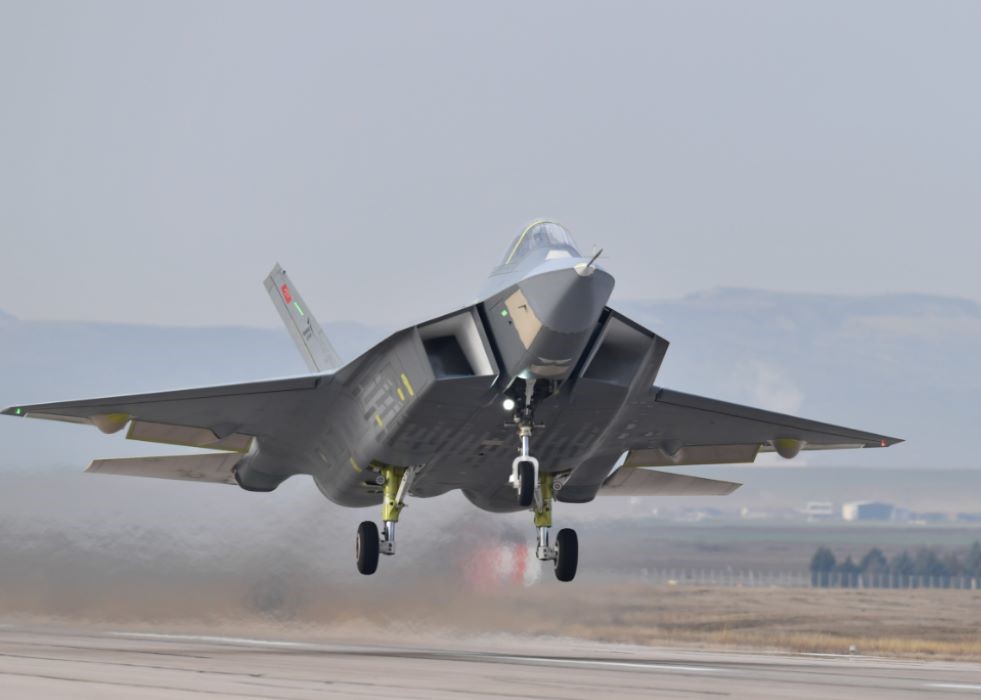
The new prototypes for KAAN have some observable changes to accommodate the high-octane (Literally and figuratively) testing schedule compared to P0’s, in terms of structure and provisions.
Firstly, the fuselage appears to have some changes to increase the useful volume for onboard systems, such as a widened mid-section and a reworked frontal section. It is known that KAAN’s new prototypes will be a meter shorter at about 20 m compared to the first.
Secondly, a new placement for the landing gears can be seen, which significantly increases the useful area at the lower mid-section. This is important to provide as much volume as possible for the internal weapon bays.
Air intake design changes are possible, which were previously hinted at by TUSAŞ CEO Mehmet Demiroğlu. Ramp intakes of KAAN with S-ducts inside will be important for both supersonic flight and low observability features.
Additionally, some sensor integrations might take place on the new prototypes, as suggested by the radome being more like a working radome with lightning strips and less like a mockup. It is no secret that KAAN's avionics, some of them if not all, are being tested on a testbed platform.
It should be noted that this is not the end of changes in the prototype phase, as P4 to P6 are anticipated to have extra refinements, especially in terms of aerodynamics.
What Awaits the New Prototypes?
As stated before, P1 to P3 will go through a highly active flight test schedule with higher-end tests to assess the performance. This more than likely includes tests at high altitudes and supersonic speeds, as well as high G loads.
There will also be ground-based tests, such as static structural tests and lightning strike tests, the latter to be performed in cooperation with Hızal Elektroerozyon, which specialises in pulsed power systems.
The New Prototypes as New Pillars of Trust for the Market
Before the unveiling of the new prototypes, KAAN earned its first export customer, Indonesia, during IDEF2025 with an order for 48 fighters. In addition to this, Saudi Arabia has a significant level of interest in becoming a partner in terms of investment, as evidenced by the statements from the officials and the timing of TUSAŞ’s presentation at WDS2026.
The new prototypes are making their appearance, and performing the more advanced flight tests can be described as new pillars to support the trust from the existing and potential partners or customers for KAAN, which is a long run, as stated before.
Author: Kaan Azman
Editor: Özgür Ekşi