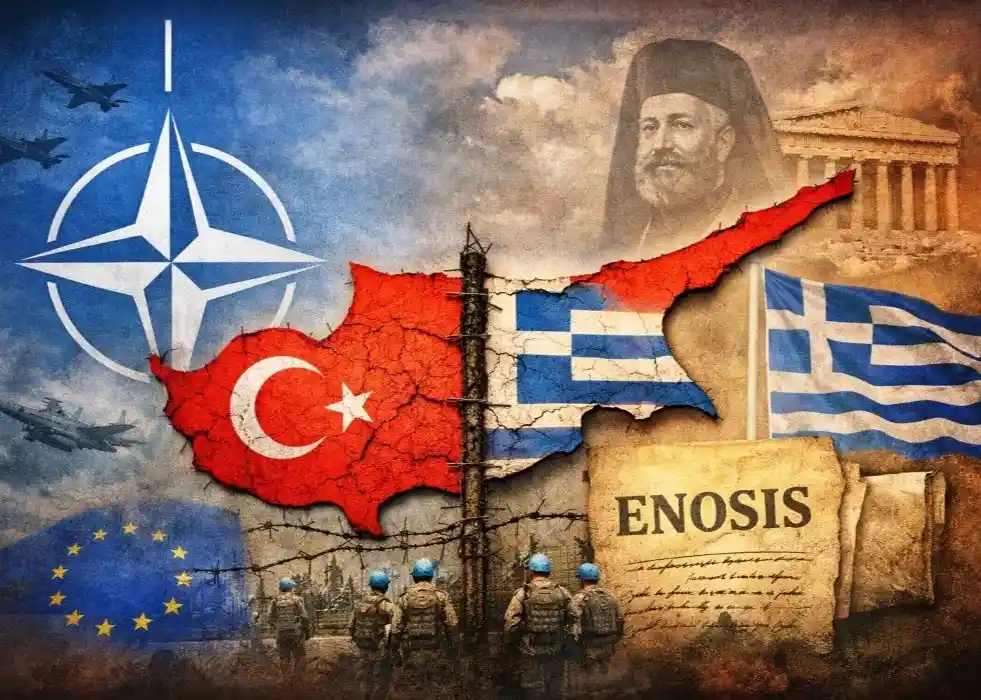
The Greek Cypriot Administration of Southern Cyprus (GKRY) signalling that it is ready to join NATO has reopened debate over the strategic implications of such a move in the Eastern Mediterranean. The leadership in Nicosia has in recent days stated that it would be prepared to pursue NATO membership, framing the idea primarily in terms of security cooperation and alignment with Western institutions.
At first glance, the proposal may appear to be a small state's search for stronger security guarantees. Yet when the recent history of Cyprus and the political relationship between Greece and the GKRY are taken into account, the discussion can also be interpreted through a different lens: a post-modern version of Enosis. Enosis refers to the political project advocating the union of Cyprus with Greece, an idea that became one of the central objectives of Greek nationalist policy during the twentieth century.
The present structure of the Cyprus issue dates back to 1974, when the military junta ruling Greece supported a coup on the island aimed at annexing Cyprus to Greece. The move was widely seen as an attempt to implement Enosis. Türkiye’s subsequent military intervention not only altered the balance on the island but also contributed to the collapse of the military regime in Athens. In the immediate aftermath, the Enosis policy appeared to have come to an end.
However, the concept itself did not disappear entirely; rather, its method evolved. While openly advocating Enosis has largely become taboo in Greek politics today, the level of political coordination between Athens and Nicosia often creates the impression that the two governments operate as a single political bloc in international forums.
One of the clearest examples of this dynamic emerged during the European Union accession process. Greece provided strong diplomatic backing for the GKRY’s EU membership bid, ultimately resulting in a decision that many observers argued contradicted the EU’s own membership criteria.
In 2004, a referendum was held under the framework of the United Nations plan associated with then Secretary-General Kofi Annan. The principle behind the arrangement was straightforward: if both sides approved the plan, the island would enter the European Union as a unified state. If either side rejected it, EU membership would not proceed.
The outcome was starkly asymmetrical. The Turkish Cypriot side approved the plan by a large majority, while the Greek Cypriot electorate rejected it by an equally decisive margin. Despite this, the European Union proceeded with accepting the GKRY as a member.
This decision also appeared to conflict with the EU’s stated requirement that candidate states should have resolved their border or territorial disputes with neighbouring countries. Some observers dismiss this contradiction on the grounds that the Turkish Republic of Northern Cyprus is not widely recognised internationally. Others frame the issue through accusations of occupation directed at Türkiye. Yet the same condition could also be phrased differently: the GKRY entered the European Union without resolving its fundamental political dispute with Türkiye.
The current discussion of NATO membership can therefore be viewed as an extension of this trajectory into the security domain. The fact that the issue has surfaced while the GKRY is holding the rotating presidency of the Council of the European Union is unlikely to be coincidental.
The administration in Nicosia is aware that its own military capacity and strategic weight are limited. Consequently, it has sought to expand its influence by leveraging its position within international institutions. Raising the idea of NATO membership during its EU presidency reflects this broader strategy.
A comparable pattern can also be observed in debates within the European Union on defence policy. Initiatives such as the SAFE programme, designed to strengthen Europe’s defence posture against Russia, have at times been viewed by some states as instruments that could also be used to advance regional political agendas. Greece has periodically been accused of attempting to utilise such financial and institutional mechanisms as a form of leverage against Türkiye.
Seen from this perspective, the proposal for the GKRY to join NATO cannot be explained solely by security concerns. Greece is already a member of the Alliance. If the GKRY were to join as well, the strategic decision-making environment of both actors within NATO structures would inevitably become more closely intertwined.
For this reason, it is possible to interpret the idea of GKRY membership not as a classical form of Enosis, but as a “post-modern Enosis”: a model in which direct political union is replaced by functional strategic integration through international institutions.
The Cyprus question is therefore not merely a dispute between two communities on the island; it is deeply embedded in the broader geopolitical balance of the Eastern Mediterranean. Türkiye may not always have succeeded in communicating its position effectively in the international arena since 1974. Yet treating current debates as though the events that shaped the island’s modern political reality had never occurred risks ignoring the historical context that continues to shape the issue today.
History rarely disappears from the Cyprus question. Any new proposal concerning the island inevitably carries the weight of a half-century of political and strategic legacy.
Author: Özgür Ekşi