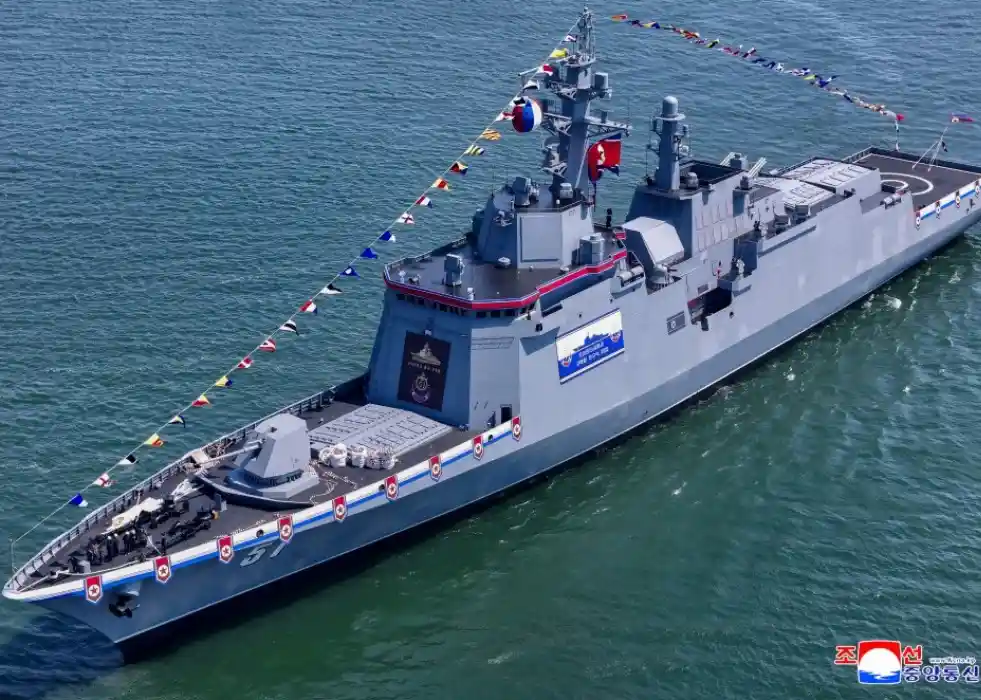
North Korea has launched its lead ship from the new class of frigates equipped with fixed electronically scanned array radars and three types of VLS cells.
The new ship was previously spotted under construction in 2024. Images from the launch ceremony give hints at the capabilities of North Korea’s new frigate.
The first attention-worthy aspect is the presence of fixed radars (Unknown if AESA or PESA type), something that the North Korean warships have lacked. They appear to be multi-function radars rather than search radars judging from size and possible range.
The unusual thing about the new frigate is the presence of three types of VLS cells with different diameters. The smallest ones will likely carry short-range air defence missiles, medium-sized ones carry long-range air defence missiles or cruise missiles, and the largest ones over the hangar will carry large-sized land-attack munitions like larger cruise missiles or even ballistic missiles.
Considering the grand strategy of North Korea being based on full throttle for land attack capabilities, this frigate might fit as a sea-based option alongside submarines while providing expanded air defence capabilities over the previous ships.
Russia and China might have provided some critical systems, such as radar or technology related to VLS cells.
Russia’s likeliness stems from having sufficient know-how on PESA radars and having developed its own VLS regarding technical terms. China is similar to Russia in technical ways.
While China has been a supporter of North Korea, Russia’s relations with the East Asian country have significantly tightened following the manpower and alleged munition contributions in the Russo-Ukrainian War. Providing a technology as valuable as shipborne fixed electronically scanned radars might have Russia written on in considering North Korea’s contributions alongside China.
Author: Kaan Azman
Editor: Özgür Ekşi