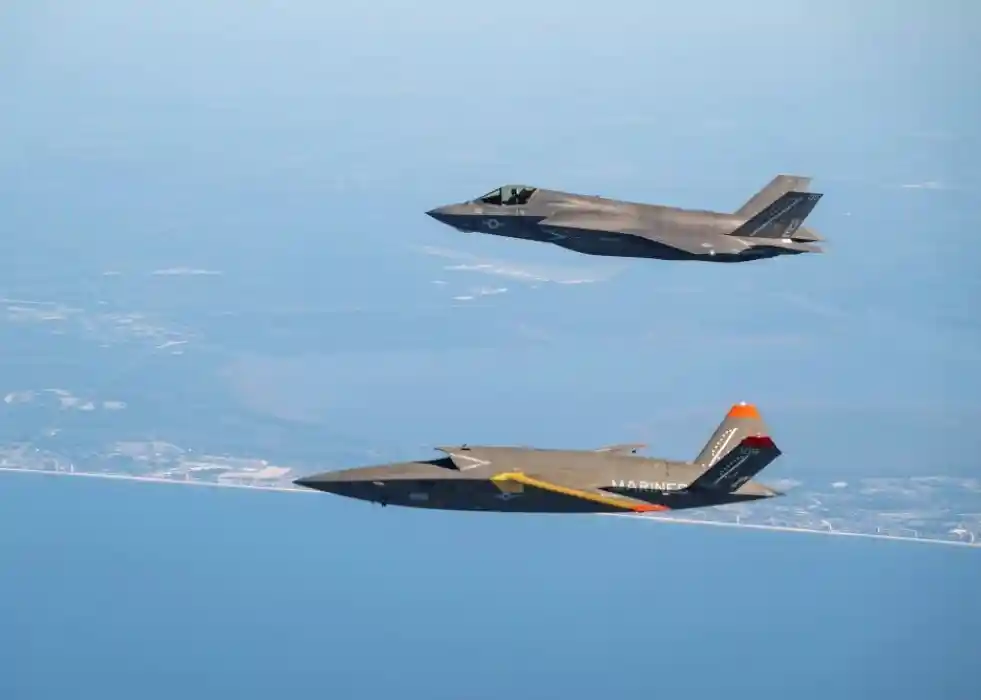
The United States Marine Corps (USMC) has chosen Northrop Grumman to work on its Marine Air-Ground Task Force Uncrewed Expeditionary Tactical Aircraft (MUX TACAIR) project. The goal of this project is to create a Collaborative Combat Aircraft (CCA) solution for future air operations.
Kratos Defence & Security Solutions will do the job, and the XQ-58A Valkyrie will be the basic platform. Northrop Grumman will supply an Advanced Mission Kit and its Prism open-architecture autonomy software. Kratos will supply the Valkyrie unmanned aircraft system.
The choice shows that the plan is to adapt an existing, flight-tested air vehicle for quick prototyping and operational testing, rather than starting a new aircraft development program from scratch.
US defence reporting described the effort as an OTA (Other Transaction Authority) arrangement with a publicly cited value of around $231.5 million, although this figure was not a focal point of the company announcements.
The Valkyrie-based path also reflects a wider pattern across CCA development efforts, where low-cost iteration and scale are balanced against requirements linked to survivability, electronic warfare resilience and weapons or payload integration.
Beyond the US effort, similar programmes are advancing in parallel. In Türkiye, Baykar’s KIZILELMA programme has drawn attention following a GÖKDOĞAN beyond-visual-range air-to-air missile test, signalling that long-range air-to-air weapon integration is emerging as a key milestone for fighter-class unmanned platforms. In Australia, Boeing’s MQ-28 Ghost Bat has been used in a test event involving an AIM-120 AMRAAM launch against an airborne target.
Author: Özgür Ekşi