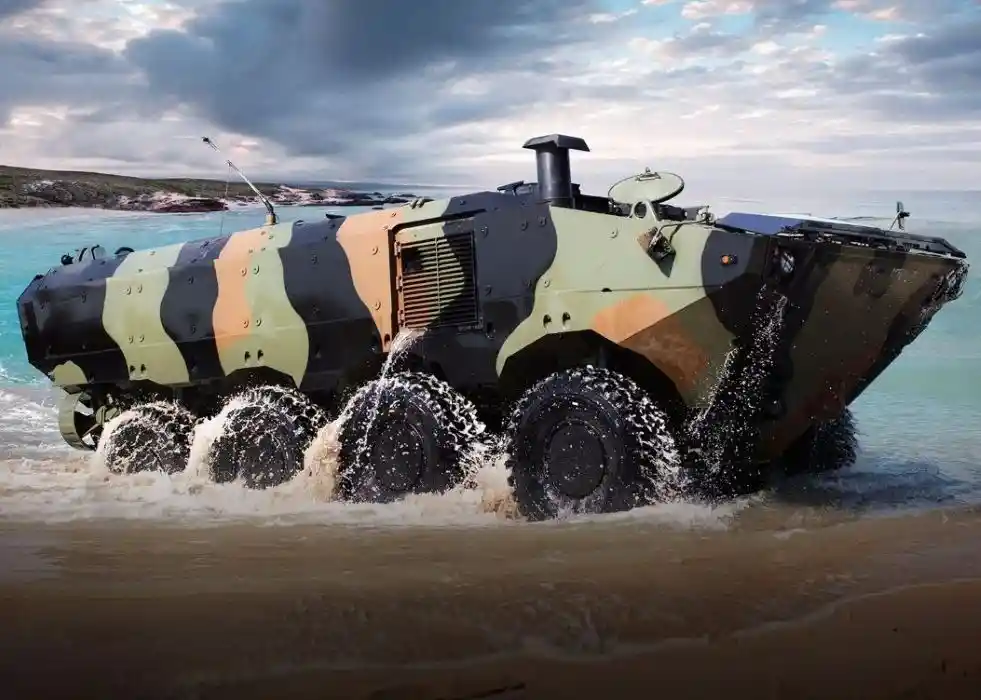
Spain is set to replace its legacy AAV-7 amphibious assault vehicles with the Italian-developed SUPERAV/VBA 8×8, marking a decisive shift not only in platform choice but in amphibious warfare doctrine. The move signals a transition from a shoreline-focused approach toward a model centred on speed, dispersion and operational reach after landing.
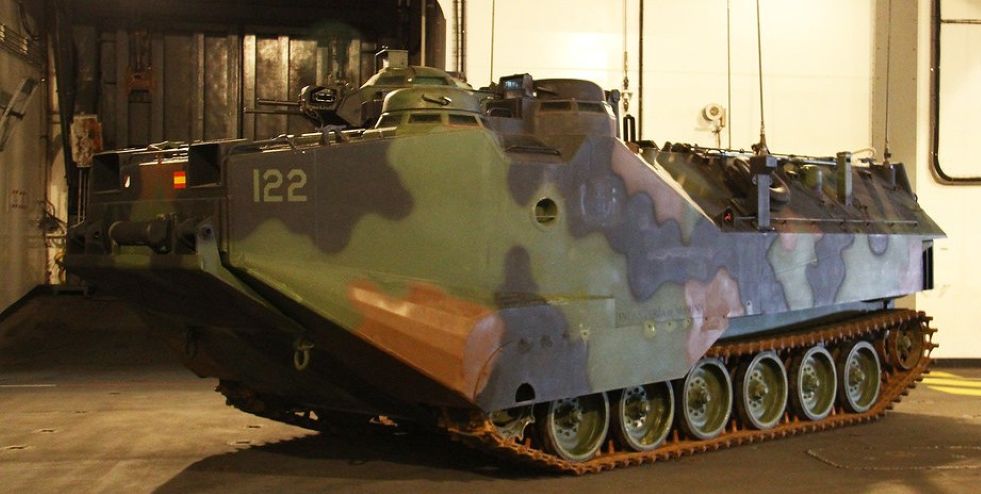
For decades, the AAV-7 defined amphibious operations across NATO. Designed as a tracked “amphibious taxi,” it enabled forces to move from ship to shore, survive the surf zone and deploy infantry onto the beach. However, its role largely ended at the waterline. It was never optimised for sustained combat inland, a limitation that has become increasingly evident in modern threat environments shaped by precision fires, drones and anti-access systems.
Spain’s adoption of the SUPERAV reflects a different operational logic. Unlike the AAV-7, the 8×8 platform is designed to continue the fight beyond the beach, allowing marine units to move rapidly inland, connect to road networks and expand the battlespace before an adversary can reorganise. The emphasis shifts from simply achieving access to exploiting momentum.
An alternative path would have been to replace the AAV-7 with a modern tracked assault vehicle, such as Türkiye’s ZAHA (Marine Assault Vehicle – MAV), which prioritises performance in the most difficult landing conditions. Tracked platforms offer superior mobility on soft terrain, stronger obstacle-crossing capability and greater resilience during contested landings. They are designed for scenarios in which forces must secure a lodgement under fire and push forward despite adverse terrain.
Spain has opted against that approach. By selecting a wheeled amphibious platform, Madrid is accepting a reduced margin in worst-case shoreline conditions in exchange for higher speed, lower logistical burden and greater operational flexibility once ashore. This is a doctrinal choice rather than a technical compromise.
Spain’s decision also carries broader strategic implications. Madrid did not structure the programme as an open competition involving a US bid. It did not invite participation through the US ACV procurement channel, instead building the programme from the outset around a European industrial partnership. Anchored by Indra as national integrator and Iveco Defence Vehicles as platform provider, this approach reflects not a rejection of a US offer, but a deliberate decision to keep the capability within a European defence-industrial framework.
This distinction is significant within NATO. While interoperability remains central, Spain’s choice underscores a growing emphasis on European defence-industrial integration and reduced reliance on US-led supply chains, without breaking alliance interoperability. It aligns with Madrid’s broader political stance favouring deeper European defence cooperation and greater strategic autonomy.
The timing further reinforces this interpretation. Spain’s relations with the United States have faced friction in recent years, particularly over Madrid’s positions on the Gaza conflict, restrictions on military shipments linked to Israel and its opposition to escalation dynamics involving Iran. These differences have highlighted a widening gap in strategic outlook between Washington and some European capitals.
At the same time, the United States has continued to press NATO allies for increased defence spending and burden-sharing, often in a more transactional tone. This has encouraged European countries, including Spain, to strengthen internal cooperation and prioritise European-based industrial solutions.
Within this context, the SUPERAV decision reflects more than fleet modernisation. It signals a dual shift: from shoreline assault to inland manoeuvre in operational terms, and from US-centric procurement toward a European industrial axis in strategic terms.
In practical terms, Spain is prioritising tempo. The ability to land, move rapidly, disperse and establish control inland is becoming more decisive than maximising performance in the most difficult beach conditions. This suggests confidence in shaping the battlespace before landing through intelligence, naval and air capabilities.
Amphibious warfare is no longer defined by access to the shoreline, but by the ability to dominate what lies beyond it.