Pasifik Teknoloji subsidiary TITRA Technology hosted a press tour at its production facilities in Ankara, where it presented its ongoing work on unmanned helicopter conversion programmes. TurDef was also among the participants. Journalists were given on-site access to the company’s engineering, manufacturing and integration infrastructure.
One of the topics that drew the most attention during the briefing was TITRA’s work on converting legacy helicopter platforms, particularly the UH-1 and AB206, into unmanned systems. The programme aims to enable logistics missions without crew exposure, especially in areas without civilian settlement, where unmanned rotary-wing operations can be conducted with fewer constraints.
In this concept, unmanned helicopters are positioned to address logistics requirements that exceed the payload and speed limits of smaller unmanned aerial vehicles. By carrying heavier loads in a single sortie, these platforms are intended to reduce the number of flights required to complete time-sensitive supply missions, offering a faster and more efficient alternative to multiple small UAV deployments.
Payload planning for the UH-1 conversion is based on operational realities rather than theoretical maximum capacity. While the UH-1 platform is originally designed to carry more than 1,700 kilograms, unmanned logistics missions are planned around payloads of approximately one tonne, taking into account airframe age, environmental conditions and carrying the full payload has drawbacks in terms of range, especially at higher altitudes.This approach is intended to balance capability with reliability and safety.
The global fleet size of UH-1 and AB206 helicopters was highlighted as a key factor underpinning the programme. Large numbers of these platforms remain available to serve worldwide, creating a substantial potential market for unmanned conversion solutions. TITRA views this installed base as a foundation for both operational relevance and export opportunities.
Conversion activities are being conducted in cooperation with Military Factories General Directorate (AFGM) and the 5th Main Maintenance Centre, which is responsible for UH-1 maintenance and spare-part production. An AB206 helicopter is currently located at TITRA’s facilities in Ankara, where integration work and preparatory activities are under way. The UH-1 conversion programme follows a phased development process covering prototype manufacturing, ground testing and flight trials, with subsequent stages planned to continue in Ankara-Güvercinlik. An initial timeline of up to 36 months has been defined, while efforts are ongoing to progress the programme as efficiently as possible.
Alongside the unmanned helicopter effort, TITRA outlined its broader export strategy. The company is positioning Romania, the United States and Dubai as key hubs for its international activities. Romania is being used as a gateway to Central and Southern Europe, with export plans targeting countries such as Hungary and Italy. The United States is being approached with a focus on civilian applications alongside defence-related opportunities, while Dubai serves as a regional hub supporting wider international engagement.
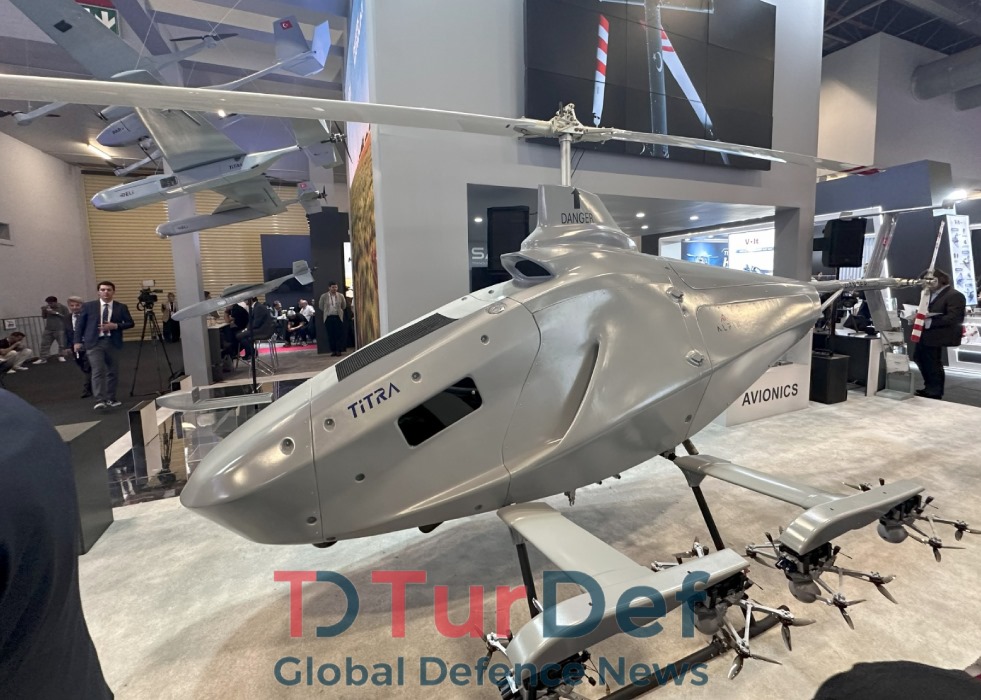
Updated information was also shared on the ALPİN-2 unmanned helicopter. Designed for logistics missions, ALPİN-2 offers a payload capacity of 200 kilograms, endurance of up to nine hours, a service ceiling of 21,000 feet and a control radius of 200 kilometres. Compared with the earlier ALPİN platform, ALPİN-2 incorporates engineering improvements in areas such as sensors, winch systems and propulsion. Following the delivery of two ALPİN platforms to the Turkish Armed Forces in 2023, four ALPİN-2 units are planned for delivery by the end of this year.
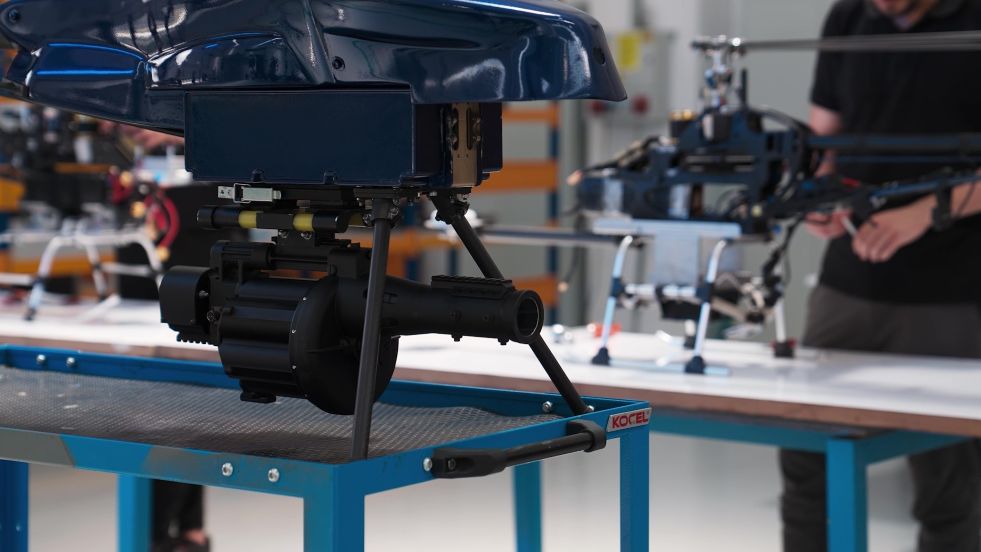
Information was also provided on other unmanned systems within TITRA’s portfolio. The Dumrul Mini Unmanned Helicopter has been integrated with Roketsan’s METE laser-guided munition. It can also perform mission with Repkon’s 40 mm revolver grenade launcher.
The DELİ loitering munition family continues to be developed within a fixed-wing swarm concept, while the Merküt FPV drone has entered the Turkish Armed Forces’ inventory in both thermal and tethered configurations.
Beyond platform development, TITRA highlighted several supporting capabilities. The company employs around 250 personnel, the majority of whom are engineers and technical staff. Work is under way on the KORGAN drone box, enabling automated take-off, mission execution and charging without operator involvement. The SEYYAH visual navigation system is being developed as a complementary solution to GNSS-supported navigation, using AI-based image analysis.
On the production side, trial deliveries of DELİ loitering munitions are being conducted at a rate of up to 100 units per month, alongside discussions on transitioning to serial production. For the Merküt FPV drone, infrastructure preparations for high-volume manufacturing have already been completed.

Addressing the company’s corporate structure, TITRA Technology General Manager Ekrem Ünlü noted that Pasifik Holding acquired a majority stake in the company in 2024 and now considers TITRA Technology one of its core activity areas. In addition to existing facilities at the Ankara HAB, an additional 35,000 square metres of space has been allocated, which is expected to play an important role in future production and operational activities.
Author: Özgür Ekşi