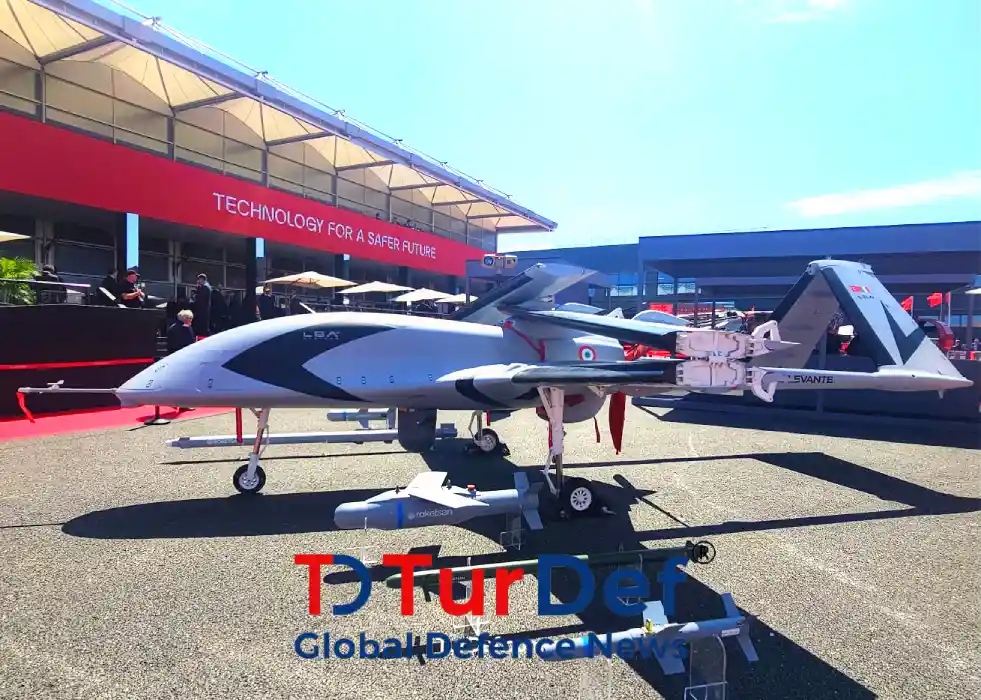
The Chief of Staff of the Italian Navy, Vice Admiral Giuseppe Berutti Bergotto, has indicated that the Baykar TB3 unmanned combat aerial vehicle could potentially operate from the aircraft carrier ITS Cavour, as part of the service’s evolving maritime aviation concept.
The remarks were delivered during Bergotto’s first parliamentary hearing since assuming command on 6 November 2025. Speaking before the Italian Senate’s Foreign Affairs and Defence Committee on 25 March, the admiral outlined the Marina Militare’s medium- and long-term development priorities.
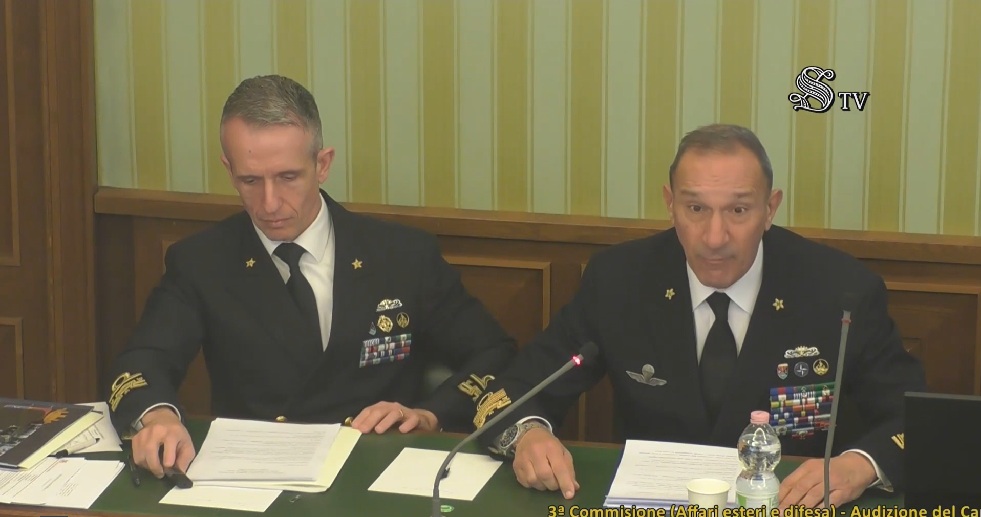
(Credit: Italian Senate TV)
Naval News first reported the parliamentary discussion, citing the hearing broadcast by Italian Senate TV.
The possibility that Italian carriers could eventually operate TB3-class unmanned aircraft had been highlighted earlier by TurDef. In June 2025, TurDef reported that Italy’s aircraft carrier ITS Cavour and the amphibious assault ship ITS Trieste could potentially operate Baykar TB3-type unmanned combat aerial vehicles, citing the platform’s short-take-off capability and compatibility with ski-jump flight decks.
Addressing senators, Bergotto said the Italian Navy is pursuing programmes “in the medium and long term to guarantee security, effectiveness and operational relevance.” He emphasised that uncrewed systems are becoming central to this vision, describing them as “real force multipliers” for future naval operations.
According to the navy chief, Italy is examining not only the acquisition of unmanned platforms but also service-based approaches for certain routine missions. At the same time, the navy is adopting new organisational models designed to bring operators and developers closer together as unmanned technologies become more integrated into naval force structures.
“In this scenario, the concept of maritime power evolves,” Bergotto told lawmakers. “It is no longer sufficient to be efficient; it is necessary to be relevant. Being relevant means being present, being ready, but above all being connected.”
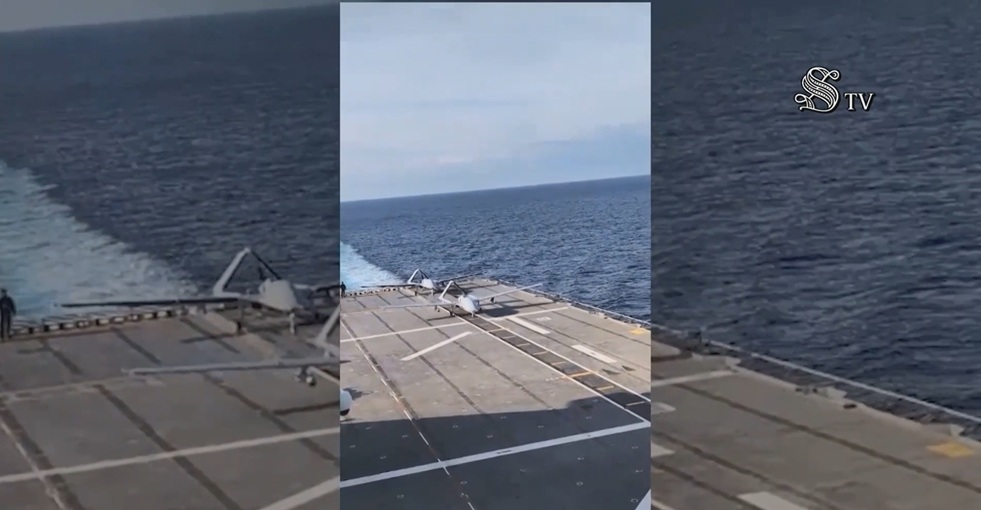
(Credit: Italian Senate TV)
During the hearing, Bergotto also referred to the Baykar TB3 UCAV system when discussing potential aviation developments linked to Italy’s aircraft carriers.
Introducing the system in the context of unmanned aviation options for naval platforms, he told senators: “It’s a slightly more complex system and Baykar, a Turkish company — you know that this company has signed a collaboration agreement with Leonardo (BIT: LDO) — therefore the acquisition is through Leonardo and it can be integrated on board ITS Cavour.”
He added that such a system would enable both surveillance missions and the possibility of carrying armament.
The remarks did not amount to a procurement announcement. Instead, the admiral’s comments suggested that TB3-class systems are being examined as a potential option for future carrier air wing concepts.
Bergotto’s reference to Leonardo reflects the industrial framework emerging from cooperation between the Italian defence group and Turkish UAV manufacturer Baykar. The two companies have established a joint venture named LBA Systems to explore collaboration in unmanned technologies and their potential integration within European defence ecosystems.
The discussion also highlights the evolving industrial landscape in Europe’s defence sector. At a time when certain EU defence initiatives — including the SAFE framework — have effectively excluded Turkish companies, alternative cooperation channels have begun to emerge through bilateral industrial partnerships.
In parallel, several Turkish defence firms have begun exploring collaboration opportunities with European partners in countries such as Romania, Hungary and Italy, seeking new industrial pathways within the continent’s defence ecosystem.
If a TB3 acquisition were to materialise, it would represent a notable defence export from Türkiye to the Italian Navy and one of the first exports of a carrier-capable unmanned combat aircraft from Türkiye to a NATO navy.
The concept itself also reflects an operational path first shaped by Türkiye’s own naval aviation requirements. After CAATSA-related restrictions prevented the deployment of F-35B aircraft aboard the amphibious assault ship TCG Anadolu, Türkiye accelerated development of carrier-capable unmanned aviation.
Unlike the F-35B, the TB3 is not intended to perform a manned fighter’s strike role. Instead, it is designed to support carrier groups primarily through intelligence, surveillance and reconnaissance missions, helping extend situational awareness around the ship. Such platforms could also support maritime patrol and potentially contribute to anti-submarine warfare operations, addressing one of the most persistent threats faced by surface combatants.
Initially seen by some observers as a niche workaround, the TB3 concept has gradually gained broader attention as navies explore cost-effective options for operating fixed-wing aviation from short-deck carriers.
Despite the availability of other UAV concepts in the Western market — including the carrier-capable MQ-1C Mojave — the Italian Navy’s consideration of TB3 highlights the platform’s emerging niche as a ski-jump compatible unmanned combat aircraft.
If realised, integration of the TB3 aboard vessels such as ITS Cavour would mark a significant step in the evolution of European naval aviation, potentially combining fifth-generation carrier fighters such as the F-35B with networked unmanned strike and surveillance platforms operating from the same deck.
Author: Özgür Ekşi