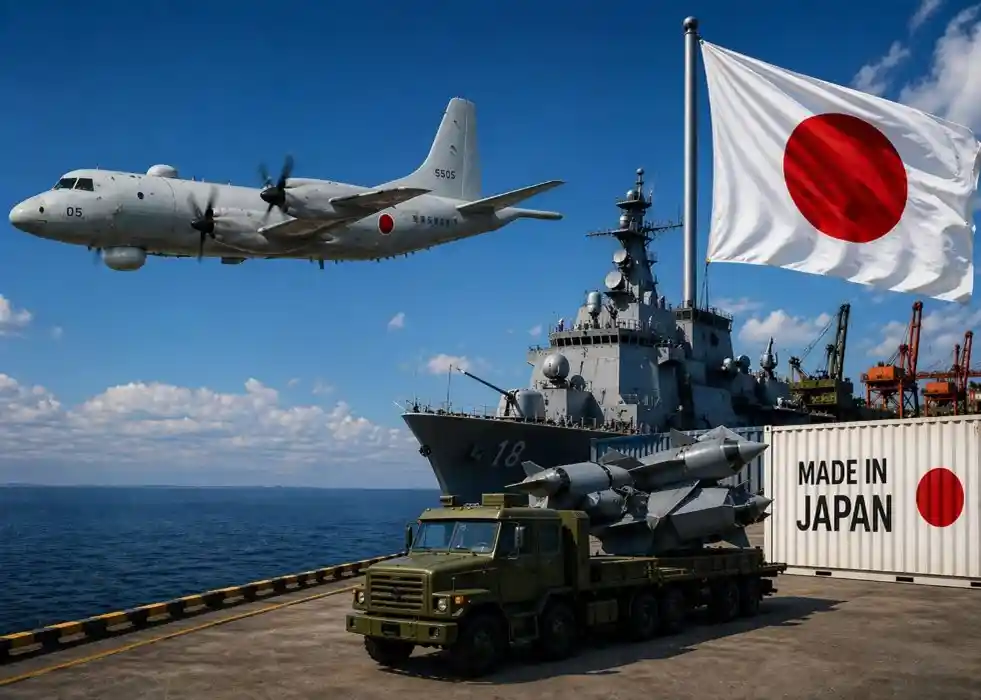
Japan is breaking long-standing barriers on defence exports, marking a significant shift from its post-war restrictions. Yet the move is less about becoming a major arms exporter and more about expanding production capacity within an increasingly strained allied system.
At the heart of this shift is a growing push from the United States to expand defence manufacturing across allied industrial bases. Washington’s capacity is being stretched by simultaneous demands from Ukraine, the Middle East and the Indo-Pacific, exposing limits in both munitions output and platform delivery. This is driving a broader effort to scale production beyond national boundaries.
Bringing Japan into this production cycle offers a way to increase output, stabilise supply chains and ease cost pressures across the system. Rather than introducing a new volume-driven exporter, the move effectively positions Japan as a high-end production node within a wider allied network.
The shift also addresses long-standing structural constraints within Japan. A defence sector largely confined to domestic demand has operated at limited scale, driving up unit costs and constraining competitiveness. Expanding production through controlled export channels offers a pathway to sustain output, reduce costs and preserve advanced manufacturing capabilities.
Japan is unlikely to compete on volume. Its role is expected to centre on high-technology segments — including naval platforms, sensors and specialised systems — where reliability, precision and alliance compatibility outweigh price.
The policy framework remains tightly controlled. Exports will be limited to approved partner nations and subject to case-by-case review, reflecting ongoing political sensitivities and constitutional constraints.
The strategic direction, however, is clear. Japan is being positioned as part of a broader industrial network designed to absorb demand pressure and reinforce supply resilience across allied nations. In this context, the move also feeds into long-term competition with China, where industrial capacity and production speed are becoming as critical as frontline capabilities.
For regional actors, the implications will vary. Southeast Asian countries may view Japan as a politically acceptable alternative supplier, while established exporters such as Republic of Korea could face increased competition in selected segments.
For Türkiye and other emerging defence producers, the shift introduces a different type of competitor — one aligned with the US-led system and focused on high-end engineering rather than cost-driven competition. The significance of Japan’s move lies not in how many systems it exports, but in how effectively it expands collective production capacity at a time of sustained global demand.
Author: Özgür Ekşi