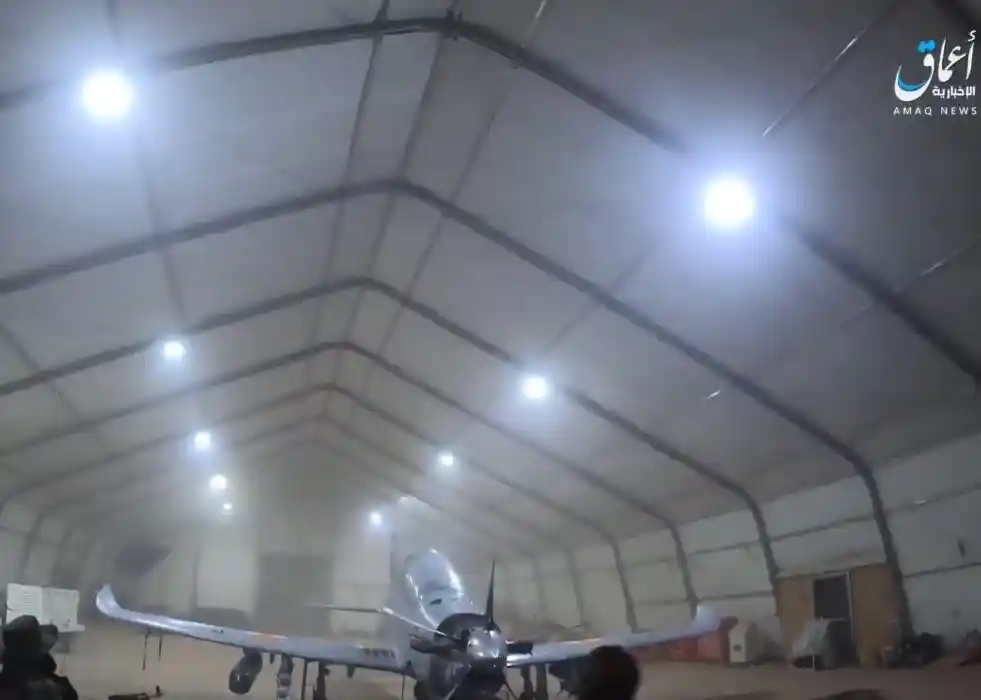
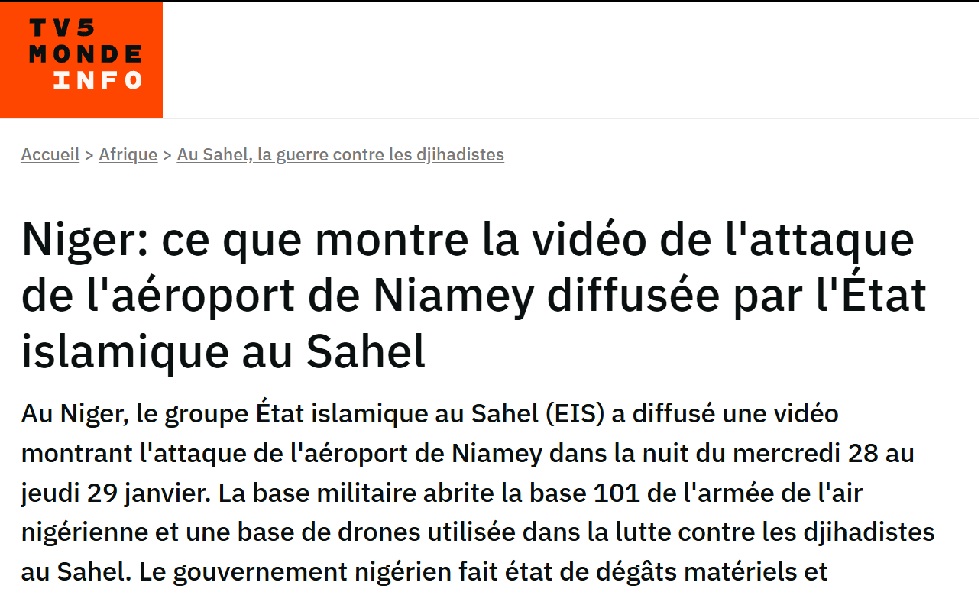
An attack carried out by Islamic State in the Sahel on 28 January, targeting Niamey airport, has renewed debate in Niger over whether aviation infrastructure linked to foreign partners has become a symbolic objective in both militant propaganda and international media narratives. Footage reviewed by TV5 Monde points to an assault on facilities associated with Niger’s military aviation, yet provides no clear imagery allowing the precise identification of the aircraft or platforms directly targeted.
Video material circulating on social media further complicates prevailing interpretations. While IS Sahel messaging appears to contain symbolic references to the Hürkuş platform supplied by Türkiye and employed in air-to-ground attack roles, the footage itself shows the destruction of a Mi-17 family armed utility helicopter, consistent with Russian or Soviet-era inventories long operated by Niger and described by sources familiar with the incident as unarmed at the time of the attack. The Hürkuş’ status as Türkiye’s first exported fixed-wing military aircraft lends additional symbolic weight to such references. The mismatch between physical damage and symbolic emphasis suggests that the attack was less about achieving an immediate operational effect and more about generating a message tied to the symbolic visibility of Türkiye’s defence exports.
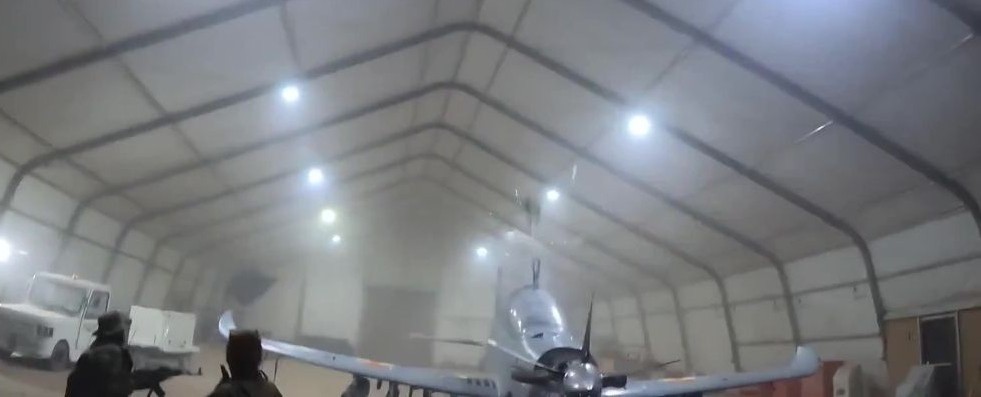
The location of the strike adds another layer to this reading. The section of the airport targeted during the attack is operated by a Turkish company. According to information obtained by TurDef from sources familiar with the incident, small-arms fire was also directed at three passenger aircraft parked on the apron at the time of the attack, as well as at the terminal building. The aircraft were unoccupied, and there is no indication that the fire reflected an intent to destroy civilian air platforms in a manner comparable to the attack on military-linked assets. On one level, this selective targeting allows the incident to be interpreted as an attack on systems perceived as constraining militant activity. At the same time, the limited scope of the damage points to the presence of additional, layered messages beyond immediate tactical objectives.
In recent years, Niger has deliberately diversified its security partnerships, including the procurement of Turkish-made systems, with the explicit aim of reducing its long-standing military dependence on France. There is no conclusive evidence that Turkish platforms constituted the primary operational targets of the attack. Nevertheless, aviation infrastructure has increasingly become a symbolic arena in which influence, legitimacy and alignment among external actors are contested as Niger distances itself from Paris.
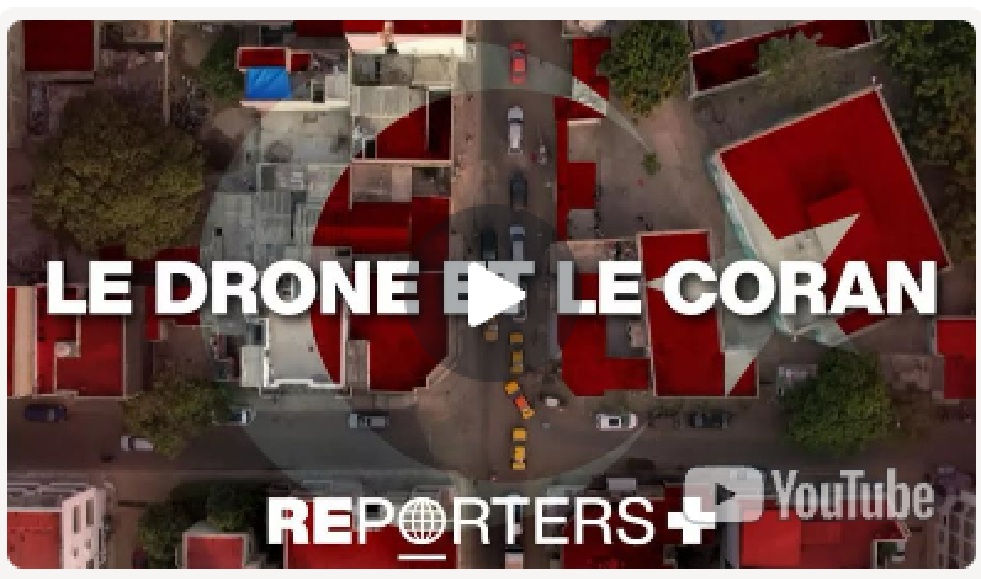 This symbolic dimension was further reinforced by a documentary released on YouTube roughly two weeks before the attack by France 24, titled Le drone et le Coran (The Drone and the Quran). The programme examines Türkiye’s expanding presence in Africa through defence cooperation, construction projects, educational initiatives and humanitarian organisations. Despite its recognised production quality and narrative coherence, TurDef argues that the documentary relies on editorial framing choices that shape perception rather than offering a strictly analytical assessment of security dynamics.
TurDef’s objection focuses on method rather than intent. The documentary advances allegations of civilian harm attributed to Turkish drones while presenting limited independent and verifiable empirical data to substantiate those claims, creating a risk of narrative steering through editorial sequencing. Moreover, the implication that responsibility lies with “Turkish drones” is considered methodologically flawed. In international practice, accountability for civilian casualties rests with the military and political authorities operating a system, not with the manufacturer. As an example, in 2008, when the United States conducted an air strike on a wedding convoy in Kandahar province that killed civilians, public debate focused on the decision-making and execution chain rather than on the specific aircraft model involved. Even in the absence of a direct operational link, the sequencing of images in the documentary may nonetheless lead viewers to associate Turkish-made drones with kinetic outcomes.
Concerns have also been raised over contextual framing. Footage recorded during the IDEF defence exhibition shows Nigerien military officials openly expressing satisfaction with cooperation with Türkiye and their distancing from France. These views are either omitted or presented without a clear cause-and-effect context. In addition, the inclusion of behind-the-scenes moments that would normally remain off the record shifts interviewees from active advocates of their positions into passive figures shaped by editorial framing. In television journalism, meaning is often produced less by what is said than by how images are selected, ordered and contextualised in the editing room.
Within this context, TurDef assesses that the documentary risks producing a broader civilisational narrative rather than a security-focused analysis — a tendency reinforced by its very title, which juxtaposes religious symbolism with military technology. Presenting military cooperation primarily through cultural and religious lenses, rather than technical and operational realities, may reposition Türkiye not as a state actor but as a culturally and ideologically defined “other”. Such framing carries the potential to generate new lines of opposition both within French public debate and across African societies where foreign military involvement is already viewed through historical and identity-based sensitivities.
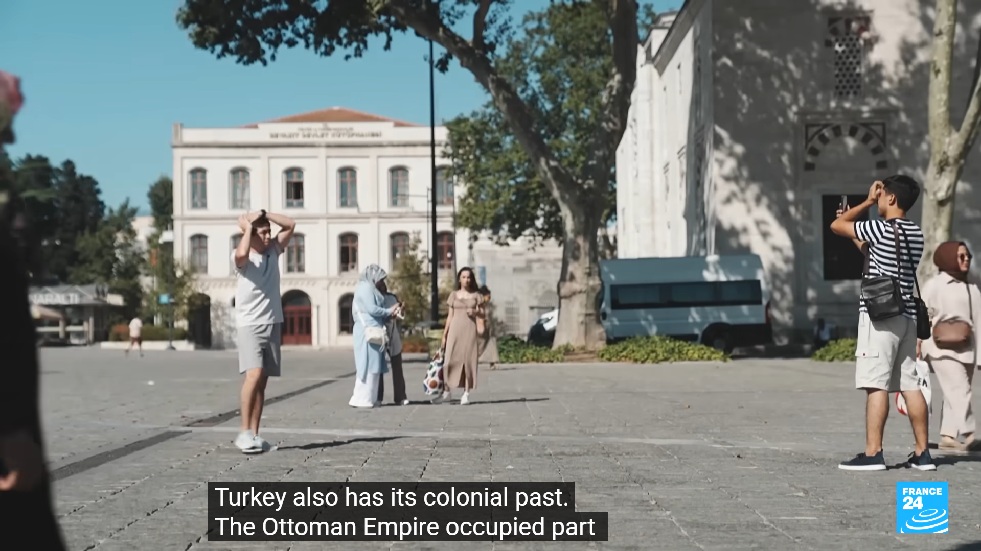
The documentary further frames Türkiye through its Ottoman-era legacy using a simplified colonial lens. TurDef argues that equating Ottoman governance with classical colonialism weakens analytical depth. While classical colonial systems were primarily based on the extraction of regional resources and the exclusion of local populations from decision-making, the devshirme system historically enabled individuals from the regions to rise to the highest administrative and political offices, including the position of Grand Vizier. Ignoring this structural distinction risks reducing complex historical governance models to modern political shorthand.
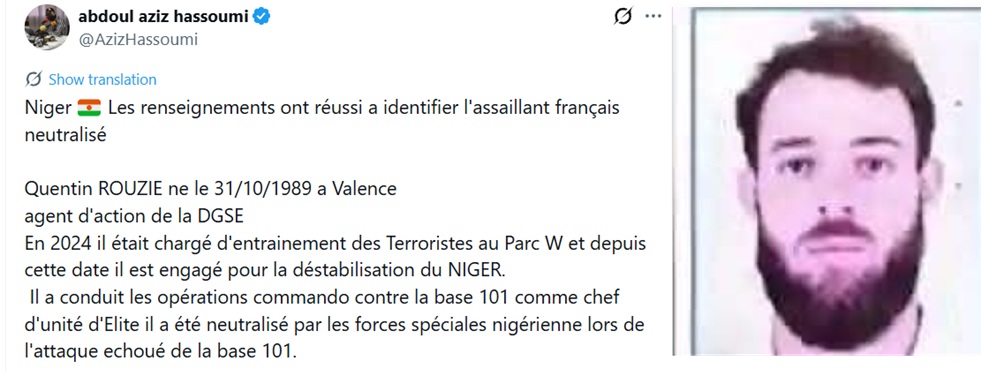
Alongside these narratives, social media claims continue to circulate. A post shared by journalist Abdoul Aziz Hassoumi includes a photograph and alleges that Nigerien intelligence identified a French national, Quentin Rouzie (born 31 October 1989 in Valence), as an “action agent” linked to France’s foreign intelligence structures. The post further claims that Rouzie was involved in training terrorist elements in the Parc W area in 2024, participated in destabilisation efforts against Niger, and led a commando operation against Base 101 before being neutralised by Nigerien special forces during the failed attack. These allegations remain unverified and have not been independently corroborated by Nigerien authorities or credible third-party reporting. TurDef’s review of official French statements and public declarations has not identified any direct response addressing these claims.
Taken together, these elements suggest that the 28 January attack on Niamey airport should be understood not only as a terrorist incident on the ground, but also as part of a broader struggle over how actors are defined and perceived. As Niger moves away from France and towards new partners, both security developments and the narratives constructed around them have become integral components of the evolving power contest in the Sahel.
From a Turkish perspective, such attacks are likely to reinforce rather than weaken defence cooperation between Türkiye and Niger. According to two separate sources familiar with ongoing discussions, work on new or additional defence procurements was already under way before the attack and is now expected to accelerate.
Author: Özgür Ekşi