TUSAŞ has signalled the continuation of HÜRJET’s carrier-borne combat aircraft derivative at SAHA EXPO 2026, including it in its interactive info panel.
TUSAŞ has officially presented the preliminaries for the carrier-borne HÜRJET derivative to be fielded onboard the MUGEM aircraft carrier that will also host a wide array of unmanned platforms.
According to the information on TUSAŞ’s interactive panel at the SAHA EXPO 2026 booth, the carrier-borne HÜRJET will have STOBAR and CATOBAR operation compatibility. STOBAR is MUGEM’s design operating principle, while CATOBAR operation is being kept on the shelf as a future upgrade in case the technology becomes available.
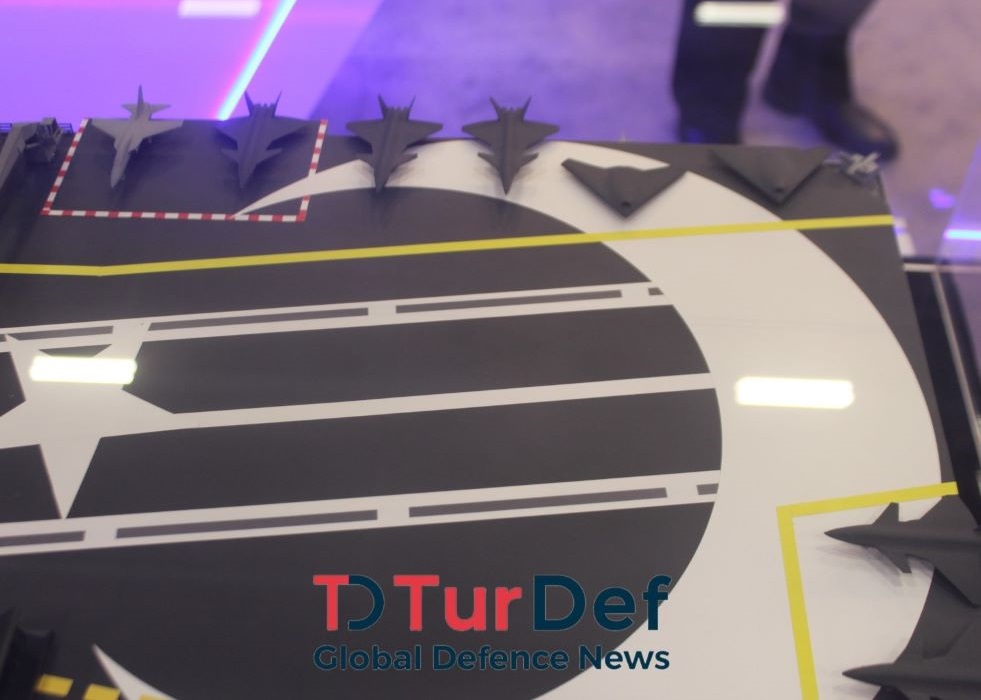
The information underlines compact footprint and multi-role capabilities, which are to be expected from TUSAŞ’s naval light combat aircraft. The Navy HÜRJET is anticipated to have structural reinforcements and outer design changes, including increased wing area to compensate for shorter runways and increased base weight from the reinforcements. The differences between the F-35A and the CATOBAR F-35C can be provided as a solid example of what changes are to be expected to allow HÜRJET to operate as a naval combat aircraft that regularly experiences violent landing loads and needs forgiving low-speed handling.
In terms of numbers, the carrier-borne HÜRJET is stated to have a capacity for 7500+ lb of payload (Around 3.4 tons), 5200 lb of internal fuel, and, interestingly, an operational radius of 1060 NM (Approximately 1960 km). The given operational radius figure, when HÜRJET’s counterparts in LCA configurations are reviewed, is understood to be with external fuel tanks. TUSAŞ previously tested the HÜRKUŞ trainer with external tanks, and it would not be hard to see external fuel tanks coming for HÜRJET as well.
Author: Kaan Azman
Editor: Özgür Ekşi