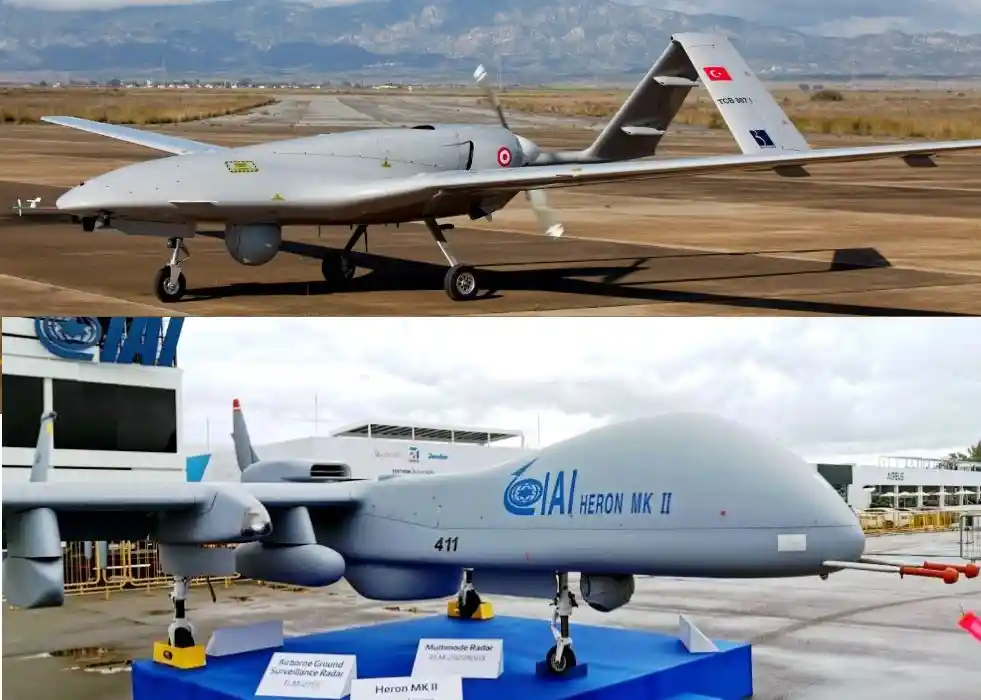
Japan’s ongoing effort to procure a new medium-altitude long-endurance (MALE) unmanned aerial vehicle is often framed as a competition between Türkiye’s Bayraktar TB2 and Israel’s Heron Mk II. In reality, Japan is not choosing a UAV. It is choosing how to build and operate its future intelligence, surveillance and reconnaissance (ISR) network.
This requirement is shaped by a rapidly evolving security environment stretching from the East China Sea to the Nansei island chain and toward the Taiwan Strait, where China maintains persistent maritime and aerial pressure. The operational challenge is not episodic detection, but continuous understanding—tracking activity over time, identifying patterns and feeding this insight into joint command structures in near real time. In such an environment, the value of a platform is defined less by its individual performance than by how effectively it contributes to a wider ISR architecture.
Japan’s requirement therefore goes beyond acquiring an aircraft. It is building a layered ISR system designed for persistence, wide-area coverage and real-time integration. Endurance matters. So does sensor diversity. Data connectivity ties it together. These are not standalone features but elements of a networked design. The UAV is not a standalone asset. It becomes a node.
Within this framework, Japan’s evaluation has effectively narrowed to two candidates: Baykar Bayraktar TB2, including its SATCOM-enabled TB2S variant, and the IAI Heron Mk II. On paper, they are compared as platforms. In practice, they reflect two different approaches to ISR architecture.
The TB2 has built its reputation on affordability, rapid deployment and proven performance across multiple theatres from Libya and Syria to Ukraine and Karabakh. While often classified as a MALE platform, it is in practice a highly capable tactical UAV, enabling operators to field larger numbers of platforms and sustain coverage through redundancy rather than relying on a limited number of high-value assets. It is not built to carry everything. Nor is it designed to do everything alone. Its constraints in payload capacity, sensor depth and electronic intelligence are real. But they are also deliberate—trade-offs that favour distributed operations over single-platform dominance.
The Heron Mk II reflects a centralised ISR approach within the MALE class. Designed as a high-end ISR system, it offers greater payload capacity, long endurance and advanced sensor integration, including electronic intelligence suites. It sees deeper. It stays longer. It collects more. Yet this concentration of capability introduces structural exposure. High acquisition and lifecycle costs, longer delivery timelines and reliance on limited assets create vulnerability if availability drops or individual systems are degraded.
At the core of Japan’s decision is therefore a choice between two ISR architectures. A centralised model concentrates capability in a few platforms and prioritises sensor depth. A distributed model spreads capability across multiple assets, emphasising persistence, redundancy and resilience. The question is not which platform performs better in isolation, but which architecture delivers more reliable ISR output under sustained operational pressure.
Seen from this perspective, Türkiye’s position depends on reframing the competition. The proposition is not cheaper UAVs. It is about ISR output—delivering equal or greater coverage through a scalable, resilient and sustainable architecture. Not more aircraft. Better coverage. This shifts the discussion from platform capability to system performance.
To make this credible, technical adaptation remains necessary. Integration of maritime-focused ISR payloads, including SAR/GMTI radar, alongside modular SIGINT and ELINT capabilities, would be required to meet Japan’s operational expectations. These are not optional upgrades. They are enablers. Still, their value emerges fully only when embedded within a broader distributed concept of operations.
Equally important is alignment with Japan’s procurement and operational preferences. A tailored configuration—focused on maritime ISR, fully compatible with Japan’s command-and-control environment and open to local industrial participation—could become a decisive factor in the competition. This is not a technical detail. It is a strategic lever. Japan has consistently prioritised controlled integration and domestic involvement. That pattern matters.
The structural vulnerability of centralised systems remains a defining factor. High-end platforms represent high-value, low-density assets. Their loss or reduced availability can create disproportionate gaps in ISR coverage. A distributed TB2 fleet, by contrast, mitigates this risk through redundancy and scalability, maintaining operational continuity even under stress. This is where architecture becomes strategy.
Japan’s UAV procurement is therefore not a simple contest between Türkiye and Israel. It is a decision about how Japan intends to see the battlespace. Not occasionally. Continuously. Not in fragments. As a system. Japan is not choosing a UAV. It is choosing how it will see the battlespace.
Author: Özgür Ekşi