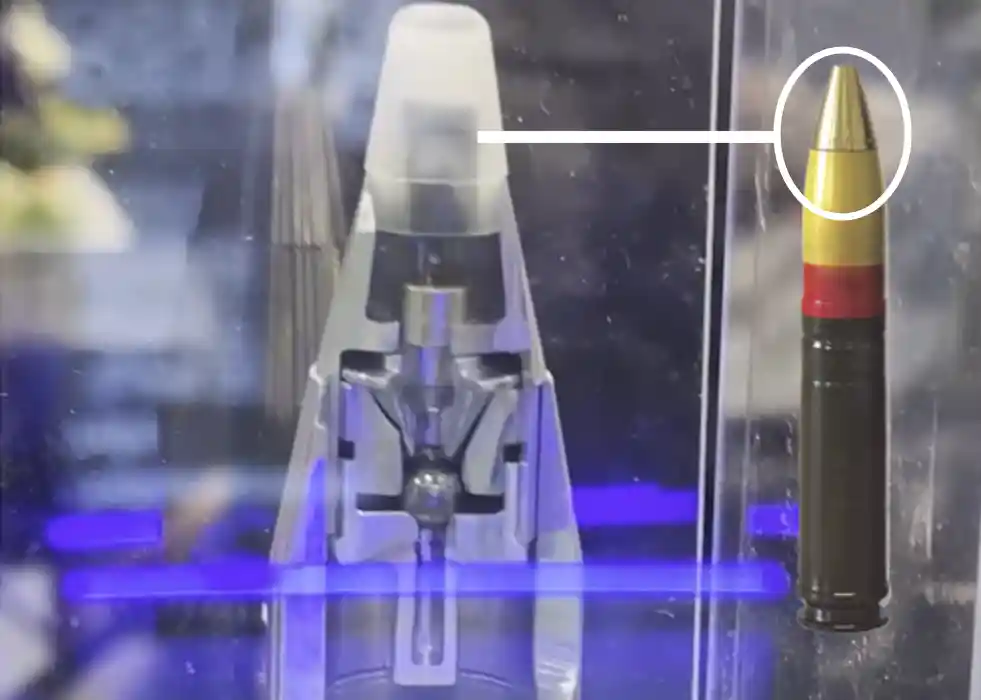
Turkish Aerospace’s stealth UCAV ANKA III launched the high-speed Super Şimşek UAV mid-flight, marking a milestone in the OKU (Autonomous Wingman) programme.
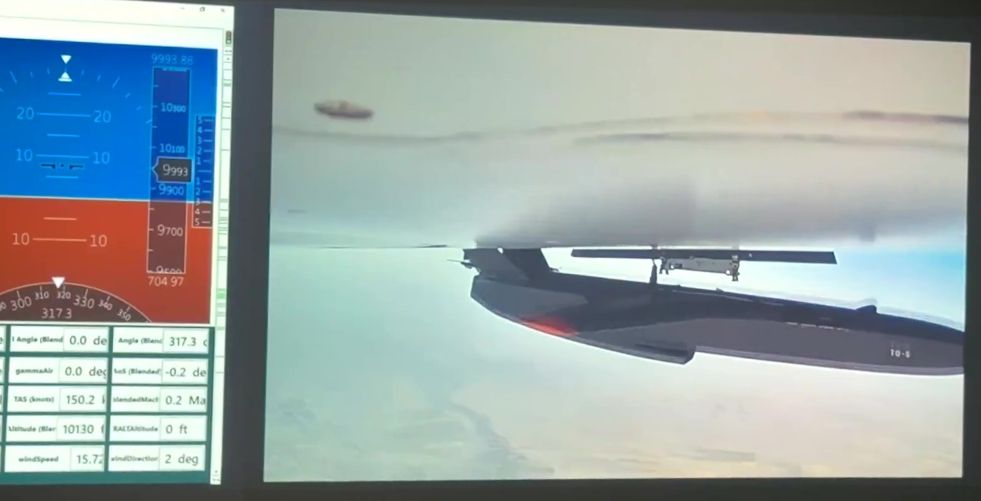
Turkish Aerospace (TUSAŞ) has carried out a critical step in its ambitious “Otonom Kol Uçucusu” (OKU), or Autonomous Wingman Concept, with the successful mid-air release of the Super Şimşek UAV from the ANKA III unmanned combat air vehicle (UCAV). This mission, conducted at 10,130 feet with a True Airspeed of 150 knots, demonstrates a key capability in manned-unmanned teaming (MUM-T) operations and marks a leap forward in the evolution of Turkiye’s next-generation air combat ecosystem.
From stealth carrier to multi-role force multiplier
Unveiled in 2023 and having completed its maiden flight in December of the same year, ANKA III represents Turkiye’s first low-observable UCAV with a tailless flying-wing configuration. Capable of speeds up to Mach 0.7 and operational ceilings reaching 40,000 feet, ANKA III can endure up to 10 hours in the air while carrying a maximum payload of 1,200 kg.
With its stealth profile and versatile weapon stations, ANKA III is designed to perform both air-to-ground and air-to-air missions. The integration of deployable unmanned assets such as Super Şimşek elevates its role from a single combat platform to a multi-layered mission commander capable of executing coordinated electronic warfare, reconnaissance, and deception operations.
Different sensors are being developed for ANKA-III including TOYGUN-100 EOTS and a derivative of the MURAD AESA radar. As an interim solution, the prototype was temporarily fitted with the ASELFLIR-500 EO/IR system for a firing test of the TEBER-82 laser/GNSS-guided bomb.

Super Şimşek: A decoy, a scout, and a kamikaze all in one
Super Şimşek is a high-speed unmanned aerial vehicle developed by Turkish Aerospace to serve multiple combat functions. Developed as a significantly larger UAV compared to the Şimşek UAV, Süper Şimşek incorporates higher performance and longer range of control. Ranging up to 700 kilometres and with a maximum speed of Mach 0.9, it may perform stand-alone or assist operations. Weighing 200 kg, the UAV is appropriate for kinetic attacks, electronic warfare functions, and ISR operations.
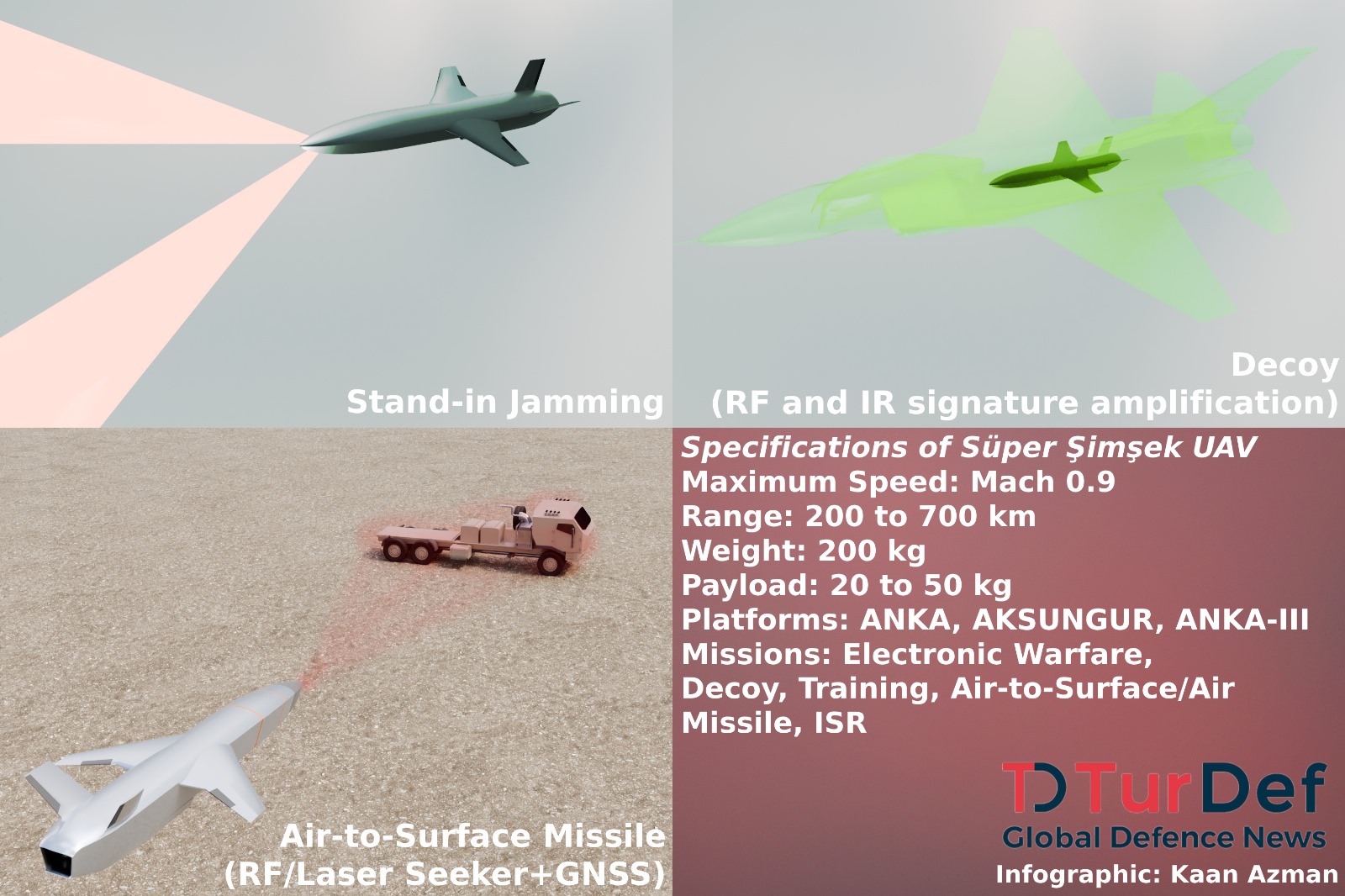
Payload options include signature enhancers in RF or IR band for use as a decoy, chaff or flares, high explosive warhead (20 to 50 kg), jammer, EO/IR system, and IFM receiver against radars.
For use as a munition against either surface targets or aircraft, Süper Şimşek can be fitted with an RF/Laser seeker (Air-to-Surface) or IIR seeker (Air-to-Air).
Originally designed as a target drone, the latest version of Şimşek—Super Şimşek—is bigger and more powerful than its predecessor. Super Şimşek has become an autonomous aerial asset that can run either alone or in concert with manned and unmanned platforms, while the baseline Şimşek was mostly for training and testing air defence systems. Though it has striking and deceptive features, it still serves as a target drone.
Super Şimşek, according to TUSAŞ, is meant for several uses, including direct attack operations, electronic warfare, and reconnaissance. It can be employed in swarms to overwhelm and destroy opposing radar systems or as a decoy to mislead enemy air defences. Its tiny size, quick speed, and flexible payload design make it perfect for high-risk operations where conventional assets would be exposed.
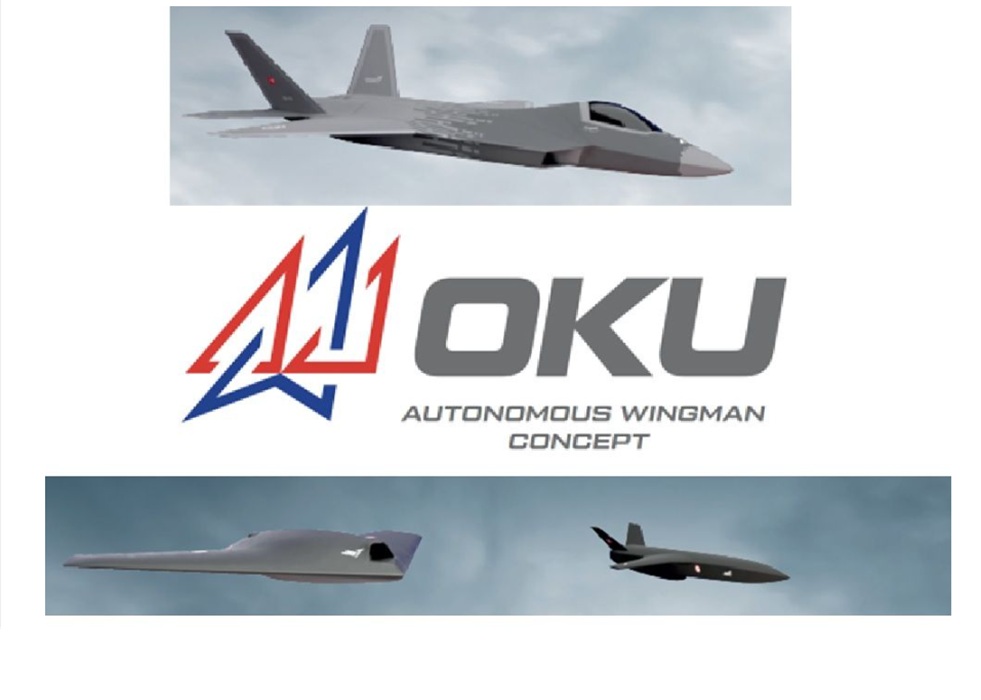
OKU: Turkiye’s strategic response to Loyal Wingman doctrine
Aimed at creating low-cost, semi-autonomous air platforms operating alongside manned fighter planes, the manned-unmanned teaming (MUM-T) idea has developed globally into the “Loyal Wingman” doctrine. Emerging in tandem with the KAAN fifth-generation fighter and ANKA III UCAV, Turkiye’s native response to this ideology is the **Otonom Kol Uçucusu (OKU)** programme.
OKU is more than just a technological initiative—it is a strategic vision. The concept aims to create operational formations where unmanned systems, such as Super Şimşek or ANKA III variants, assist manned platforms by sharing mission loads, increasing survivability, and reducing pilot workload in network-centric warfare environments. It also envisions unified mission planning, real-time data fusion, and seamless communication among assets, effectively enabling dynamic and decentralised execution in contested airspace.
Through the OKU framework, Turkiye plans to standardise a family-wide operational doctrine across manned platforms like Hürjet, and KAAN, as well as unmanned systems including ANKA III and Super Şimşek.
Strategic implications
The successful release of Super Şimşek from ANKA III is not just a test of mechanical integration but a tangible validation of Turkiye’s future air warfare concept. Battlefield supremacy will be defined by the capacity to carry out multi-platform, multi-domain operations autonomously as combat settings become more saturated with both symmetrical and asymmetrical threats.
Led by Turkish Aerospace, Turkiye’s military sector is thereby setting itself among the few equipped to create a complete, AI-enabled, autonomous battle environment. This test indicates a shift towards more combat automation, operational agility, and deterrence through indigenous innovation.
You may read more news about ANKA III here
You may read more news about Süper Şimşek here
You may read more news about OKU here
Authors: Özgür Ekşi and Kaan Azman