Spain’s Air and Space Force has selected the name Saeta II for its future advanced jet trainer based on TUSAŞ’s HÜRJET, to be acquired under the ITS-C programme led by Airbus.
According to Spanish defence outlet Infodefensa, Spain’s Air and Space Force has decided to induct TUSAŞ’s HÜRJET advanced jet trainer into service under the designation Saeta II, reviving a historically significant name from Spanish aviation heritage. The aircraft will enter service following a Spain-specific adaptation process led by Airbus Defence and Space.
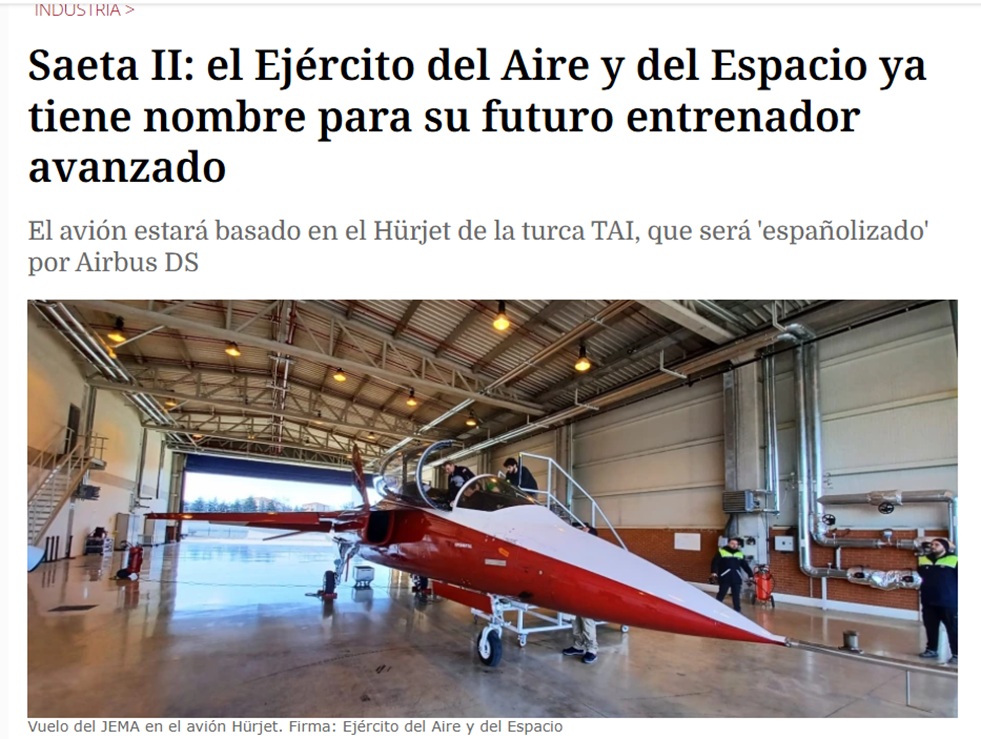
Developed by Turkish Aerospace Industries (TUSAŞ), HÜRJET will form the basis of Spain’s future advanced jet training capability. Once adapted to Spanish operational requirements, the aircraft will be designated Saeta II and integrated into the Air and Space Force’s training pipeline under the Integrated Training System for Combat Aircraft (ITS-C) programme.
In the history of Spanish aviation, the name Saeta II has a lot of symbolic value. The name comes from the Hispano Aviación HA-200 Saeta, which was the first jet-powered plane designed and built by Spanish industry in the 1950s. It was meant to be an advanced trainer and a light air-to-ground assault plane. Spain wants to connect its aviation history with a modern training platform by giving its next-generation trainer this moniker.
Saeta II will replace the F-5M advanced jet trainers that have served in the Spanish inventory for nearly half a century and are now approaching the end of their operational life. In response to this ageing fleet, the Spanish government has approved the ITS-C programme, which encompasses not only new aircraft but also advanced ground-based training systems, simulators and digital training infrastructure.
Spain’s Ministry of Defence has stated that the programme is intended to “update, expand and renew the capabilities required for training fighter and attack pilots,” ensuring that aircrews are adequately prepared for operations in increasingly complex and demanding security environments.
Under the ITS-C programme, Spain plans to procure up to 45 Saeta II aircraft through Airbus Defence and Space and Turkish Aerospace Industries, likely via a joint-venture structure. The total programme value is estimated at €3.12 billion, covering both the aircraft and a comprehensive advanced ground training system. The contract is expected to run until the end of 2035, with no option for extension.
Spanish authorities have indicated that all required administrative and procedural steps have been completed and that the programme is currently pending only formal award and contract signing. The first Saeta II aircraft are expected to enter service around 2028.
Airbus Defence and Space’s leading role in the programme places Saeta II within Spain’s broader combat aviation ecosystem, including the Eurofighter Typhoon Halcón II programme. Airbus is a central industrial actor in both initiatives, underlining a deliberate alignment between Spain’s advanced training architecture and its future frontline fighter force.
While Saeta II is not officially designated as a Halcón II training aircraft, the objectives of the ITS-C programme closely match the operational profile of the latest Eurofighter standards. In this context, Saeta II is intended to provide the advanced jet training environment required before pilots transition to Eurofighter Typhoon aircraft delivered under the Halcón II programme, replacing the increasingly limited F-5M in that role.
The Spanish variant of HÜRJET will undergo a dedicated “Spanishisation” process led by Airbus Defence and Space Spain, which will act as national coordinator and prime industrial driver. Airbus DS Spain is expected to establish a dedicated centre to adapt the aircraft to Spanish avionics, mission systems, training requirements and sustainment infrastructure.
A broad consortium of Spanish defence and aerospace companies will participate in the programme, including Aciturri, Aernnova, Aertec, Airtificial, Amper, Centum, CESA, CLUE, GMV, Grabysur, Indra, Grupo Oesía, Orbital and Sener, underscoring the programme’s significance for Spain’s national aerospace industry.
The Talavera la Real Air Base in Badajoz has been designated as the future main operating base for Saeta II. As part of the programme, the Spanish Air and Space Force will expand and modernise the base’s infrastructure to support the new training aircraft and its associated systems.
Author: Özgür Ekşi